

Harnessing Industrial Environmental Sensors for Maximum Data Accuracy
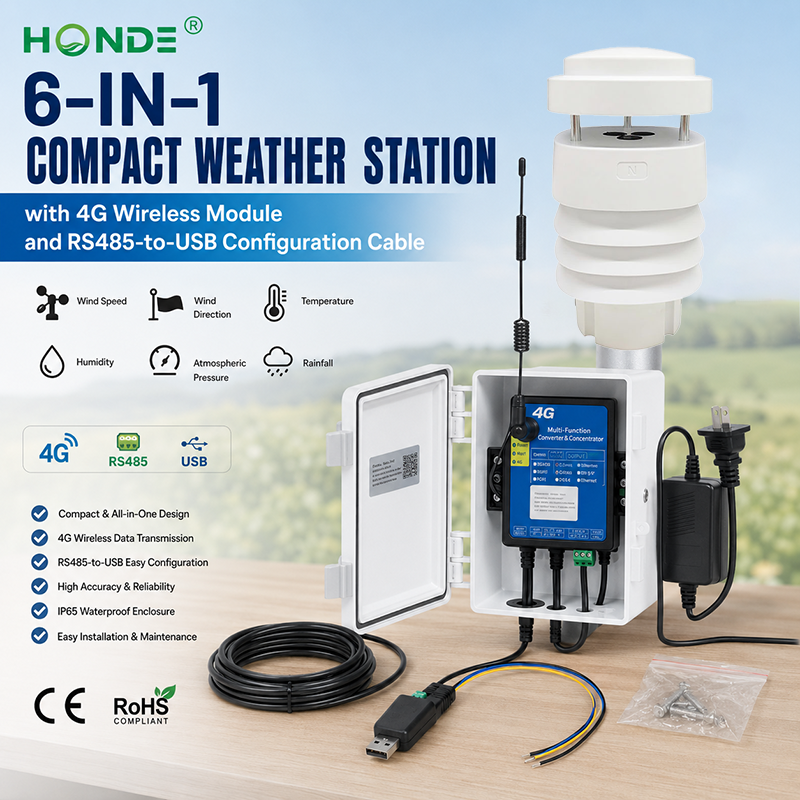
In the world of Industrial IoT, data accuracy is only as reliable as the sensor hardware. This compact station replaces the complexity of multi-sensor arrays with a unified design, reducing the potential points of failure and simplifying site maintenance.
The station captures six essential data points:
- Ambient Temperature: Essential for tracking thermal fluctuations in sensitive environments.
- Relative Humidity: Critical for agricultural and HVAC-integrated monitoring.
- Atmospheric Pressure: Provides high-precision barometric data for meteorological forecasting.
- Wind Speed: Real-time velocity monitoring for structural safety and logistics.
- Wind Direction: Accurate orientation tracking for pollutant dispersion or aviation.
- Rainfall: Integrated precipitation sensing to monitor irrigation or flood risks.
By consolidating these sensors into a “compact” form factor, engineers can achieve significantly lower installation costs and reduced wind resistance compared to traditional sprawling sensor masts.
Advanced Connectivity: The Power of 4G MQTT Protocol in IIoT
For B2B applications, connectivity is not just about signal; it is about efficiency. The Honde 4G wireless module connects to the station via a robust B-type waterproof connector, ensuring the electronics remain protected in extreme weather.
The true value for systems integrators lies in the MQTT protocol. Unlike standard HTTP requests, MQTT is designed for low-bandwidth, high-latency environments, significantly reducing data overhead and improving reliability in remote telemetry. The station transmits data in a standardized JSON format, allowing for immediate ingestion into SCADA systems, cloud dashboards, or custom enterprise software without the need for complex parsing scripts.
Technical Specifications & Configuration Table
This structured overview provides the necessary technical data for procurement and engineering evaluation.
| Feature | Specification / Requirement | Industrial Benefit |
|---|---|---|
| Model Type | 4G Wireless with MQTT v3.1.1 support | Reliable remote data transmission |
| Parameters | Temp, Humidity, Pressure, Wind Speed, Wind Direction, Rainfall | Comprehensive environmental awareness |
| Connectivity | 4G LTE SIM Card (Yellow button ejection) | No local Wi-Fi or Ethernet required |
| Data Format | JSON (JavaScript Object Notation) | Native compatibility with modern IIoT platforms |
| Config Interface | RS485 to USB connector | Rapid PC-side configuration for field engineers |
| Hardware Link | B-type waterproof connector | IP-rated durability in outdoor deployments |
How to Configure Your 4G Weather Station: A Practical Walkthrough
Configuring industrial hardware requires precision. From an engineer’s perspective, the setup of the Honde station is designed for speed, provided you follow the correct sequence for the 4G module.
- 1 Hardware Connection: Attach the 4G wireless module to the weather station via the B-type waterproof connector. Ensure the connection is hand-tight to maintain the environmental seal.
- 2 SIM Card Installation: On the bottom of the module, you will find a yellow button. Engineer’s Note: In our testing, we found that using a small tool or stylus to click this button ensures a clean ejection of the SIM slot. Insert your 4G SIM card and click the slot back into place.
- 3 The Two-Cable Configuration: The kit includes two cables. The primary cable—the RS485 to USB connector—is the “active” tool used to bridge the wireless module to your PC. While a second cable is provided for direct weather station-to-PC connection, it is typically unnecessary for standard MQTT deployments.
- 4 Network Setup: Launch the configuration software on your PC. The most critical step is ensuring the APN (Access Point Name) matches your carrier’s credentials exactly. Without a correct APN, the 4G handshake will fail.
- 5 Broker & Topic Configuration: Input your server’s IP address and the specific port number. You must also define the “publish topic” (e.g.,
/env/weather/data) so your MQTT broker knows where to route the incoming JSON packets. - 6 Verification: Once the settings are saved, monitor your server logs. In our experience, verifying the MQTT connection through a tool like MQTT.fx before final deployment saves hours of troubleshooting in the field.
Why Choose Honde Technology for Industrial Monitoring?
Honde Technology Co., Ltd. is a global leader in integrated weather solutions, recognized for delivering hardware that balances technical sophistication with ease of use. By providing a complete “out-of-the-box” kit—including the critical RS485 to USB configuration bridge—Honde significantly reduces the Total Cost of Ownership (TCO).
B2B buyers benefit from a streamlined procurement process where the sensors, wireless modules, and configuration tools are pre-validated for compatibility. This eliminates the integration risks associated with sourcing components from multiple vendors, allowing for rapid scalability in large-scale environmental projects.
Conclusion
The Honde 6-in-1 4G MQTT weather station is the definitive solution for high-stakes remote monitoring. By merging high-precision sensors with efficient JSON/MQTT telemetry, it provides the data transparency required for modern industrial operations.
Contact Honde Technology for Project Inquiries
- Company Name: Honde Technology Co., Ltd.
- Website: www.hondetechco.com
- Email: info@hondetech.com
Post time: Jul-13-2026