

A 6 in 1 Optical Rain Gauge Weather Station is one of the most efficient weather monitoring solutions for agriculture, environmental monitoring, smart cities, hydrology, and renewable energy projects. Unlike traditional tipping bucket rain gauges, optical rainfall sensors contain no moving mechanical parts, offering higher reliability, lower maintenance requirements, and excellent long-term stability.
Modern weather stations integrate multiple environmental sensors into one compact device, allowing users to monitor rainfall, wind speed, wind direction, temperature, humidity, and atmospheric pressure in real time through RS485, LoRaWAN, WiFi, 4G, or cloud platforms.
If you are planning a professional weather monitoring project in 2026, this guide explains everything you need to know before purchasing.
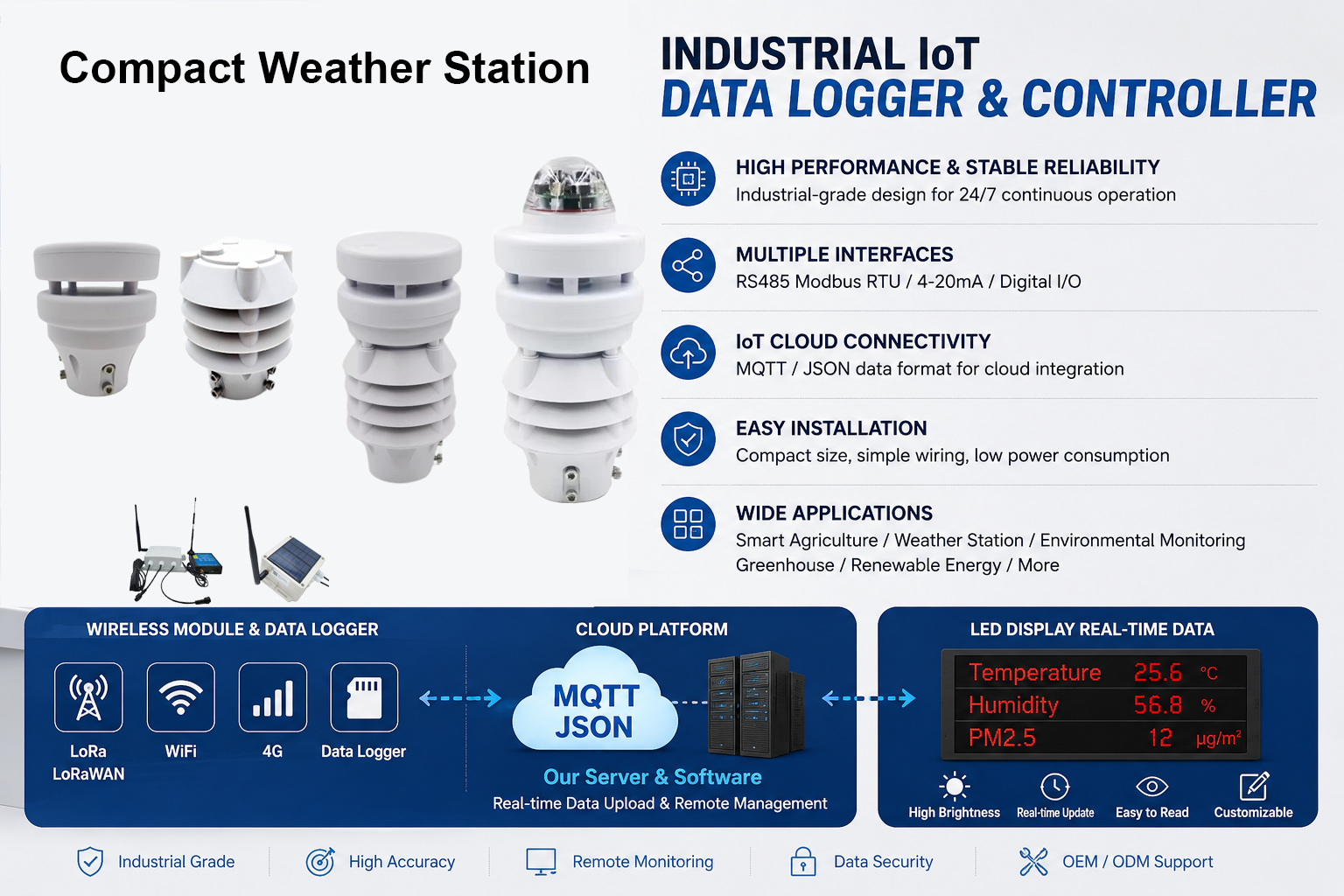
What Does a 6 in 1 Weather Station Measure?
A typical optical weather station integrates six essential meteorological parameters:
| Parameter | Function | Typical Application |
|---|---|---|
| Rainfall (Optical) | Real-time precipitation measurement | Flood warning, irrigation |
| Wind Speed | Wind monitoring | Agriculture, construction |
| Wind Direction | Wind analysis | Weather forecasting |
| Air Temperature | Climate monitoring | Greenhouse control |
| Relative Humidity | Environmental monitoring | Crop management |
| Atmospheric Pressure | Weather prediction | Scientific research |
By combining six sensors into one compact unit, installation becomes faster while reducing wiring and maintenance costs.
Why Optical Rainfall Sensors Are Better Than Tipping Bucket Rain Gauges
One of the biggest improvements in modern weather stations is the adoption of optical rainfall technology.
Advantages include:
- No moving mechanical parts
- No clogging problems
- Maintenance-free operation
- Faster rainfall response
- High measurement accuracy
- Long service life
- Excellent performance during continuous rainfall
For remote installations where maintenance is difficult, optical rain gauges provide significantly lower lifetime operating costs.
Industrial IoT Connectivity Makes Remote Monitoring Easy
Today’s weather stations are more than standalone sensors.
The Honde 6 in 1 Optical Rain Gauge Weather Station supports multiple communication methods including:
Users can remotely monitor environmental data through PCs, smartphones, LED displays, or cloud dashboards from anywhere in the world.
Typical Applications
The 6 in 1 weather station is widely used in:
Its compact all-in-one structure greatly reduces installation time compared with installing six independent sensors.
Comparison: Optical Rain Gauge vs Traditional Tipping Bucket
| Feature | Optical Rain Gauge | Tipping Bucket |
|---|---|---|
| Moving Parts | None | Yes |
| Maintenance | Very Low | Regular Cleaning |
| Anti-blocking | Excellent | Moderate |
| Response Speed | Fast | Medium |
| Heavy Rain Performance | Excellent | Good |
| Long-term Stability | Excellent | Moderate |
| Installation | Easy | Easy |
For projects requiring continuous unattended operation, optical rainfall technology offers clear long-term advantages.
Our Manufacturing Experience
At Honde Technology Co., Ltd., we have more than 10 years of experience designing and manufacturing industrial weather monitoring equipment.
Based on feedback from customers in over 60 countries, one of the most common installation mistakes is placing weather stations too close to trees, buildings, or communication towers. These obstacles can affect wind measurements and reduce rainfall accuracy.
For the best performance, we recommend installing the weather station in an open area that complies with World Meteorological Organization (WMO) installation guidelines.
Our engineering team also provides customized communication solutions, including LoRaWAN gateways, 4G data loggers, MQTT cloud servers, LED displays, and OEM/ODM services for global partners.
Why Choose Honde Technology?
Frequently Asked Questions
Q: Is an optical rain gauge more accurate than a tipping bucket?
Yes. Optical rainfall sensors eliminate mechanical wear and provide faster rainfall detection with lower maintenance requirements.
Q: Can the weather station connect to cloud platforms?
Yes. It supports MQTT, JSON, WiFi, 4G, LoRaWAN, and customized cloud platforms for remote monitoring.
Q: Does it support industrial communication?
Absolutely. RS485 Modbus RTU is standard, making it compatible with PLCs, SCADA systems, and industrial IoT applications.
Get a Custom Weather Monitoring Solution
Whether you are building a smart agriculture project, environmental monitoring network, or industrial IoT system, Honde Technology provides complete weather monitoring solutions tailored to your application.
Contact our engineering team today to request a quotation, product catalog, or customized solution for your next project.
Post time: Jun-26-2026