

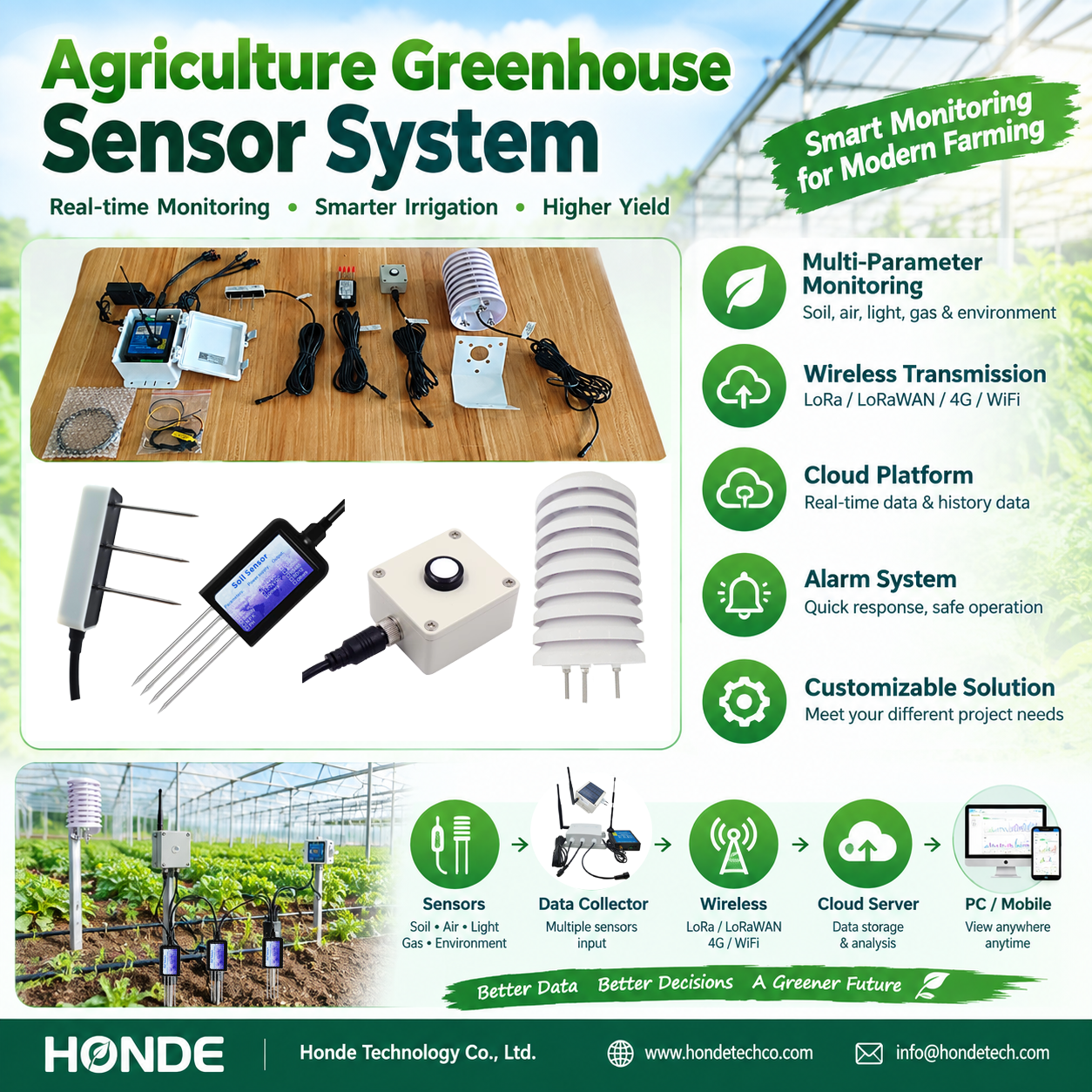
An agriculture greenhouse sensor system combines soil, air, environmental and climate sensors to provide real-time data for greenhouse management. Instead of relying only on manual inspection, growers can continuously monitor key conditions such as soil moisture, soil temperature, air temperature, humidity, light, radiation and other environmental parameters. When connected to a wireless communication system and cloud platform, these measurements can support remote monitoring, irrigation management and more data-driven greenhouse operations.
For greenhouse projects, the key is not simply choosing one sensor. The more important question is how to build a complete greenhouse monitoring system that connects sensors, data collection, wireless communication and software into one practical architecture.
Honde Technology Co., Ltd. develops IoT sensing and monitoring solutions covering smart agriculture, soil monitoring, weather monitoring, environmental monitoring and related wireless systems. The company’s product portfolio includes soil sensors, weather sensors, gas sensors, water monitoring equipment and wireless IoT solutions.
1. What Is an Agriculture Greenhouse Sensor System?
An agriculture greenhouse sensor system is an integrated monitoring network used to measure environmental and soil conditions inside or around a greenhouse.
A typical architecture can be represented as:
Greenhouse Sensors → Data Collector → Wireless Communication → Cloud Server → PC / Mobile Phone
Depending on the project requirements, the system can include:
- Soil moisture sensors
- Soil temperature sensors
- Soil EC and salinity sensors
- Soil pH sensors
- NPK sensors
- Air temperature sensors
- Air humidity sensors
- Light sensors
- Solar radiation sensors
- CO₂ and other gas sensors
- Weather sensors
- Water-level sensors
- LoRa / LoRaWAN / 4G / WiFi communication devices
This modular architecture makes it possible to start with a small number of monitoring points and expand the system as the greenhouse project grows.
Honde’s existing agricultural monitoring solutions use this same sensor-to-cloud concept, combining environmental sensors with wireless communication and remote data transmission.
2. Why Greenhouses Need More Than Temperature Monitoring
Temperature is one of the most important greenhouse parameters, but it does not provide a complete picture of crop growing conditions.
For example, two greenhouses may have similar air temperatures while having very different soil moisture levels.
A more complete monitoring strategy should consider both:
Above-Ground Environment
- Air temperature
- Air humidity
- Light intensity
- Solar radiation
- CO₂ or other gas parameters
- Wind and ventilation conditions where applicable
Root-Zone Environment
- Soil moisture
- Soil temperature
- Soil EC
- Soil salinity
- Soil pH
- NPK or other nutrient-related parameters
Honde’s multi-parameter soil monitoring solutions are designed to measure several soil conditions, while its weather and environmental sensors can provide complementary above-ground information.
This creates a more complete environmental picture:
Air + Light + Gas + Soil + Water = A More Complete Greenhouse Monitoring Dataset
3. Key Sensors for a Smart Greenhouse Monitoring System
3.1 Soil Moisture Sensor
Soil moisture is one of the most important parameters for irrigation management.
A soil moisture monitoring sensor can continuously measure changes in water content in the root zone instead of relying entirely on manual soil inspection.
Typical applications include:
- Greenhouse vegetables
- Fruits and berries
- Nursery production
- Flower cultivation
- Precision irrigation
- Agricultural research
Continuous soil moisture monitoring can help greenhouse operators identify dry or excessively wet conditions and make irrigation decisions based on measured data.
Honde provides soil moisture monitoring solutions designed for real-time agricultural data collection.
3.2 Soil Temperature Sensor
Soil temperature provides additional information about root-zone conditions.
When soil temperature is monitored together with soil moisture, growers can obtain a more complete picture of the root environment rather than looking at water content alone.
3.3 Soil EC and Salinity Sensor
Electrical conductivity, or EC, is commonly used as an indicator related to dissolved salts in the soil.
For greenhouse production, EC monitoring can be useful when fertilizer and irrigation management need closer observation.
A multi-parameter soil sensor can combine moisture, temperature and EC measurements in one monitoring point.
3.4 Soil pH and NPK Sensors
Depending on the crop and project requirements, the monitoring system can also include:
- Soil pH
- Nitrogen
- Phosphorus
- Potassium
- Salinity
Not every greenhouse requires every parameter. The appropriate sensor combination should be selected according to the crop, growing medium, irrigation method and project objectives.
Depending on the crop and project requirements, the monitoring system can also include:
For projects requiring combined soil and air monitoring, see Honde’s [Multiple Parameters Soil and Air Gas Sensor for Agricultural Applications].
4. Air and Environmental Sensors for Greenhouse Monitoring
The greenhouse environment above the soil is equally important.
An agricultural greenhouse sensor system may monitor:
| Parameter | Why It Matters |
|---|---|
| Air Temperature | Tracks the thermal environment around crops |
| Air Humidity | Helps evaluate greenhouse humidity conditions |
| CO₂ / Gas | Supports environmental monitoring for crop production |
| Light Intensity | Indicates available light conditions |
| Solar Radiation | Helps evaluate incoming solar energy |
| Soil Moisture | Provides root-zone water information |
| Soil Temperature | Monitors root-zone temperature |
| Soil EC | Supports soil/fertilizer condition monitoring |
| Soil pH | Helps evaluate soil chemical conditions |
The exact combination can be customized according to the greenhouse application.
Honde’s product range includes soil sensors, gas sensors, weather sensors and environmental monitoring equipment for agricultural applications.
5. How a Greenhouse Sensor System Works
A complete greenhouse monitoring system normally contains four functional layers.
Layer 1: Sensors
Sensors are installed at different monitoring points.
For example:
Soil Sensor → Root Zone
Air Sensor → Greenhouse Environment
Light Sensor → Canopy / Light Environment
Gas Sensor → Greenhouse Air
The sensors continuously collect measurement data.
Layer 2: Data Collector
The data collector receives information from multiple sensors.
This reduces the need to connect every sensor directly to a cloud platform.
A collector can aggregate data and then transmit it through an appropriate wireless communication network.
Layer 3: Wireless Communication
Depending on the project environment, different communication technologies can be selected:
- LoRa
- LoRaWAN
- 4G
- WiFi
- RS485
- MQTT
For larger agricultural monitoring projects, LoRa/LoRaWAN can be used to connect distributed field sensors with a gateway. Honde has documented agricultural monitoring architectures using LoRa collectors and gateways for distributed soil and weather sensors.
For larger agricultural monitoring projects, LoRa/LoRaWAN can be used to connect distributed field sensors with a gateway. Honde has documented agricultural monitoring architectures using LoRa collectors and gateways for distributed soil and weather sensors. [Agriculture Weather Station and Soil Sensor System with 4G MQTT]
Layer 4: Cloud Server and Software
After the data reaches the server, users can view:
- Real-time data
- Historical data
- Data trends
- Sensor status
- Alarm information
- Monitoring records
The final objective is to turn individual sensor readings into information that greenhouse operators can use.
6. LoRaWAN vs 4G for Greenhouse Sensor Systems
The communication method should be selected according to the greenhouse size, sensor distribution, power supply and network environment.
| Communication | Typical Advantage | Suitable Scenario |
|---|---|---|
| RS485 | Stable wired communication | Short-distance local sensor networks |
| WiFi | Convenient local network access | Greenhouses with reliable WiFi |
| LoRa | Long-distance low-power communication | Distributed agricultural sensors |
| LoRaWAN | Multi-node LPWAN architecture | Large monitoring networks |
| 4G | Direct cellular connectivity | Remote sites without local Internet |
| MQTT | Lightweight IoT data communication | Sensor-to-cloud applications |
For example, a greenhouse with many distributed sensors may use:
Multiple Sensors → LoRa Collector → LoRaWAN Gateway → 4G/Ethernet → Cloud
A smaller installation may use:
Sensors → 4G/WiFi Data Logger → Cloud Platform
The architecture can therefore be selected according to the project rather than forcing every customer into the same configuration.
Honde has already documented both LoRa/LoRaWAN and 4G MQTT agricultural monitoring architectures.
7. What Should Buyers Check Before Choosing a Greenhouse Sensor System?
Choosing sensors based only on price can create problems later.
For B2B greenhouse projects, buyers should check at least these seven factors.
1. Measurement Parameters
Confirm exactly which parameters are required.
For example:
- Moisture
- Temperature
- EC
- pH
- NPK
- Air humidity
- Light
- CO₂
- Radiation
2. Installation Depth
For soil monitoring, probe length and installation depth can be important.
If the project requires root-zone monitoring at different depths, a multi-depth sensor configuration may be more suitable than a single shallow sensor.
3. Output Interface
Common interfaces include:
- RS485
- Modbus RTU
- Analog output
- SDI-12
- Wireless communication
Make sure the sensor output is compatible with the selected data logger or collector.
4. Communication Distance
A greenhouse with sensors distributed over a large area should consider communication distance before installation.
LoRa and LoRaWAN can be particularly useful when multiple low-power monitoring points need to communicate over a larger area.
5. Power Supply
Power options may include:
- DC power
- Battery
- Solar power
- Solar + battery
For remote agricultural installations, low-power sensor and communication architecture can reduce maintenance requirements.
6. Cloud Integration
Ask whether the system can provide:
- Real-time monitoring
- Historical data
- Remote access
- Alarm functions
- MQTT communication
- API or other data integration options
7. Customization
Commercial greenhouse projects often have different requirements.
A professional supplier should be able to customize:
- Sensor combinations
- Probe length
- Communication method
- Number of monitoring points
- Data transmission method
- Power supply
- Software functions
8. Typical Greenhouse Sensor System Architecture
A practical greenhouse project can be designed as follows:
                GREENHOUSE ENVIRONMENT
                         │
        ┌────────────────┼────────────────┐
        │                │                │
   Air Sensor       Light Sensor      Gas Sensor
        │                │                │
        └────────────────┼────────────────┘
                         │
                    Data Collector
                         │
              LoRa / LoRaWAN / 4G
                         │
                      Gateway
                         │
                    Cloud Server
                         │
              ┌──────────┴──────────┐
              │                     │
           Computer              Mobile
At the same time, underground sensors can monitor the root zone:
Soil Moisture
Soil Temperature
Soil EC
Soil pH
NPK
     │
     ↓
Data Collector
     │
     ↓
Wireless Network
     │
     ↓
Cloud Platform
Combining the two creates an integrated greenhouse monitoring network.
9. Greenhouse Monitoring Is Moving From Single Sensors to Integrated Systems
One important trend in agricultural IoT is the transition from individual sensors to integrated monitoring systems.
A farmer may initially need only a soil moisture sensor.
Later, the project may require:
Soil Moisture → Soil EC → Air Temperature → Humidity → Light → Gas → Weather → Water Level
A modular IoT architecture makes this expansion easier.
Honde’s documented agricultural monitoring systems demonstrate this modular approach, where soil sensors, weather stations and water-level monitoring can be connected through a common wireless architecture.
This is particularly useful for:
- Commercial greenhouses
- Smart farms
- Agricultural research centers
- Nursery projects
- High-value crop production
- Precision irrigation projects
- Agricultural demonstration projects
10. From Sensor Data to Smart Agriculture Decisions
The value of a greenhouse sensor system is not simply the sensor itself.
The real value comes from connecting measurement → communication → data → decision.
For example:
Low Soil Moisture
↓
Monitoring platform detects a change
↓
Operator checks soil and environmental conditions
↓
Irrigation decision
↓
New sensor data confirms the result
This creates a continuous feedback loop.
Similarly, combining air temperature, humidity, solar radiation and soil moisture can provide a broader environmental picture than using any one measurement independently.
For large IoT environmental monitoring systems, ISO/IEC 30179:2023 specifically addresses IoT systems for ecological environment monitoring, including natural entities such as air, water and soil.
11. Why Honde Technology for Greenhouse Sensor Projects?
Honde Technology Co., Ltd. was founded in 2011 and focuses on IoT products and solutions for smart water, smart agriculture and smart environmental protection.
Its product portfolio covers:
- Soil sensors
- Weather sensors
- Gas sensors
- Water-quality sensors
- Water-level sensors
- Wireless modules
- Data loggers
- Cloud monitoring solutions
- Agricultural IoT systems
The company provides products and related solutions for agriculture, aquaculture, environmental monitoring, greenhouse monitoring and other applications.
For greenhouse projects, the advantage of a system-oriented supplier is that customers can discuss the complete architecture instead of sourcing every component independently.
The monitoring system can be configured around the project’s actual requirements, including sensor type, measurement parameters, communication method, power supply and data platform.
12. Honde Greenhouse Sensor System: Project Configuration Example
A typical customized greenhouse project could include:
| System Part | Example Configuration |
|---|---|
| Soil Monitoring | Moisture + Temperature + EC |
| Air Monitoring | Temperature + Humidity |
| Light Monitoring | Light / Solar Radiation |
| Gas Monitoring | CO₂ or Other Gas Sensor |
| Communication | LoRaWAN / 4G / WiFi |
| Data Collection | Wireless Data Collector |
| Cloud | Cloud Server + Software |
| Remote Access | PC + Mobile |
| Alarm | Configurable Alarm System |
| Power | DC / Battery / Solar |
The actual configuration should be determined according to the crop, greenhouse structure, monitoring points and communication environment.
13. Common Mistakes When Buying Greenhouse Sensors
Mistake 1: Choosing Sensors Before Defining the System
A sensor may have excellent specifications but still be unsuitable if its interface cannot connect to the customer’s data collector.
Mistake 2: Monitoring Only Air Temperature
Temperature alone cannot describe the complete crop environment.
Soil moisture, soil temperature, EC, humidity and light can provide important complementary information.
Mistake 3: Ignoring Communication
A high-quality sensor is not useful if its data cannot reliably reach the monitoring platform.
Mistake 4: Not Planning Future Expansion
Greenhouse projects often expand.
Selecting a modular communication architecture can make it easier to add sensors later.
Mistake 5: Looking Only at Sensor Price
For B2B projects, the total cost should include:
Sensor + Collector + Gateway + Communication + Installation + Software + Maintenance
The cheapest individual sensor is not necessarily the lowest-cost complete system.
14. FAQ: Agriculture Greenhouse Sensor System
What sensors are needed for a smart greenhouse?
A basic system can start with soil moisture, soil temperature, air temperature and humidity. More advanced systems can add EC, pH, NPK, light, radiation, CO₂ and other gas sensors according to the crop and project requirements.
Can greenhouse sensors work wirelessly?
Yes. Depending on the application, greenhouse sensors can communicate through LoRa, LoRaWAN, WiFi or 4G. The appropriate option depends on communication distance, power supply, network coverage and number of monitoring points.
Can soil and weather sensors use the same monitoring platform?
Yes. A properly designed IoT architecture can combine soil sensors, weather stations and environmental sensors through a common collector and gateway before sending the data to a cloud platform.
Can the greenhouse monitoring system be customized?
Yes. Commercial agricultural projects often require customized sensor combinations, probe lengths, communication protocols, power supplies and data interfaces.
Can the system support remote monitoring?
Yes. With a suitable wireless gateway and cloud server, sensor data can be transmitted remotely for real-time and historical monitoring.
15. Conclusion: Build a Complete Greenhouse Monitoring Network
A modern agriculture greenhouse sensor system should not be viewed as a single sensor.
It is a complete chain:
Sensors → Data Collection → Wireless Communication → Cloud → Data Analysis → Agricultural Decisions
Soil sensors provide information from the root zone, while air, gas, light and weather sensors describe the environment around the crop.
When these data sources are integrated into one IoT monitoring architecture, greenhouse operators can obtain a more complete picture of growing conditions and build a foundation for precision irrigation, environmental management and smart agriculture.
For projects that require customized greenhouse sensors, wireless communication or a complete agricultural monitoring solution, Honde Technology can provide the corresponding IoT products and system configuration.
Company Name: Honde Technology Co., Ltd.
Website: www.hondetechco.com
Email: info@hondetech.com
Get a customized greenhouse monitoring solution and quotation from Honde Technology.
Recommended Internal Links for Honde Website
- Agriculture Weather Station and Soil Sensor System with 4G MQTT
Use as an internal link when discussing 4G + MQTT agricultural monitoring architecture. - Weather Station with Soil Moisture Monitoring System
Use when introducing the combination of weather monitoring + soil moisture monitoring. - Multiple Parameters Soil and Air Gas Sensor for Agricultural Applications
Use when discussing soil + air/gas multi-parameter monitoring.
Post time: Sep-23-2026