

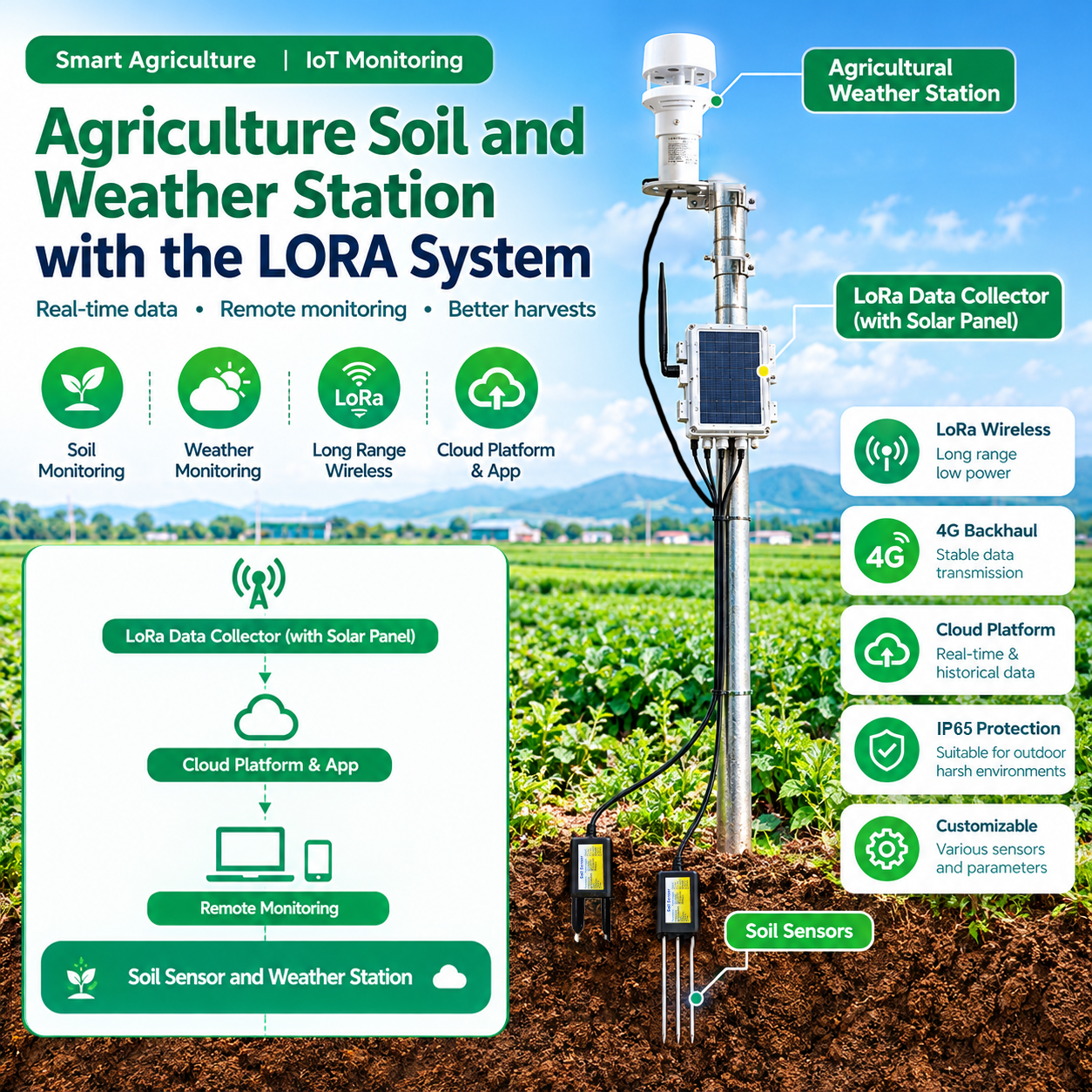
An agriculture soil and weather station with a LoRa wireless system enables farmers and agricultural project operators to monitor soil conditions and local weather data remotely. By integrating soil sensors, a weather station, a LoRa data collector and a cloud-based monitoring platform, this solution can support continuous agricultural data collection while reducing the need for frequent manual inspections.
For precision agriculture, combining soil and weather monitoring provides useful information about the growing environment. A LoRa-based system is particularly relevant to farms, greenhouses, orchards and agricultural projects where wireless communication and flexible sensor deployment are required.
In this guide, we explain the system architecture, its key components, how LoRa communication works, practical applications and the main factors to consider when selecting a wireless agricultural monitoring solution.
1. What Is an Agriculture Soil and Weather Station with LoRa?
An agriculture soil and weather monitoring system combines soil sensors and weather monitoring equipment with a LoRa wireless communication network. The system collects environmental data from different monitoring points and transmits it to a central data collector or gateway.
Depending on the configuration, collected data can be forwarded to a cloud platform for remote viewing, historical analysis and alarm management.
Typical LoRa agricultural monitoring system architecture
Soil Sensors : Soil condition monitoring, Weather Station : Local weather monitoring → LoRa Data Collector / Gateway : Wireless data reception and transmission → Cloud Server and Monitoring Software : Real-time data · Historical records · Remote access → Computer, Tablet or Smartphone
The system generally consists of four main parts:
-
Soil sensors: Measure selected soil parameters at designated monitoring points.
-
Agricultural weather station: Collects local meteorological data to help evaluate crop-growing conditions.
-
LoRa data collector: Receives wireless sensor data and transfers it to the next communication layer.
-
Cloud monitoring platform: Displays real-time measurements and stores historical records, subject to the configured software and connectivity.
The combination of soil and weather data provides a more comprehensive view of the agricultural environment than monitoring either one independently.
2. Key Components and Their Functions
|
Component |
Main function |
Value for agricultural projects |
|---|---|---|
|
Measures soil water content |
Supports irrigation management |
|
|
Soil temperature sensor |
Measures soil temperature |
Helps monitor root-zone conditions |
|
Soil EC sensor |
Measures soil electrical conductivity |
Helps assess soil salinity and nutrient-related conditions |
|
Weather station |
Measures selected meteorological parameters |
Monitors local weather conditions |
|
LoRa collector |
Receives wireless sensor data |
Reduces dependence on individual wired connections |
|
Cloud platform |
Displays and stores monitoring data |
Supports remote monitoring and historical analysis |
The actual parameters available depend on the sensors selected for the project. Not every configuration includes all the parameters listed above.
Soil monitoring
Soil monitoring is important for understanding the conditions in which crops grow. Soil moisture and temperature are commonly used to evaluate the root-zone environment. Soil electrical conductivity can provide additional information for agricultural soil management.
For projects that require more detailed monitoring, buyers can select different sensor types and measurement parameters according to crop requirements, soil characteristics and installation conditions.
Weather monitoring
A weather station provides information about the local atmosphere. Depending on the model, typical parameters may include:
-
Air temperature
-
Relative humidity
-
Atmospheric pressure
-
Wind speed and direction
-
Rainfall
-
Solar radiation
Not all weather stations support every parameter. The measurement range, accuracy and available interfaces should be confirmed against the specific model’s technical datasheet.
LoRa wireless data collection
LoRa is a long-range, low-power wireless communication technology. It is suitable for many agricultural monitoring applications in which sensors are distributed across a relatively large area.
Compared with a fully wired arrangement, a wireless design can simplify deployment in locations where installing communication cables is inconvenient. Actual communication range depends on antenna placement, terrain, obstructions, interference and radio settings.
3. How Does a LoRa Agricultural Monitoring System Work?
A typical LoRa agricultural monitoring system follows a straightforward data collection and transmission process.
01 Environmental data collection
Soil sensors measure selected soil parameters, while the weather station collects meteorological data. Measurements are taken according to the configured sampling interval.
02 Wireless data transmission
Compatible LoRa-enabled sensors transmit their measurements to a designated data collector or gateway. The network configuration determines the communication frequency and data format
03 Data forwarding to the cloud
The collector forwards received data through its configured backhaul connection, such as 4G or another supported network, to the monitoring platform.
04 Remote monitoring and analysis
Authorized users can view available measurements, review historical data and use configured alarms to identify environmental conditions requiring attention.
The complete communication arrangement should be selected according to the project’s sensor interfaces, network coverage, data transmission requirements and cloud platform.
4. Why Use LoRa for Agricultural Monitoring?
Agricultural monitoring projects often involve multiple measurement points distributed across open fields, greenhouses or orchards. LoRa wireless communication offers several characteristics that make it suitable for these environments.
|
LoRa characteristic |
Description |
Agricultural relevance |
|---|---|---|
|
Long-range communication |
Designed for communication over longer distances than many short-range wireless technologies |
Useful for distributed monitoring points |
|
Low power consumption |
Designed for low-power data transmission |
Suitable for appropriately designed battery-powered nodes |
|
Wireless deployment |
Reduces the need for communication cables |
Simplifies installation in some field environments |
|
Flexible network design |
Supports different network configurations |
Can accommodate different monitoring layouts |
|
Small data transmission |
Well suited to periodic sensor measurements |
Suitable for many environmental monitoring applications |
However, LoRa is not a universal solution for every agricultural project. High-frequency data transmission, large data payloads, complex terrain and substantial obstructions may require additional network planning.
When choosing a system, buyers should confirm the radio frequency, local regulatory requirements, communication distance and compatibility between sensors and the collector.
5. Main Applications of LoRa Soil and Weather Monitoring Systems
1. Precision agriculture
Farmers can combine soil moisture, soil temperature and weather information to understand variations in growing conditions. These measurements can support irrigation planning and field management.
2. Greenhouse environmental monitoring
Soil sensors and weather monitoring equipment can help operators track growing conditions and identify environmental changes that may require intervention.
3. Orchard monitoring
Distributed sensors can provide soil and local weather information across different areas of an orchard, supporting more informed irrigation and cultivation management.
4. Agricultural research projects
Researchers can use continuous environmental measurements and historical records to study soil conditions, local weather variations and crop-growing environments.
6. LoRa vs. Wi-Fi vs. 4G for Agricultural Monitoring
Choosing the communication technology is an important part of agricultural system design. The appropriate option depends on the monitoring area’s size, infrastructure and data transmission requirements.
|
Feature |
LoRa |
Wi-Fi |
4G |
|---|---|---|---|
|
Communication coverage |
Long-range, depending on conditions |
Typically local |
Cellular network coverage |
|
Power requirements |
Low-power design possible |
Generally higher |
Depends on modem and usage |
|
Internet infrastructure |
Requires a suitable gateway or backhaul |
Requires Wi-Fi infrastructure |
Requires cellular coverage |
|
Deployment |
Suitable for distributed low-data sensors |
Suitable for local networks |
Suitable for independently connected devices |
|
Typical use |
Distributed field sensors |
Greenhouses and local installations |
Remote collectors and standalone stations |
For many agricultural projects, these technologies can complement each other rather than compete. For example, LoRa can connect multiple field sensors to one collector, while 4G can provide the collector’s connection to a remote cloud platform.
The final choice should be based on actual site conditions, the number of sensors and the required reporting frequency.
7. How to Choose a LoRa Agricultural Soil and Weather Station
Before purchasing a wireless agricultural monitoring system, buyers should evaluate the following factors.
|
Selection factor |
What to check |
|---|---|
|
Measurement parameters |
Soil moisture, temperature, EC and required weather parameters |
|
Measurement accuracy |
Accuracy and measurement range in the product datasheet |
|
Sensor compatibility |
Whether the sensors and collector support the same communication protocol |
|
Communication range |
Expected distance under actual field conditions |
|
Power supply |
Mains, battery or solar power requirements |
|
Data transmission |
Sampling interval, reporting frequency and network capacity |
|
Cloud platform |
Real-time data, historical records and supported alarm functions |
|
Environmental protection |
IP rating and suitability for outdoor installation |
|
Customization |
Available sensor combinations and communication interfaces |
Practical purchasing tip
Before ordering, provide your supplier with the required measurement parameters, the number of monitoring points, the distance between sensors and the collector, the power supply conditions and the preferred communication method. These details help determine whether a proposed configuration meets your project’s requirements.
8. Common Questions About LoRa Agricultural Monitoring Systems
Q1. What is the main advantage of a LoRa agricultural monitoring system?
Its principal advantage is the ability to connect distributed, low-data-rate sensors over relatively long wireless links. This can reduce the need for communication cables and simplify data collection across agricultural sites.
Q2. Can LoRa soil sensors and a weather station work together?
Yes, provided that the sensors, communication protocols and data collector are compatible. A properly configured system can collect soil and meteorological data through a common monitoring platform.
Q3. How far can a LoRa agricultural sensor transmit data?
There is no universal communication distance. The actual range depends on antenna height, transmit power, radio frequency, terrain, buildings, vegetation and interference. A field test is recommended for projects requiring reliable coverage over a specified area.
Q4. Can a LoRa agricultural monitoring system use solar power?
Yes. Solar power can be used in appropriately designed monitoring systems. Solar panel capacity, battery capacity, sensor consumption, transmission frequency and local sunlight conditions should all be considered when designing the power supply.
Q5. Can I customize the soil and weather measurement parameters?
Customization depends on the available sensor models and system interfaces. Buyers should specify the required parameters, measurement ranges, accuracy and installation conditions before confirming the configuration.
Q6. Can agricultural monitoring data be viewed remotely?
Yes, when the system includes a suitable backhaul connection and a compatible cloud monitoring platform. Remote access, historical data and alarm functions depend on the selected software and configuration.
9. Honde LoRa Agricultural Monitoring Solutions
Honde Technology Co., Ltd. specializes in the research, development, production and sales of smart water equipment, smart agriculture equipment and smart environmental monitoring equipment.
For agricultural monitoring projects, a combination of soil sensors, weather stations, wireless collectors and cloud software can be configured according to specific project requirements.
Honde provides solutions for different agricultural monitoring requirements, including sensor selection, wireless data collection and remote monitoring. Specific measurement parameters, wireless protocols and system functions can be confirmed according to the selected products.
Company Information
Looking for a LoRa agricultural soil and weather monitoring solution? Contact Honde Technology to discuss your required measurement parameters, wireless communication range and project configuration.
Post time: Sep-28-2026