

An Agriculture Weather Station and Soil Sensor System with 4G MQTT is an integrated IoT monitoring solution that combines above-ground weather monitoring, underground soil measurement, and wireless 4G communication.
The system collects environmental data from weather stations and soil sensors, then transmits the information remotely through a 4G network using the lightweight MQTT protocol. This architecture helps farms, orchards, greenhouses, agricultural research projects, and digital farming platforms access environmental data in real time. (Honde)
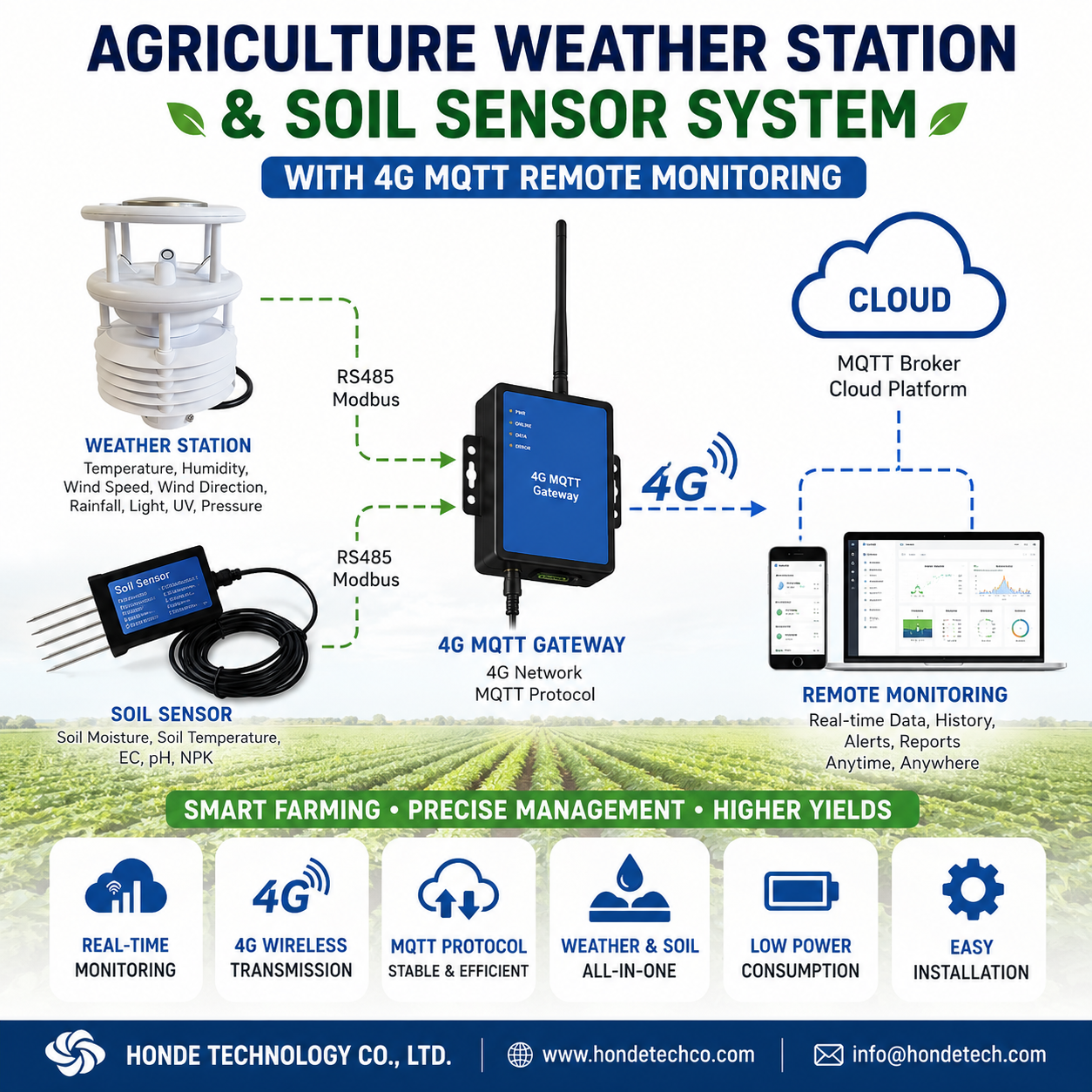
Basic Workflow
For modern agriculture, monitoring only the weather is not enough.
A weather station can tell you what is happening above the ground, while soil sensors show what is happening inside the crop root zone.
Combining these two types of information creates a more complete environmental monitoring system.
Depending on the selected weather station configuration, agricultural projects can monitor parameters such as:
- ✓ Air Temperature
- ✓ Air Humidity
- ✓ Wind Speed
- ✓ Wind Direction
- ✓ Rainfall
- ✓ Solar Radiation
- ✓ Light Intensity
- ✓ Atmospheric Pressure
The soil monitoring system can be configured for parameters such as:
- ✓ Soil Moisture
- ✓ Soil Temperature
- ✓ Soil EC
- ✓ Soil pH
- ✓ Soil Salinity
- ✓ Nitrogen
- ✓ Phosphorus
- ✓ Potassium
Different sensor combinations can be selected according to the requirements of the agricultural project. (Honde)
The key advantage of this system is its complete Sensor-to-Cloud IoT architecture.
The agricultural weather station continuously monitors atmospheric conditions around the crops.
At the same time, soil sensors measure conditions in the soil, especially within the crop root zone.
This allows agricultural managers to understand both:
What is happening in the air?
What is happening in the soil?
This combination provides more useful information for irrigation, fertilization, crop management, and environmental analysis.
The sensor system collects data through industrial communication interfaces such as RS485 and Modbus RTU, depending on the selected configuration.
Multiple sensors can be integrated into one agricultural monitoring solution, allowing users to build customized systems for different applications. (Honde)
Traditional agricultural monitoring systems may require complicated communication cables.
A 4G agricultural monitoring system can reduce this installation complexity where suitable cellular coverage is available.
The system uses the mobile network to transmit environmental data remotely.
This makes the solution particularly useful for applications such as:
(Honde)
MQTT (Message Queuing Telemetry Transport) is widely used in IoT applications because it is designed for efficient communication between devices and servers.
For an agricultural monitoring project, MQTT can help create a structured connection between field equipment and a remote server.
The publish/subscribe communication model makes MQTT suitable for IoT systems that need to transmit sensor data efficiently over remote networks. (Honde)
This modular architecture allows agricultural projects to select different sensor combinations based on their actual monitoring requirements. (Honde)
Farm managers can access environmental information without manually visiting every monitoring location.
The system can provide continuous data transmission from the field to a remote monitoring platform.
One of the biggest advantages is the ability to combine:
Atmospheric Environment + Soil Environment
For example:
- High Temperature + Low Soil Moisture
- Heavy Rainfall + High Soil Moisture
- Strong Wind + Agricultural Operations
- High Solar Radiation + Increased Water Demand
Looking at multiple environmental variables together can support more informed agricultural decisions.
Soil moisture data helps indicate the water condition in the soil.
Weather data provides additional environmental context.
By combining these data sources, agricultural managers can develop more data-driven irrigation strategies instead of relying only on manual observation.
Precision agriculture applications commonly use this combination of environmental monitoring technologies. (Honde)
Different agricultural projects need different parameters.
Recommended parameters may include:
- Air Temperature
- Humidity
- Rainfall
- Wind Speed
- Soil Moisture
- Soil Temperature
Projects may focus on:
- Air Temperature
- Humidity
- Light
- CO2
- Soil Moisture
- Soil EC
A more comprehensive system may include:
- Weather Parameters
- Soil Moisture
- Soil Temperature
- EC
- pH
- NPK
A modular sensor architecture makes it possible to customize the system according to the monitoring objective.
Field crops such as:
can benefit from continuous monitoring of weather and soil conditions.
Fruit growers can monitor:
- Microclimate
- Rainfall
- Soil Moisture
- Temperature
- Environmental Changes
This information can support irrigation planning and crop management.
Greenhouse projects can combine environmental sensors with soil monitoring to create a more complete agricultural data system.
Potential monitoring parameters include:
Universities, agricultural laboratories, and research organizations can use environmental monitoring systems to collect long-term field data.
A network of weather stations and soil sensors can become part of a larger Digital Agriculture Platform.
The goal is to transform field environmental information into structured data that can be analyzed remotely. (Honde)
Before selecting a system, we recommend answering these questions.
Do you need only:
- Soil Moisture?
Or a complete system including:
Choosing only the necessary parameters can help create a more suitable monitoring solution. (Honde)
Different installation environments may require:
| Installation Environment | Recommended Communication |
|---|---|
| Short Distance | RS485 |
| Distributed Field Sensors | LoRa |
| Remote Cloud Transmission | 4G |
| Local Network | WiFi |
| IoT Server Integration | MQTT |
For remote agricultural monitoring, communication architecture should be selected according to network coverage and project requirements.
For some commercial IoT projects, the ability to integrate with an existing server is important.
MQTT can provide an efficient communication method for connecting sensor systems with compatible IoT platforms.
Before purchasing, users should confirm requirements such as:
- MQTT Compatibility
- Data Format
- Server Address
- API Requirements
- Cloud Platform Requirements
- Historical Data Storage
Based on typical system integration requirements, there are several important issues to consider.
A farm does not always need every possible sensor.
The first step should be identifying the actual agricultural problem.
For example:
Before selecting a 4G system, confirm whether reliable cellular network coverage is available at the installation location.
Communication infrastructure should always be evaluated before large-scale deployment.
Collecting sensor data is only the first step.
A complete project should consider:
- What data will be collected?
- Where will it be transmitted?
- How long will it be stored?
- Who will access the data?
- Will alarms be required?
- Will the data connect with another agricultural platform?
A complete agricultural IoT system can follow this workflow:
Weather Station and Soil Sensors collect environmental data.
The monitoring system gathers information from different sensors.
4G communication sends the data remotely.
MQTT transfers data to the selected server architecture.
The cloud platform displays real-time and historical information.
Farm managers use the information to support irrigation, fertilization, and environmental management decisions.
This approach transforms individual sensors into a connected Smart Agriculture Monitoring System.
Agricultural environments are different.
A small greenhouse and a large commercial farm do not require exactly the same system.
A customized solution can help users select:
This flexibility is especially valuable for system integrators, agricultural technology companies, research projects, and large farms.
Honde Technology Co., Ltd. provides environmental monitoring and IoT sensing solutions for applications including agriculture, weather monitoring, soil monitoring, environmental monitoring, and wireless data transmission.
The company’s product ecosystem includes configurations combining weather stations, soil sensors, wireless communication technologies, gateways, and MQTT-based data transmission. (Honde)
Company Name: Honde Technology Co., Ltd.
Website: www.hondetechco.com
Email: info@hondetech.com
An agriculture weather station is a monitoring system designed to measure environmental conditions relevant to agricultural production, such as temperature, humidity, rainfall, wind, and solar conditions.
Weather sensors monitor above-ground environmental conditions, while soil sensors monitor conditions around the crop root zone. Combining both provides a more complete picture of the agricultural environment.
Yes. Where compatible cellular network coverage is available, a 4G communication system can transmit agricultural sensor data to a remote server or cloud platform. (Honde)
MQTT is a lightweight IoT messaging protocol that can be used to transfer sensor data between devices, gateways, servers, and cloud platforms.
Yes. A modular agricultural monitoring system can be configured with different weather sensors, soil sensors, communication technologies, and data transmission methods depending on project requirements. (Honde)
An Agriculture Weather Station and Soil Sensor System with 4G MQTT provides a practical architecture for building connected smart agriculture projects.
By integrating: Weather Monitoring + Soil Monitoring + 4G Communication + MQTT Data Transmission
agricultural projects can build a continuous connection between the physical field and the digital management platform.
The result is a more connected approach to environmental monitoring, precision agriculture, irrigation management, agricultural research, and digital farming.
Honde Technology can help configure a solution based on your required:
- Weather Parameters
- Soil Parameters
- Wireless Communication
- 4G Connectivity
- MQTT Output
- Custom Monitoring Requirements
Contact us today to discuss your agricultural IoT monitoring project.
Email: info@hondetech.com
Website: Honde Technology Co Ltd
Post time: Sep-03-2026