

Agriculture Weather Station and Soil Sensor System with 4G MQTT: The Short Answer
An Agriculture Weather Station and Soil Sensor System with 4G MQTT combines meteorological monitoring, soil measurement, wireless communication, and IoT data transmission into one agricultural monitoring solution.
The system can collect important weather and soil environmental data from the field and transmit information remotely through a 4G network using MQTT communication technology. This architecture helps agricultural users monitor changing field conditions and integrate sensor data into cloud platforms, agricultural management systems, or customized IoT applications.
The product system demonstrated in the video focuses on combining an agricultural weather station, soil sensors, 4G communication, and MQTT-based data transmission. (YouTube)
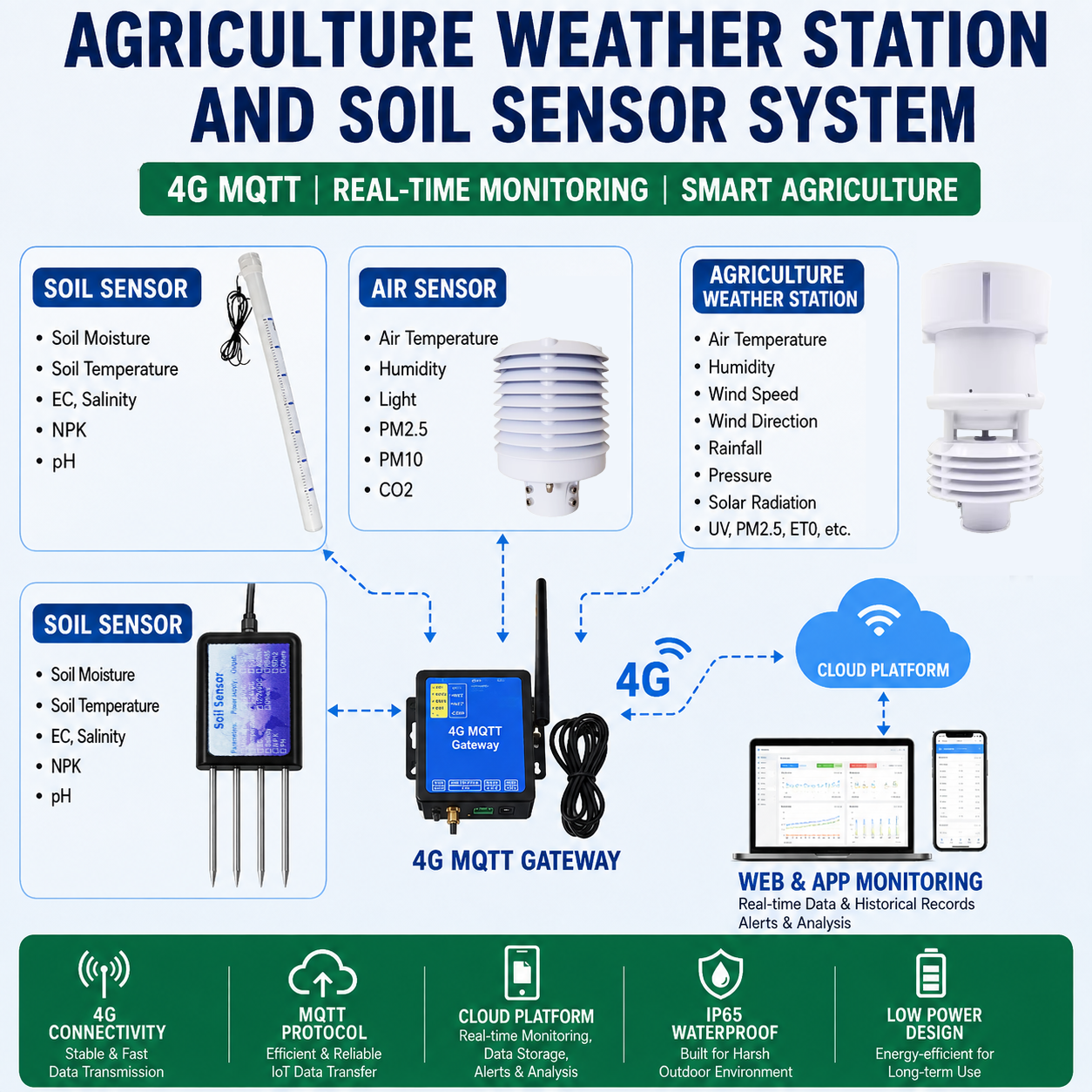
What Is an Agriculture Weather Station and Soil Sensor System?
Modern agriculture increasingly depends on environmental data rather than manual observation alone.
A complete agricultural monitoring system can combine two important categories of information:
Above-Ground Environmental Data
Depending on the selected weather station configuration, monitoring may include parameters such as:
- Air Temperature
- Air Humidity
- Wind Speed
- Wind Direction
- Atmospheric Pressure
- Rainfall
- Solar Radiation
- Light Intensity
Below-Ground Soil Data
Soil monitoring configurations may include parameters such as:
- Soil Moisture
- Soil Temperature
- Soil EC
- Soil pH
- Soil Nutrients
- Other customized soil parameters
By combining weather and soil information, agricultural managers can obtain a broader understanding of field conditions.
Honde provides weather monitoring products designed for applications including agriculture, environmental monitoring, and other outdoor monitoring projects. (Honde)
Why Combine Weather Monitoring and Soil Monitoring?
A common problem in agricultural monitoring is collecting only one type of environmental information.
For example:
- A weather station can show that rainfall occurred.
- A soil sensor can show the actual soil moisture condition.
These two pieces of information are related—but they are not identical.
Rainfall does not always produce the same soil response. Factors such as soil type, irrigation, drainage, evaporation, and crop conditions can influence the actual soil environment.
Therefore, combining multiple sensors can create a more useful monitoring system.
Weather Data + Soil Data = Better Field Visibility
| Monitoring Area | Typical Information | Agricultural Value |
|---|---|---|
| Weather | Temperature and humidity | Environmental monitoring |
| Wind | Wind speed and direction | Field condition awareness |
| Rainfall | Precipitation information | Water management reference |
| Solar conditions | Radiation or light | Crop environment analysis |
| Soil | Moisture and temperature | Irrigation monitoring |
| Soil chemistry | EC pH or nutrients | Soil condition management |
This structured combination is particularly useful for:
How Does the 4G MQTT Agricultural Monitoring System Work?
A typical system architecture can be understood as:
Step 1: Sensors Collect Environmental Data
The weather station monitors atmospheric conditions while soil sensors monitor underground conditions.
Step 2: The System Processes Sensor Data
Sensor information is collected through the system’s data acquisition and communication architecture.
Step 3: Data Is Transmitted Through 4G
4G communication makes the solution suitable for remote agricultural locations where wired communication may be inconvenient or expensive.
Step 4: MQTT Transfers Data to the IoT System
MQTT is a lightweight client-server publish/subscribe messaging protocol designed for IoT and machine-to-machine communication environments. (OASIS)
Step 5: Data Can Be Used by a Monitoring Platform
Depending on the project architecture, collected information can be integrated into:
- Cloud Platforms
- Agricultural IoT Systems
- Custom Software
- Data Management Platforms
- Remote Monitoring Applications
Why Is MQTT Useful for Agricultural IoT?
MQTT has become an important communication technology for many IoT applications.
The protocol uses a publish/subscribe architecture, allowing devices and applications to exchange messages efficiently. MQTT was specifically designed as a lightweight messaging protocol suitable for machine-to-machine and IoT environments. (OASIS)
For agricultural monitoring projects, this can be valuable when multiple sensors and remote devices need to communicate with a centralized system.
MQTT Advantages for IoT Monitoring
Lightweight Communication
MQTT is designed to minimize communication overhead, making it suitable for connected sensor systems. (OASIS Open)
Publish and Subscribe Architecture
Different applications can subscribe to relevant sensor information without requiring every device to communicate directly with every application.
Scalable System Architecture
MQTT can support larger IoT systems involving multiple connected devices and applications. (OASIS Open)
Suitable for Remote Monitoring
Combined with 4G communication, MQTT can help connect agricultural monitoring equipment installed in remote locations.
4G vs Traditional Wired Agricultural Monitoring
| Feature | Traditional Wired System | 4G MQTT Monitoring System |
|---|---|---|
| Installation | Requires communication cables | Wireless network communication |
| Remote Locations | Cable installation may be difficult | Suitable where cellular coverage is available |
| Remote Data Transmission | Additional infrastructure may be required | Uses cellular communication |
| IoT Integration | Depends on system design | Designed for connected applications |
| Scalability | Can become complex | Suitable for distributed monitoring architectures |
The best communication method should always be selected according to the actual project environment, power availability, communication coverage, and software requirements.
Typical Applications of a 4G MQTT Agriculture Monitoring System
1. Precision Agriculture
Farmers and agricultural managers can monitor weather and soil conditions from multiple locations.
Potential applications include:
- Field environment monitoring
- Irrigation management
- Crop environment observation
- Agricultural data collection
2. Irrigation Projects
Soil moisture information can provide valuable reference data for irrigation management.
When combined with weather information, users can better understand environmental conditions affecting water demand.
3. Orchards and Fruit Plantations
Orchards often have specific microclimate requirements.
Monitoring systems can help collect information about:
- Air conditions
- Rainfall
- Wind
- Soil moisture
- Soil temperature
4. Agricultural Research
Research institutions may require continuous environmental data collection.
A combined weather and soil monitoring system can provide a structured way to collect multiple environmental parameters from the same project location.
5. Smart Farming and IoT Projects
The combination of:
Sensors + 4G + MQTT + Cloud Platform
creates a flexible architecture for smart agriculture projects.
This approach can be useful for system integrators and companies developing customized agricultural IoT platforms.
How to Choose the Right Agriculture Weather Station and Soil Sensor System
Before purchasing an agricultural monitoring system, buyers should check more than just the number of sensors.
1. Choose the Required Measurement Parameters
Start with the actual project requirements.
For example:
Weather Monitoring
- Temperature
- Humidity
- Wind Speed
- Wind Direction
- Rainfall
- Pressure
- Solar Radiation
Soil Monitoring
- Moisture
- Temperature
- EC
- pH
- Nutrients
Avoid paying for unnecessary parameters if the project does not require them.
2. Check the Communication Method
Possible communication options may include:
For remote agricultural projects, 4G can be a practical option where cellular network coverage is available.
3. Confirm MQTT Compatibility
For customers developing their own IoT platforms, MQTT compatibility can be particularly important.
Before purchasing, confirm:
- MQTT data transmission requirements
- Server requirements
- Data format
- Topic structure
- Integration requirements
- Platform compatibility
This is especially important for system integrators and customized IoT projects.
4. Consider the Installation Environment
Outdoor agricultural equipment may be exposed to:
The selected equipment should match the actual installation environment.
A Common Mistake: Buying Sensors Without Planning the Data System
From an engineering perspective, one of the most important questions is not simply:
“What sensor should I buy?”
A better question is:
“How will the complete system collect, transmit, manage, and use the data?”
A successful agricultural IoT project usually requires planning for:
- Sensors
- Communication
- Power
- Data Transmission
- Cloud or Server Platform
- Software Integration
- Data Visualization
- Project Maintenance
This is why a complete Agriculture Weather Station and Soil Sensor System with 4G MQTT can be more valuable than purchasing individual sensors without a communication architecture.
Honde Agricultural Weather and Soil Monitoring Solutions
Honde Technology Co., Ltd. provides environmental monitoring products and solutions covering weather stations, soil sensors, agricultural sensors, wireless communication systems, and IoT monitoring applications.
The company’s product range includes weather monitoring systems designed for agricultural and environmental applications, with different sensor and communication configurations available according to project requirements. (Honde)
The official product video demonstrates an Agriculture Weather Station and Soil Sensor System with 4G MQTT, showing the concept of integrating agricultural environmental monitoring with wireless IoT communication. (YouTube)
FAQ: Agriculture Weather Station and Soil Sensor System with 4G MQTT
What is an agriculture weather station?
An agriculture weather station is a monitoring system designed to collect meteorological information relevant to agricultural environments, such as temperature, humidity, wind, rainfall, and other selected weather parameters.
Why use soil sensors together with a weather station?
Weather sensors provide information about above-ground environmental conditions, while soil sensors provide information about underground conditions. Combining both can provide a more complete picture of the agricultural environment.
What is MQTT used for?
MQTT is a lightweight publish/subscribe messaging protocol commonly used for IoT and machine-to-machine communication. (OASIS)
Can a 4G agricultural monitoring system be installed in remote areas?
It can be suitable for remote locations where appropriate cellular network coverage is available.
Can the system be customized?
The required sensor parameters, communication methods, and system architecture should be selected according to the specific agricultural project and integration requirements.
Build a Smarter Agricultural Monitoring System
An Agriculture Weather Station and Soil Sensor System with 4G MQTT brings together environmental sensing and IoT communication in a practical architecture for modern agricultural monitoring.
Instead of relying on isolated devices, farms and agricultural system integrators can consider a connected solution that combines:
This approach can support smarter data collection and create a stronger foundation for precision agriculture and connected farm management.
Contact Honde Technology Co., Ltd.
Company Name: Honde Technology Co., Ltd.
Website: www.hondetechco.com
Email: info@hondetech.com
Looking for a customized Agriculture Weather Station and Soil Sensor System?
Contact Honde Technology Co., Ltd. to discuss your required measurement parameters, communication method, 4G solution, MQTT integration, and agricultural monitoring project requirements.
Post time: Sep-02-2026