

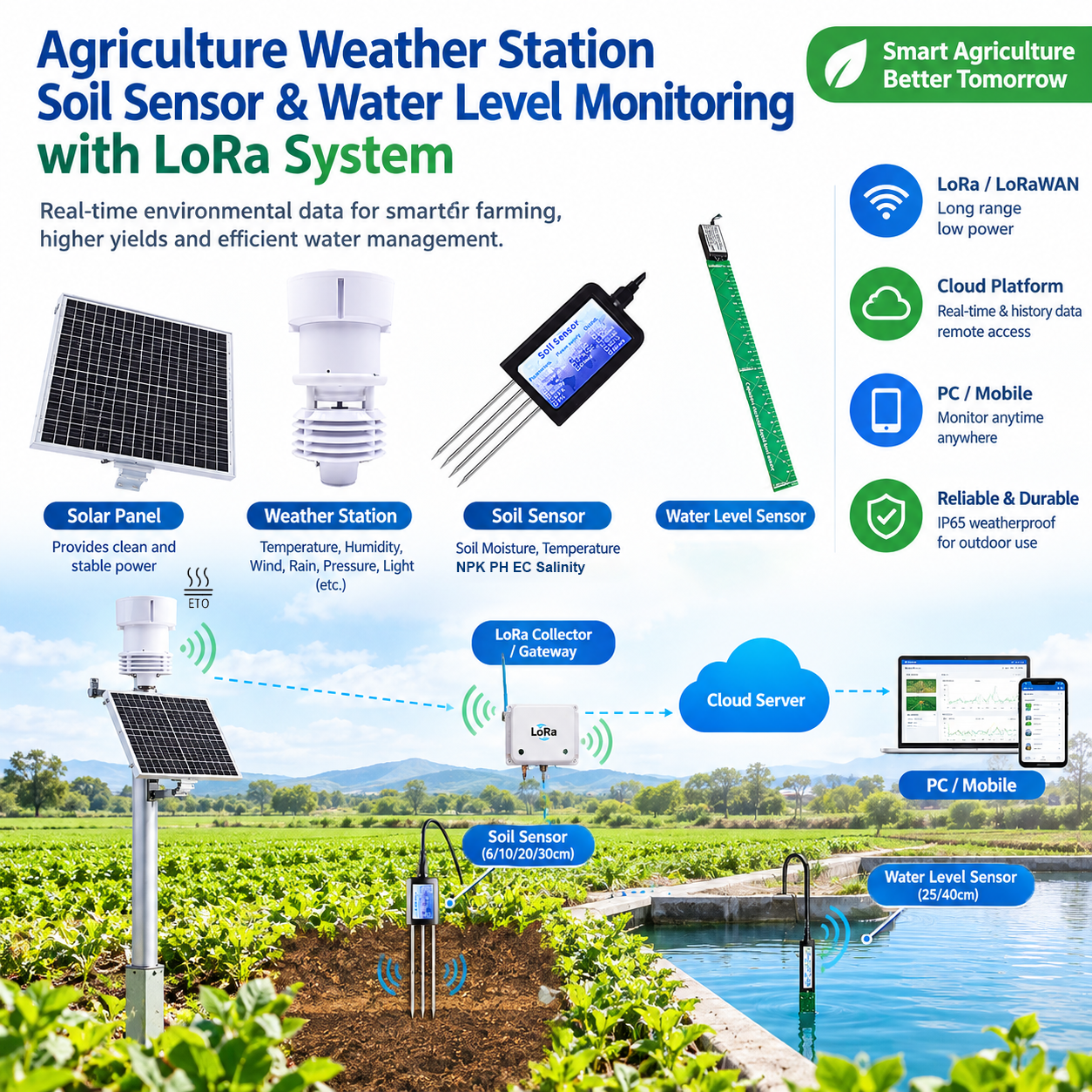
An agriculture weather station soil sensor and water level monitoring system with LoRa combines above-ground weather monitoring, root-zone soil sensing, water-resource monitoring, and long-range wireless communication into one smart agriculture IoT network. A typical architecture connects the weather station, soil sensors, and water level sensor to a LoRa data collector, then forwards the data through a LoRa gateway to cloud software for remote monitoring.
This integrated approach helps farms monitor weather conditions, soil moisture, irrigation water availability, and environmental changes from a centralized platform. It is especially useful for open-field agriculture, orchards, greenhouses, irrigation projects, agricultural research, reservoirs, and other remote monitoring applications.
System Architecture:
Weather Station + Soil Sensors + Water Level Sensor → LoRa Collector → LoRa Gateway → Cloud Server → PC / Mobile Phone
Why Combine Weather, Soil and Water Level Monitoring?
Traditional agricultural monitoring often treats weather, soil, and water resources as separate systems. However, these three factors are closely connected.
For example, soil moisture may decrease because of high temperature, strong solar radiation, low humidity, insufficient rainfall, or limited irrigation water. Looking at only one parameter makes it difficult to understand the complete situation.
An integrated monitoring system provides three levels of environmental information:
| Monitoring Layer | Typical Data | Agricultural Value |
|---|---|---|
| Weather | Temperature, humidity, wind, rainfall, pressure, radiation | Understand field climate |
| Soil | Moisture, temperature, EC, salinity and other selected parameters | Monitor root-zone conditions |
| Water | Reservoir, canal or tank water level | Understand irrigation water availability |
| Communication | LoRa / LoRaWAN | Wireless field data transmission |
| Cloud | Real-time and historical data | Remote monitoring and analysis |
This makes the system more useful for precision irrigation, crop management, water-resource management, and agricultural environmental monitoring.
How Does a LoRa Agriculture Monitoring System Work?
A LoRa-based agricultural monitoring system can be divided into several functional layers.
1. Sensor Layer: Collect Environmental Data
The first layer contains the field sensors.
A weather station can monitor selected atmospheric parameters such as:
- Air temperature
- Air humidity
- Wind speed
- Wind direction
- Rainfall
- Atmospheric pressure
- Light intensity
- Solar radiation
- PAR
The soil monitoring layer can be configured according to the crop and project requirements. Common measurements include:
- Soil moisture
- Soil temperature
- Soil EC
- Soil salinity
- Soil pH
- Soil nutrients
A water-level sensor can monitor irrigation reservoirs, agricultural tanks, canals, ponds, rivers, or other water resources.
The exact sensor combination should be selected according to the project environment rather than using every available parameter in every installation.
2. LoRa Collector: Connect Multiple Field Sensors
The LoRa collector acts as an important field data acquisition device.
Instead of giving every sensor an independent cellular connection, multiple monitoring devices can send data to a local LoRa collector or wireless network.
This creates a simpler architecture:
Multiple Sensors → LoRa Collector → Gateway → Internet → Cloud
For large farms, this architecture can reduce the amount of communication infrastructure required at individual monitoring points.
3. LoRa Gateway: Transfer Data to the Cloud
The LoRa gateway provides the connection between the field wireless network and the Internet.
Depending on the project design, the gateway can use communication methods such as 4G or Ethernet to forward collected information to a cloud server or monitoring platform.
Users can then access the data remotely using a computer, tablet, or mobile phone.
The actual communication range depends on factors such as terrain, antenna installation, obstacles, interference, and network configuration.
Why Is Soil Monitoring Important for Precision Agriculture?
Weather data describes what is happening above the ground. Soil sensors provide information about what is happening around the crop root zone.
This distinction is important.
For example, a weather station may detect high temperature and low humidity. However, the farm manager still needs to know whether the soil contains sufficient water.
A soil moisture sensor can provide direct information about the monitored soil layer.
The relationship can be simplified as:
Weather Conditions → Crop Water Demand
Soil Moisture → Root-Zone Water Condition
Water Level → Irrigation Water Availability
When these three data sources are analyzed together, agricultural managers can make more informed irrigation decisions.
For more advanced projects, additional soil parameters such as EC, salinity, pH, or nutrient-related measurements can be incorporated according to the crop and soil-management requirements.
How Does Water Level Monitoring Improve Agricultural Management?
Monitoring soil moisture alone does not tell the complete irrigation story.
Imagine an agricultural project where the soil moisture is low. Before starting irrigation, the operator may also need to know whether sufficient water is available in the reservoir or irrigation tank.
This is where water-level monitoring becomes valuable.
A water-level sensor can be used for:
- Irrigation reservoirs
- Agricultural water tanks
- Irrigation canals
- Ponds
- Rivers
- Aquaculture areas
- Other agricultural water resources
The data relationship becomes:
Water Level → Available Water
Soil Moisture → Soil Water Condition
Rainfall + Weather → Natural Environmental Conditions
Combining these measurements gives farm operators a broader understanding of agricultural water management.
Weather Station Monitoring for Smart Farming
A weather station is another important part of the system because crop growth is strongly influenced by local environmental conditions.
A compact agricultural weather station can provide information about temperature, humidity, wind, rainfall, pressure, radiation, and other selected environmental parameters.
For example:
High Temperature + Low Humidity + Low Soil Moisture
This combination may indicate increased crop water demand.
Recent Rainfall + High Soil Moisture
This combination may indicate that additional irrigation should be evaluated carefully.
Strong Wind + Low Humidity
This may provide useful information for field operations and environmental risk assessment.
The value of the weather station is therefore not simply the measurement of individual parameters. The real value comes from connecting weather information with soil and water data.
Key Advantages of a LoRa-Based Agriculture Monitoring System
A wireless architecture can provide several practical benefits for agricultural projects.
1. Long-Range Wireless Communication
LoRa is designed for low-power, long-range IoT communication, making it suitable for distributed agricultural sensors.
2. Reduced Field Wiring
Sensors can communicate wirelessly instead of requiring long communication cables from every monitoring point to a central control room.
3. Multi-Sensor Integration
A single monitoring architecture can incorporate weather stations, soil sensors, water-level sensors, and other agricultural devices.
4. Remote Monitoring
Collected information can be transferred to cloud software, allowing users to check field conditions remotely.
5. Scalable Architecture
A pilot project can start with a small number of monitoring points and later expand with additional sensors and monitoring zones.
6. Suitable for Remote Agricultural Areas
LoRa-based communication is particularly useful when sensors are distributed across large agricultural areas where traditional wired communication is inconvenient.
Typical Applications
The combination of weather station, soil sensor, water-level monitoring, and LoRa communication can be adapted to different agricultural scenarios.
| Application | Weather Monitoring | Soil Monitoring | Water Level | Main Purpose |
|---|---|---|---|---|
| Open-Field Agriculture | ✓ | ✓ | Optional | Precision irrigation |
| Orchard | ✓ | ✓ | Optional | Root-zone and microclimate monitoring |
| Greenhouse | ✓ | ✓ | Optional | Growing environment management |
| Irrigation Project | ✓ | ✓ | ✓ | Water-resource management |
| Agricultural Research | ✓ | ✓ | ✓ | Field data collection |
| Reservoir Monitoring | Optional | Optional | ✓ | Water-resource monitoring |
| Smart Farm | ✓ | ✓ | ✓ | Integrated IoT management |
The system is modular, so the final configuration can be customized according to crop type, farm size, sensor quantity, communication requirements, and monitoring objectives.
What Should You Consider Before Buying a LoRa Agriculture Monitoring System?
Choosing a monitoring system only by the sensor price can lead to problems later. B2B buyers should evaluate the complete system architecture.
1. Define the Required Parameters
First determine exactly what needs to be measured.
For example:
- Weather only
- Weather + soil
- Soil + water level
- Weather + soil + water level
- Additional water or environmental sensors
2. Consider Monitoring Locations
Sensor spacing, terrain, buildings, vegetation, and installation height can affect wireless communication.
3. Check the Communication Architecture
Clarify whether the project uses:
- LoRa
- LoRaWAN
- 4G
- Wi-Fi
- RS485
- MQTT
- Cloud API
The communication method should match the project’s field conditions and software requirements.
4. Plan for Future Expansion
A good agricultural IoT system should not only work for today’s sensors. It should also allow additional monitoring points or sensor types to be added later.
5. Evaluate the Complete System
For B2B projects, the sensor itself is only one part of the solution.
The complete system may include:
Sensors + Collector + Gateway + Communication + Cloud Platform + Installation + Technical Support
Evaluating the complete architecture can be more useful than comparing individual sensor prices.
Honde Technology’s Approach to Agricultural IoT Monitoring
Honde Technology Co., Ltd. develops sensing and IoT solutions for smart agriculture, environmental monitoring, and related applications.
Our agricultural monitoring architecture can integrate:
- Agricultural weather stations
- Soil moisture and temperature sensors
- Multi-parameter soil sensors
- Water-level sensors
- LoRa / LoRaWAN communication
- 4G wireless communication
- Data collectors and gateways
- Cloud monitoring systems
- Customized sensor configurations
The objective is to provide a flexible sensor-to-cloud monitoring solution rather than a single standalone sensor.
For different projects, customers can select the required monitoring parameters and communication architecture according to their application.
Frequently Asked Questions
What is an agriculture weather station soil sensor water level monitoring system?
It is an integrated agricultural IoT system that combines weather monitoring, soil sensing, water-level monitoring, and wireless communication. Data from different sensors can be collected through a LoRa network and transferred to a gateway or cloud platform.
Why use LoRa for agricultural monitoring?
LoRa is useful when sensors are distributed across agricultural fields and long-distance, low-power wireless communication is required. It can help reduce the need for extensive communication cabling.
Can a weather station and soil sensors use the same LoRa system?
Yes. A properly designed agricultural IoT network can connect weather stations, soil sensors, water-level sensors, and other compatible devices through a common LoRa/LoRaWAN communication architecture.
Can the system monitor irrigation water?
Yes. A compatible water-level sensor can be integrated to monitor reservoirs, tanks, canals, ponds, or other agricultural water resources.
Can more sensors be added later?
A modular architecture can be designed for future expansion. Additional soil, weather, water, or environmental sensors can be added according to the collector, gateway, and software capabilities.
Is the system suitable for large farms?
Yes. A distributed LoRa architecture can be used for multiple monitoring points across agricultural areas. The actual coverage and network design should be evaluated according to terrain, antenna position, obstacles, and project requirements.
Conclusion: From Individual Sensors to Integrated Smart Agriculture
An agriculture weather station, soil sensor, and water-level sensor each provide valuable information. However, the real advantage comes from connecting them into one wireless monitoring architecture.
Weather Station + Soil Sensor + Water Level Sensor + LoRa Collector + Gateway + Cloud
This architecture provides a more complete view of the agricultural environment—from atmospheric conditions above the crop canopy, to moisture conditions around the roots, to water availability in irrigation infrastructure.
For farms, orchards, greenhouses, irrigation projects, and agricultural research, this integrated approach can provide a scalable foundation for precision agriculture, smart irrigation, remote environmental monitoring, and IoT-based farm management.
If you are planning an agricultural monitoring project, Honde Technology can help configure the sensor combination, wireless communication, data collection, and monitoring architecture according to your application.
Get a customized agricultural IoT monitoring solution from Honde Technology.
Company Name: Honde Technology Co., Ltd.
Website: www.hondetechco.com
Email: info@hondetech.com
Post time: Oct-08-2026