

Quick Answer
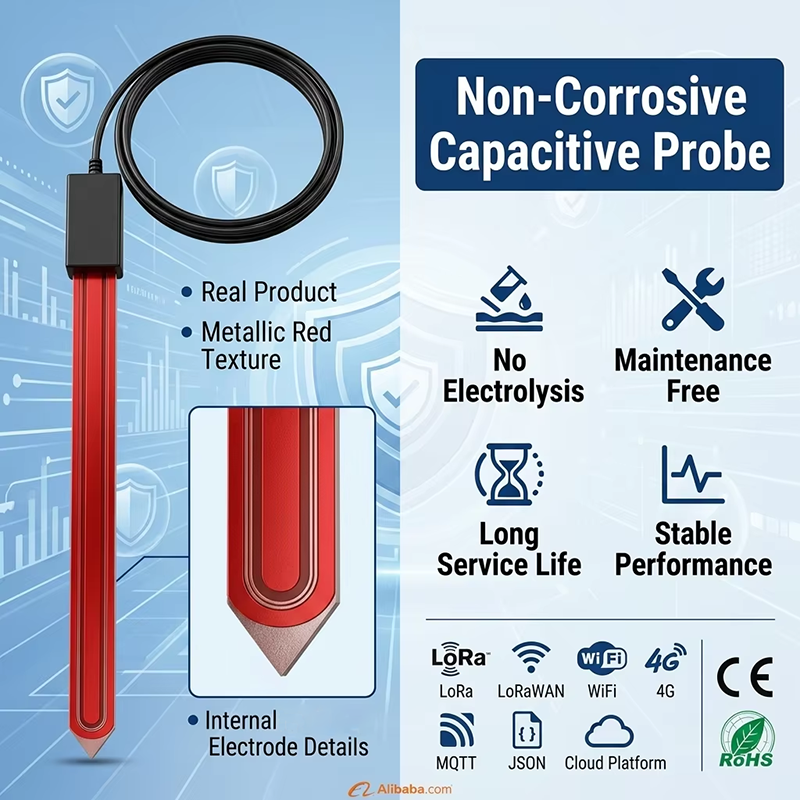
If you are looking for a reliable soil moisture monitoring solution, a Capacitive Soil Moisture Sensor is one of the best choices available today. Unlike traditional resistive sensors, capacitive sensors do not rely on exposed metal electrodes, making them more stable, corrosion-resistant, and suitable for long-term outdoor deployment.
For professional applications, choose a sensor with IP68 waterproof protection, RS485 Modbus communication, optional analog outputs (0–3V, 0–5V, 0–10V, 4–20mA), and wireless connectivity such as LoRa, LoRaWAN, WiFi, or 4G. These features ensure accurate monitoring for precision irrigation, greenhouse automation, environmental monitoring, and smart agriculture.
Why Soil Moisture Monitoring Matters
Water management has become one of the biggest challenges in modern agriculture. Over-irrigation wastes water and fertilizer, while under-irrigation reduces crop yield and quality.
Real-time soil moisture monitoring allows growers to:
- Optimize irrigation schedules
- Reduce water consumption
- Improve fertilizer efficiency
- Increase crop yield
- Prevent root diseases
- Lower labor costs
With the rise of IoT-based smart farming, soil moisture sensors have become a fundamental component of intelligent irrigation systems.
What Is a Capacitive Soil Moisture Sensor?
A capacitive soil moisture sensor measures the volumetric water content of soil by detecting changes in its dielectric constant.
Water has a much higher dielectric constant than air or dry soil. As soil moisture changes, the sensor detects variations in capacitance and converts them into accurate electrical signals.
Unlike resistive sensors, capacitive sensors do not pass electrical current through the soil. This design prevents electrode corrosion and significantly improves long-term stability.
Capacitive vs. Resistive Soil Moisture Sensors
| Feature | Capacitive Sensor | Resistive Sensor |
|---|---|---|
| Accuracy | Excellent | Medium |
| Long-Term Stability | Excellent | Fair |
| Electrode Corrosion | No | Yes |
| Waterproof Performance | IP68 Available | Limited |
| Maintenance | Very Low | High |
| Service Life | Long | Short |
| Precision Irrigation | Highly Recommended | Basic Applications |
For commercial agriculture and industrial monitoring projects, capacitive technology is generally the preferred option.
Key Features You Should Look For
1. High Accuracy Measurement
Reliable irrigation decisions require accurate data.
A professional capacitive sensor should provide:
- High sensitivity
- Stable calibration
- Excellent repeatability
- Low drift
- Fast response
Accurate measurements reduce irrigation errors and improve crop consistency.
2. IP68 Waterproof Protection
Agricultural sensors often remain buried underground for years.
A true IP68 design provides:
- Complete waterproof sealing
- Underground installation
- Rain and flood resistance
- Long outdoor service life
This greatly reduces maintenance costs.
3. Anti-Corrosion Technology
Traditional resistive probes gradually corrode because current flows directly through the electrodes.
Capacitive sensors eliminate this problem.
Benefits include:
- No electrolysis
- Stable long-term readings
- Longer lifespan
- Better return on investment
4. Multiple Output Interfaces
Industrial users often require different communication methods.
Common output options include:
- RS485 Modbus RTU
- 0–3V
- 0–5V
- 0–10V
- 4–20mA
These outputs integrate easily with:
- PLC controllers
- Data loggers
- Weather stations
- Irrigation controllers
- Environmental monitoring systems
5. Wireless IoT Integration
Smart farming increasingly depends on remote monitoring.
Modern soil moisture sensors should support:
- LoRa
- LoRaWAN
- WiFi
- 4G LTE
Communication protocols include:
- MQTT
- JSON
This enables remote monitoring via cloud dashboards and mobile applications.
Typical Applications
Capacitive soil moisture sensors are widely used in:
These applications benefit from accurate, real-time soil moisture data.
Common Mistakes Buyers Make
Many buyers focus only on price.
However, the lowest-cost sensor often results in higher maintenance expenses.
Before purchasing, verify:
- Waterproof rating
- Measurement technology
- Output compatibility
- Communication protocol
- Sensor calibration
- Manufacturer experience
- Technical support
- Product certifications
Selecting the right supplier can significantly reduce long-term operating costs.
Our Engineering Experience
At Honde Technology Co., Ltd., we have specialized in environmental monitoring equipment for more than a decade.
Our engineering team has supplied thousands of monitoring systems to customers in agriculture, meteorology, environmental protection, water resources, and industrial automation.
Based on feedback from global projects, we have found that customers often overlook installation depth, soil type calibration, and communication compatibility during system design.
Helping customers avoid these common issues is one of the reasons many international partners choose Honde Technology.
Why Choose Honde Technology?
We provide complete monitoring solutions instead of only individual sensors.
Our advantages include:
Complete IoT Monitoring Solution
Our capacitive soil moisture sensor can be integrated into a complete monitoring system.
Typical architecture:
This architecture enables real-time remote monitoring anywhere in the world.
Frequently Asked Questions
Which sensor is better, capacitive or resistive?
Capacitive sensors provide better stability, longer lifespan, and higher accuracy.
Can the sensor remain buried underground?
Yes. Our IP68 waterproof design supports long-term underground installation.
Does it support wireless monitoring?
Yes. Optional communication methods include:
- LoRa
- LoRaWAN
- WiFi
- 4G
Cloud communication supports MQTT and JSON protocols.
Which output should I choose?
RS485 Modbus RTU is recommended for most industrial automation projects.
Analog outputs are suitable for legacy control systems.
Which industries commonly use soil moisture sensors?
Typical industries include:
- Agriculture
- Greenhouse
- Environmental Monitoring
- Forestry
- Landscaping
- Scientific Research
- Water Conservancy
Conclusion
Choosing the right capacitive soil moisture sensor is not only about measurement accuracy but also about long-term reliability, waterproof protection, communication compatibility, and technical support.
For professional agricultural monitoring projects, selecting an experienced manufacturer can significantly improve system performance and reduce maintenance costs over the product’s lifetime.
If your project requires industrial-grade soil moisture monitoring with wireless connectivity and cloud integration, a capacitive sensor is an excellent long-term investment.
Get a Custom Quote Today
Whether you are building a smart irrigation system, greenhouse automation project, environmental monitoring network, or precision agriculture solution, our engineering team is ready to help.
We provide:
- Product Selection Support
- OEM & ODM Manufacturing
- Technical Consultation
- Complete IoT Monitoring Solutions
- Fast Quotation
- Worldwide Shipping
Contact Us
Company Name: Honde Technology Co., Ltd.
Website: www.hondetechco.com
Email: info@hondetech.com
Contact our team today to receive the latest catalog, technical datasheets, and a customized quotation for your next project.
Post time: Jul-01-2026