

In construction sites, open-pit mines, or large smelters, scorching environments not only cause physical discomfort but are also hidden killers in occupational health management. Many site managers still habitually refer to ordinary air temperatures, but this often creates a “false sense of security.”
Simply relying on air temperature ignores the impact of humidity, thermal radiation, and wind speed on the human body’s thermal balance. The truly scientific metric is WBGT (Wet Bulb Temperature). However, how can this complex scientific data be translated into operational instructions that frontline workers and safety supervisors can understand and execute instantly? As an expert in the Industrial Internet of Things, I believe that this WBGT monitoring system, which integrates modern sensing technology and intuitive early warning logic, is precisely addressing the pain point of the “last mile” in industrial site safety decision-making.
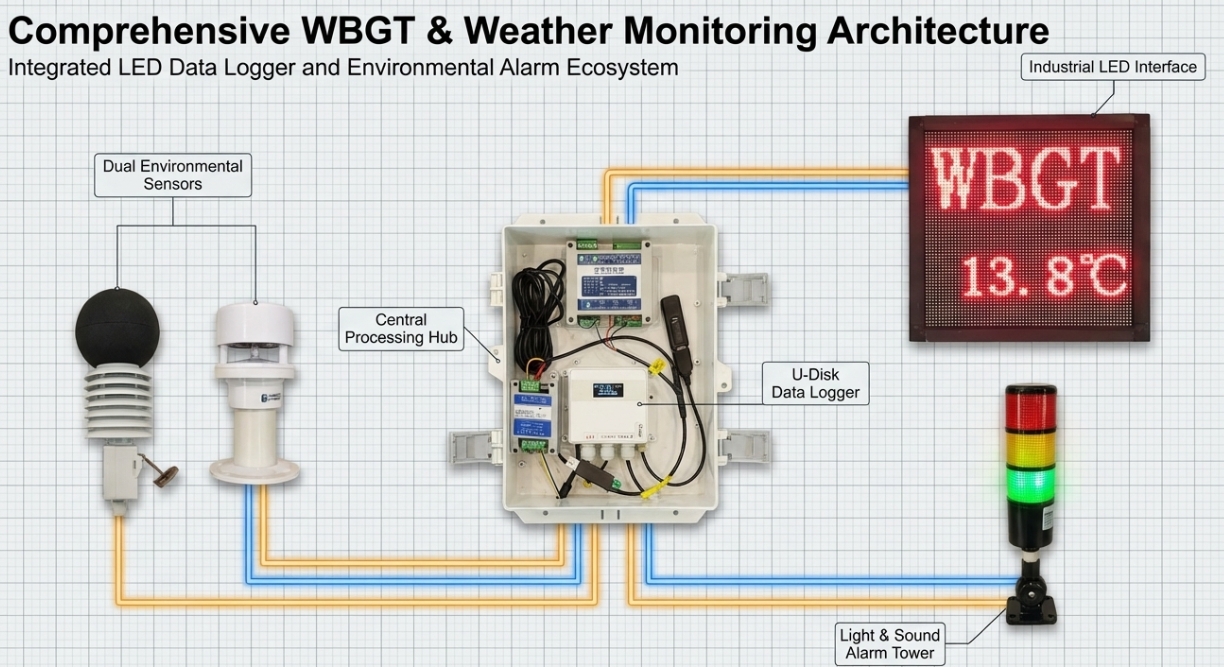
Key Highlight 1: Highly Integrated “One-Stop” Power Management
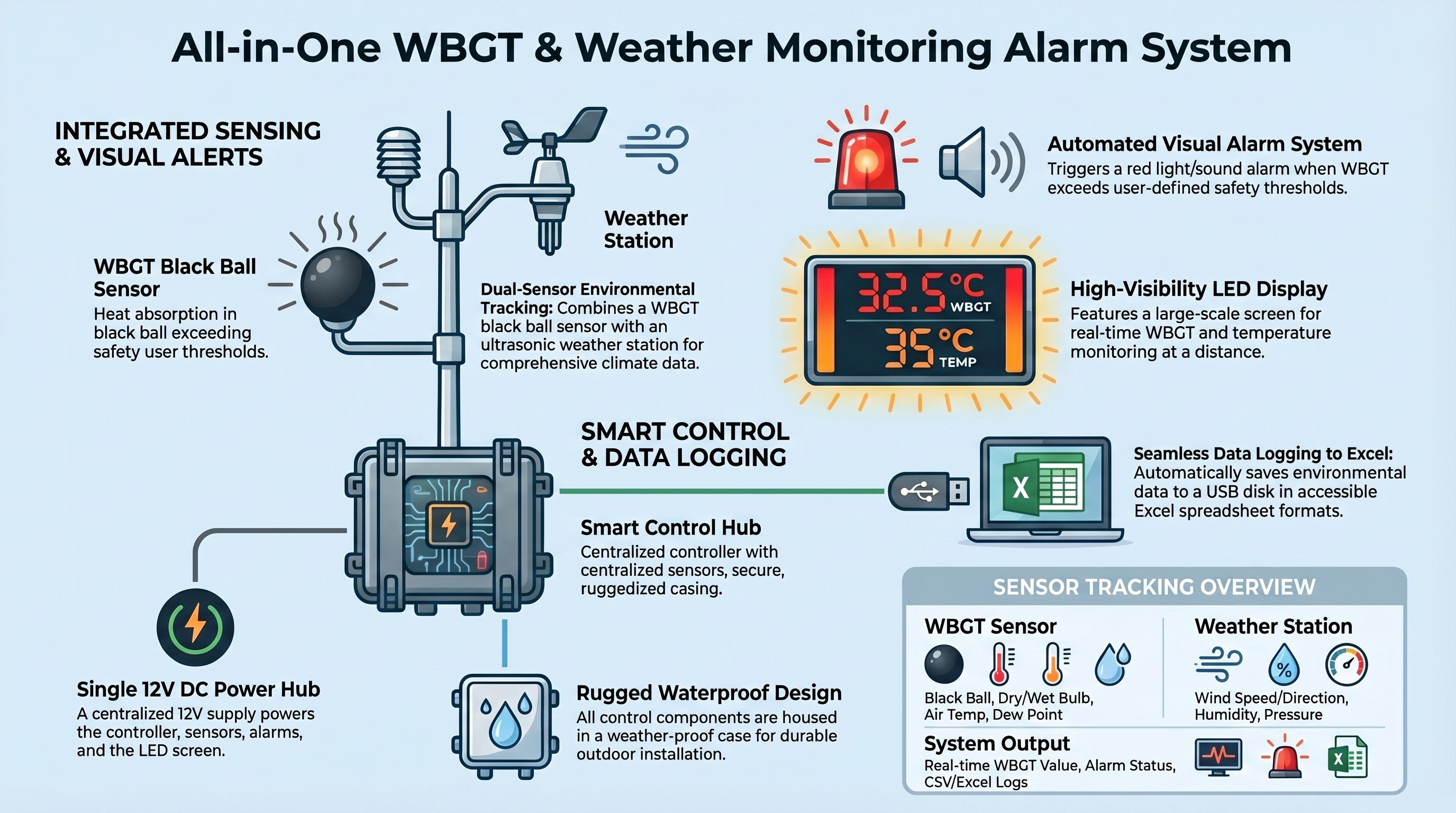
In complex industrial construction or field operation environments, powering multiple devices is often a nightmare for system deployment due to wiring costs and environmental limitations. This system showcases highly practical industrial design logic: employing a single 12V DC power supply. The most ingenious design lies in its power flow—the power supply first connects to the LED screen, and then the screen powers the core controller via an internal interface, achieving a “series drive” for the entire system. This minimalist power solution, combined with a robust waterproof chassis, significantly reduces the deployment difficulty of the system in temporary infrastructure projects.
This integrated approach not only simplifies on-site cable management but also reduces potential points of failure, which is crucial for industrial environments requiring high stability.
Key Highlight Two: Comprehensive Weather Sensing — WBGT and Ultrasonic Technology
This system is called the “Invisible Guardian” because of the multi-dimensional environmental profile it constructs. It’s not a single sensor, but rather composed of two complementary precision modules:
Five-in-one WBGT Sensor
Centered around the iconic black bulb thermometer, this single module integrates black bulb temperature, dry bulb temperature, wet bulb temperature, air temperature, and dew point temperature. This high level of integration ensures absolute accuracy in thermobaric index calculations.
Compact Ultrasonic Weather Station
Monitors wind speed, wind direction, temperature, humidity, and atmospheric pressure in real time.
Of particular note is its use of ultrasonic technology in the weather station. Compared to traditional mechanical anemometers, ultrasonic sensors have no internal mechanical rotating parts. In dusty environments such as mines and construction sites, this not only means higher accuracy but also a long-term “maintenance-free” advantage—data drift is prevented by bearing wear or dust blockage.
Furthermore, a small LCD secondary screen is embedded inside the waterproof enclosure. This provides field technicians with a highly convenient diagnostic window, allowing them to verify the raw data from both sensors in real time during maintenance without needing to access complex external networks.
Key Highlight 3: Intuitive Alarm Logic Based on Modbus Protocol
In noisy work environments, numbers often prove ineffective. This system employs a highly intuitive “traffic light” alarm mechanism, translating complex WBGT scientific values into action commands.
Using the accompanying Modbus software (with an RS485 to USB converter), administrators can precisely set alarm thresholds. For example:
When the WBGT value is below the set value (e.g., 30.9°C), the system displays a green light, indicating the environment is under control.
Once the value exceeds the threshold (e.g., reaching 31°C or higher), the red light immediately illuminates, accompanied by an audible and visual alarm.
This software configuration based on the Modbus industrial protocol ensures accurate settings and system stability. It doesn’t just indicate “heat,” but rather uses visual signals to forcefully raise the safety awareness of on-site personnel.
Key Highlight 4: Data Storage Solution to Mitigate Network Risks
In the era of the Internet of Things, this system retains a seemingly “back-to-basics” yet highly industrially intelligent solution: local storage via USB flash drive.
System data is written directly to the USB flash drive in Excel format. For many large industrial enterprises or sensitive infrastructure projects, this offers two core values:
Many industrial sites strictly prohibit unauthorized devices from connecting to Wi-Fi or the company intranet. The USB flash drive solution perfectly avoids network configuration challenges and potential hacker attack risks.
Timestamped Excel logs are the “gold standard” for legal audits and occupational health records. Safety managers can obtain tamper-proof raw environmental data simply by periodically reading the USB flash drive, providing authoritative evidence for heatstroke prevention allowance payments or heatstroke claims.
Key Highlight 5: Flexible Industrial Scalability (RS485 and PLC)
This is not just a standalone alarm station, but also a scalable industrial IoT node.
The system provides standard RS485 A/B interfaces and RF output interfaces. This means that enterprises can easily integrate it into their existing industrial automation architecture:
Through the RS485 interface, WBGT data can be uploaded to the central control system’s PLC in real time. When thermal stress exceeds limits, the PLC can automatically trigger automatic sprinkler cooling equipment or turn on industrial fans, achieving a leap from “monitoring” to “closed-loop control.”
Supports external wireless modules, transmitting data to project management departments several kilometers away.
Conclusion: A Data-Driven Future for Occupational Health
This WBGT intelligent monitoring system demonstrates that true industrial IoT devices should not be mere accumulations of complex technologies, but rather powerful tools for solving practical problems. Through simplified 12V power management, maintenance-free ultrasonic technology, USB flash drive storage that avoids network pitfalls, and strong PLC compatibility, it builds a scientific defense line for workers operating in harsh environments.
With extreme heat becoming increasingly commonplace, are our factories and construction sites prepared for this kind of “visible” safety? This is not just about technological upgrades, but also about respect for life and health.
For more weather station information, please contact Honde Technology Co., LTD.
WhatsApp: +86-15210548582
Email: info@hondetech.com
Company website: www.hondetechco.com
Post time: Apr-14-2026