

The 2026 standard for mobile IoT wind sensing requires solid-state, ultrasonic technology housed in ultra-compact form factors (45mm to 57mm). These sensors must eliminate moving parts for maintenance-free durability in high-vibration mobile deployments while integrating E-compass and GPS modules to provide precision true wind data. Support for NMEA and MQTT/JSON protocols is essential for seamless Edge AI and telematics integration.
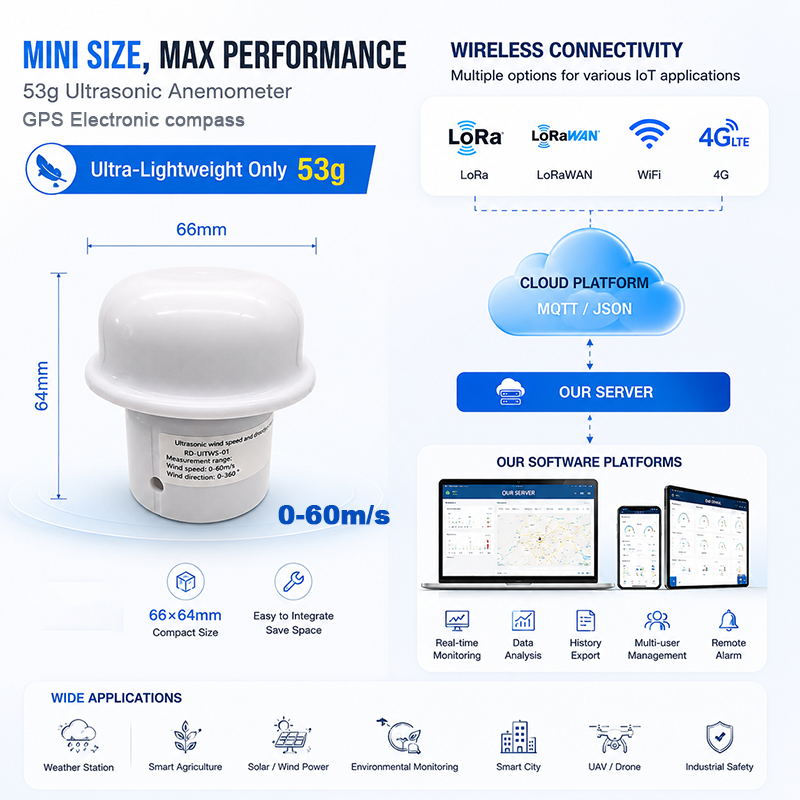
Why Ultrasonic Technology Over Mechanical Sensors?
In the evolving landscape of industrial and mobile IoT, the transition from mechanical to ultrasonic technology is driven by the need for absolute reliability in high-vibration mobile deployments and extreme thermal cycles.
Unlike traditional mechanical cup-and-vane anemometers, ultrasonic sensors are solid-state with no moving parts. This eliminates mechanical wear and the need for periodic lubrication, ensuring a significantly longer operational lifespan in the field.
From an engineering perspective, a critical advantage is the placement of the internal ultrasonic probes. These probes are protected within the sensor housing, rendering them immune to environmental accretion such as rain or snow. This ensures that the sensor maintains high accuracy during the extreme winter conditions that typically cause mechanical sensors to freeze or seize.
The Advantage of Miniaturization: 45mm vs. 57mm Form Factors
Spatial constraints are a primary hurdle when integrating sensing arrays into modern mobile platforms. To address this, industrial-grade ultrasonic sensors are now engineered in two specialized mini form factors to suit specific spatial profiles:
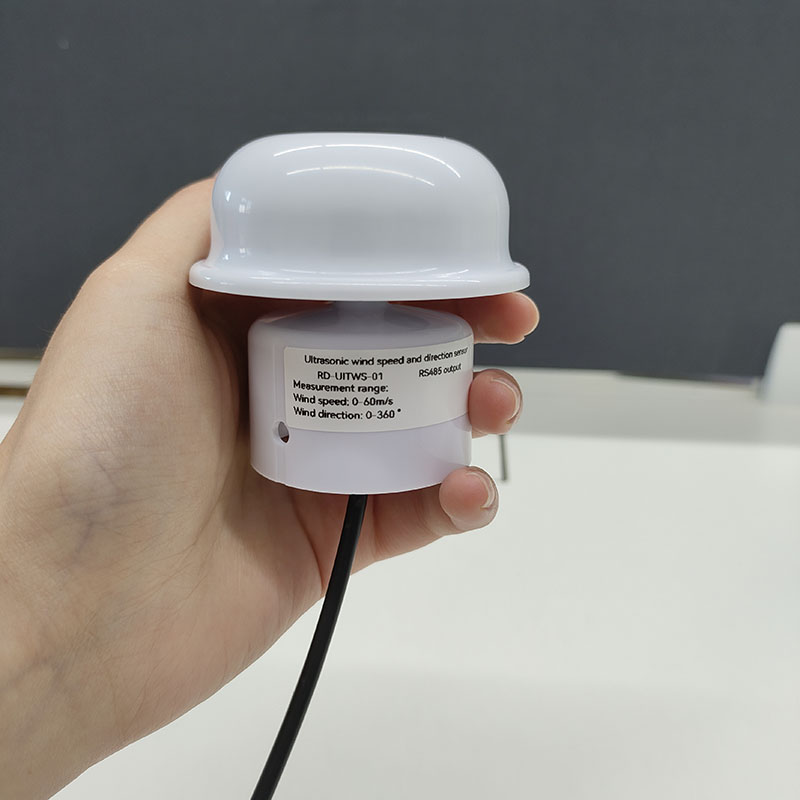
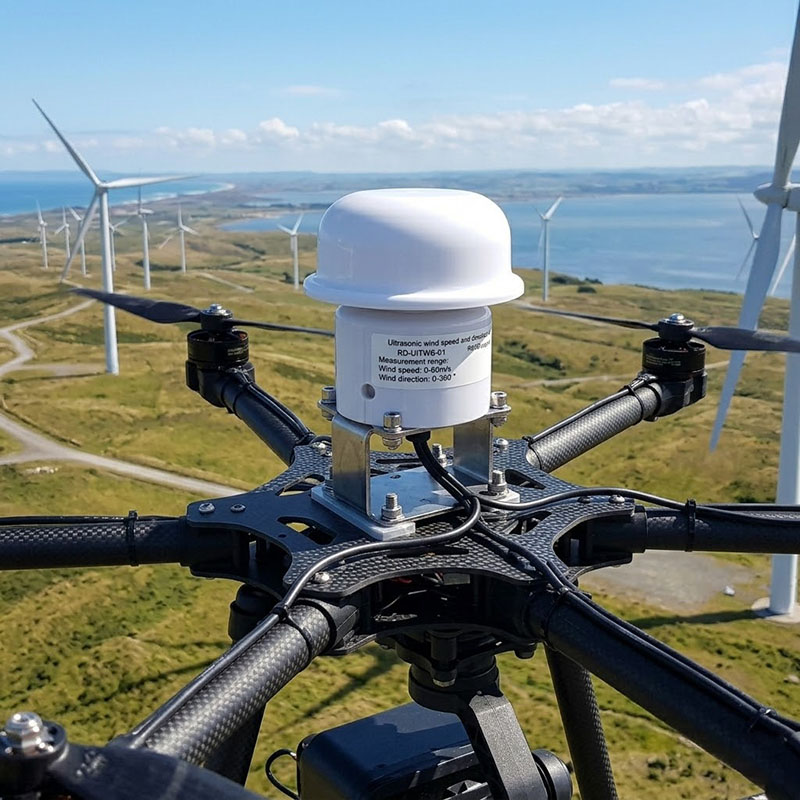
Unmanned Aerial Vehicles (UAVs): The 45mm model is specifically optimized for drone payload constraints, offering a reduced spatial profile and lightweight build that preserves battery life and aerodynamic stability.
Automotive & Transit (Buses/Cars): The compact dimensions allow for low-profile mounting on vehicle roofs or seamless integration into existing telematics architectures.
Compact Enclosures: Ideal for specialized industrial machinery, narrow robotic corridors, or cramped outdoor monitoring stations where traditional equipment is non-viable.
Feeding the AI: Technical Specifications & Protocol Comparison
For engineers designing Edge AI or automated telematics systems, the following specifications summarize the technical capabilities of Honde Technology’s miniaturized sensor lineup:
| Feature | Specification/Detail |
| Measurement Range | 0-60 m/s |
| Output Protocols | RS485 (Standard Modbus), RS232, SDI-12, NMEA |
| Integration Options | Built-in GPS, E-compass, Lora, 4G, WiFi |
| Data Formats | MQTT, JSON, Hex |
| Power Requirement | 12V DC (Power adapter included) |
| Standard Cable | Customizable up to 20m |
| Included Hardware | RS485-to-USB Tester, Mounting Screws, Power Adapter |
Engineering Insights: Solving the “True Wind” Challenge on Moving Platforms
As an engineer specializing in mobile IoT, I have found that the most complex variable in wind measurement is accounting for the motion of the mounting platform itself. When a sensor is mounted on a moving drone or vehicle, the raw data collected is “apparent wind”—a vector sum of the actual ambient wind and the velocity of the vehicle.
By utilizing sensors with integrated E-compass and GPS modules, we can solve this through real-time vector subtraction. The GPS provides the vehicle’s ground speed and heading, while the E-compass tracks the sensor’s orientation relative to magnetic north. The internal processor uses these inputs to calculate and output true wind speed and true wind direction automatically via the NMEA protocol—the gold standard for marine and mobile data integration.
During field commissioning, I highly recommend the configuration featuring the integrated LCD screen and data logger. Beyond simple monitoring, the LCD serves as a critical tool for the field calibration of the E-compass and GPS, allowing you to verify longitude, latitude, and true wind vectors on-site before finalizing your cloud data stream.
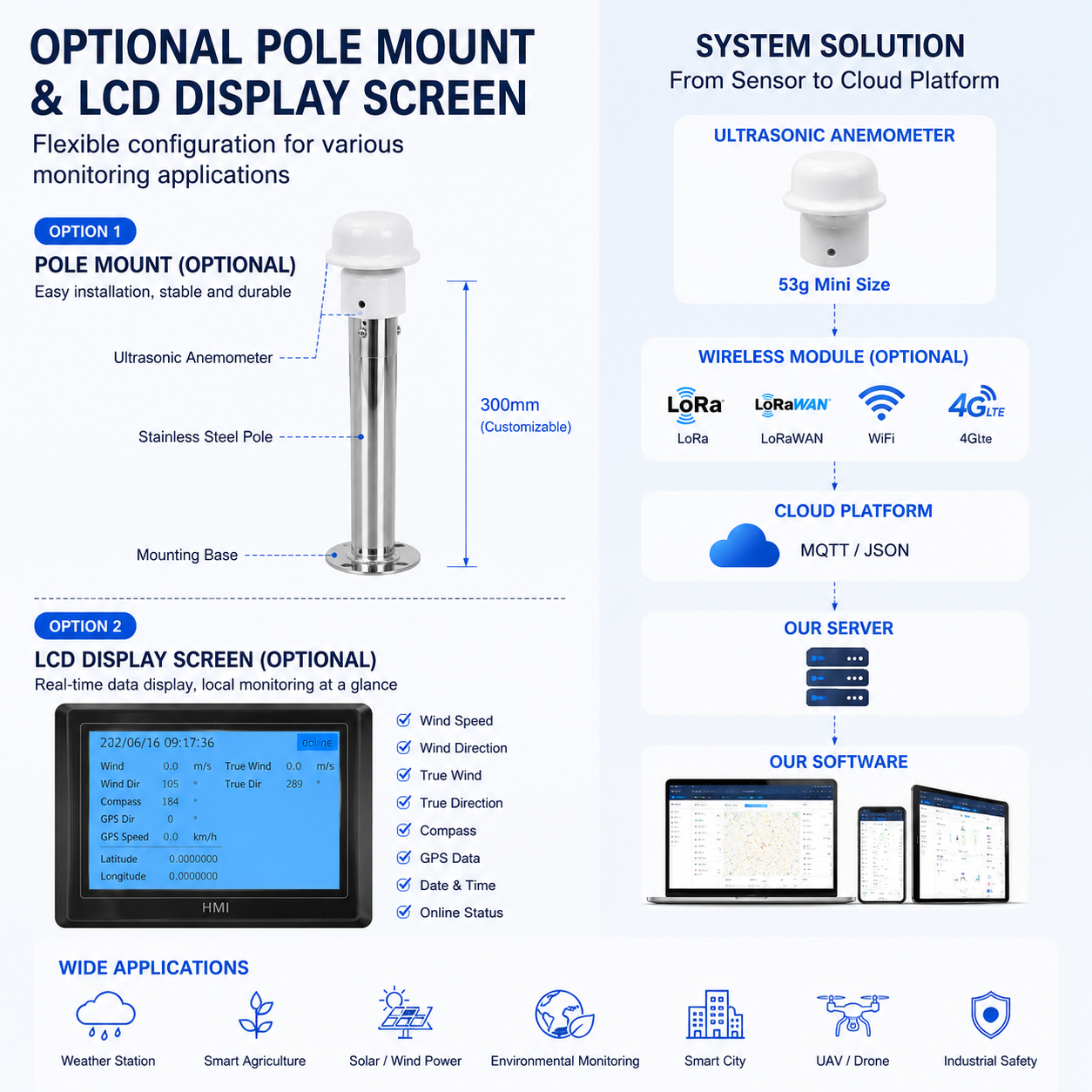
Installation and Connectivity: A Step-by-Step Technical Guide
Integrating the mini ultrasonic sensor into a fixed or mobile architecture follows a rigorous technical procedure:
- 1
Power Infrastructure: Provide a stable 12V DC power source using the included power adapter.
- 2
Interface Wiring:
- Connect VCC (Positive) and GND (Negative) to the power supply.
- Connect the A and B lines to the corresponding RS485 terminals on your PLC, IoT gateway, or the provided LED display.
- 3
Physical Integration:
- Route the communication cable (available in lengths up to 20m) through the internal cavity of the standpole.
- Seat the sensor onto the pole and secure it using the provided screws to ensure a rigid, vibration-resistant connection.
- 4
Signal Verification: Use the provided RS485-to-USB connector to interface with a PC. This allows you to verify the MQTT/JSON data packets or NMEA strings before the final deployment.
Conclusion
Honde Technology’s miniaturized ultrasonic sensors represent a significant evolution for engineers requiring high-precision wind data in ultra-small form factors. Whether you are optimizing UAV flight paths, enhancing vehicle telematics, or monitoring narrow industrial corridors, these solid-state sensors provide the durability and integrated intelligence required for the data-driven demands of 2026.
Download the detailed specs sheet to identify the optimal diameter for your deployment, or contact our engineering team for a custom MQTT/JSON integration quote to streamline your cloud architecture.
- Company Name: Honde Technology Co., Ltd.
- Website: www.hondetechco.com
- Email: info@hondetech.com
Post time: Jun-17-2026