

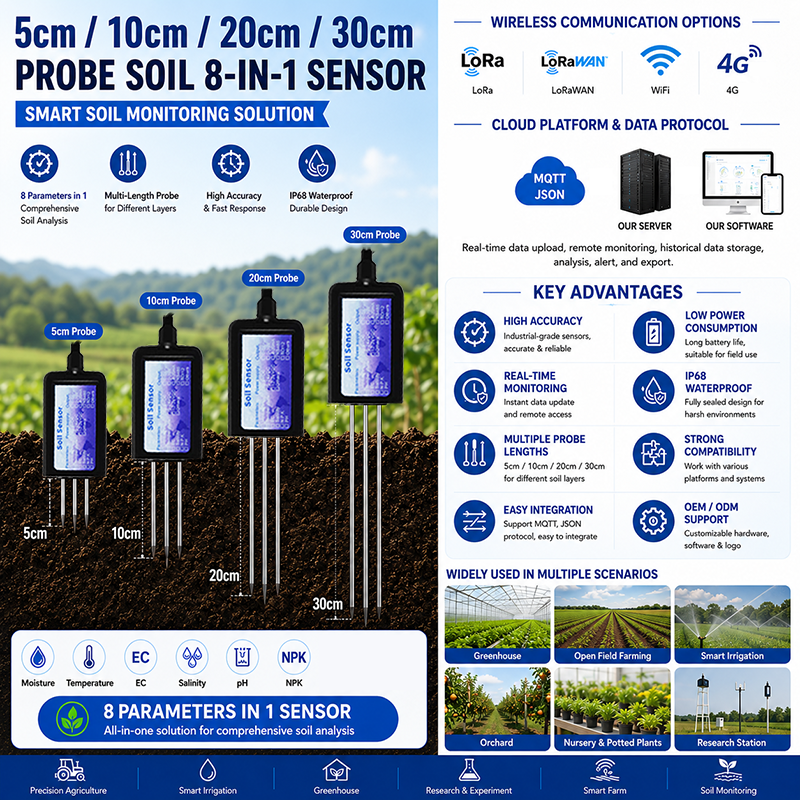
To optimize soil profile characterization, probe length must align with the specific root zone depth of your crop, typically ranging from 5cm to 30cm. Note that Honde Technology sensors exclusively measure data at the sensor head (tip) to ensure depth-specific accuracy rather than a column average. Our industrial-grade 8-in-1 sensors capture Moisture, Temperature, EC, Salinity, pH, Nitrogen (N), Phosphorus (P), and Potassium (K) in a single insertion, facilitating comprehensive subsurface nutrient analysis for precision agriculture.
Soil Layer Monitoring and Subsurface Nutrient Analysis: Why One Size Doesn’t Fit All
In precision soil science, accuracy depends on “Entity Matching”—the practice of ensuring a sensor’s physical reach aligns with the biological activity of the plant. A standard 5cm probe is effective for surface-level readings; however, it cannot capture the critical data required for deeper root architectures.
A vital technical distinction for field engineers is that these probes are designed to measure the environment specifically at the sensor head part. This allows for precise “point-in-depth” analysis. By utilizing 10cm, 20cm, and 30cm probes, managers can perform accurate subsurface nutrient analysis in diverse environments, from nurseries to orchards, where nutrients like Nitrogen and Potassium may leach into deeper soil layers beyond the reach of standard equipment.
Comparison of Probe Lengths and Professional Applications
The following data structure maps specific probe lengths to their optimized B2B scenarios and technical advantages.
Technical Core: The 8-in-1 Integrated Sensing Technology
Honde Technology’s integrated sensors are engineered for high-accuracy industrial use, providing near-instantaneous response times to environmental fluctuations. [View our full NPK Sensor Catalog] to see how our hardware manages these eight critical parameters:
Connectivity & Data Access: From Handheld to Cloud
To meet the demands of modern Smart Farm integration, our sensors support a wide array of industrial protocols and hardware interfaces.
On-site Monitoring
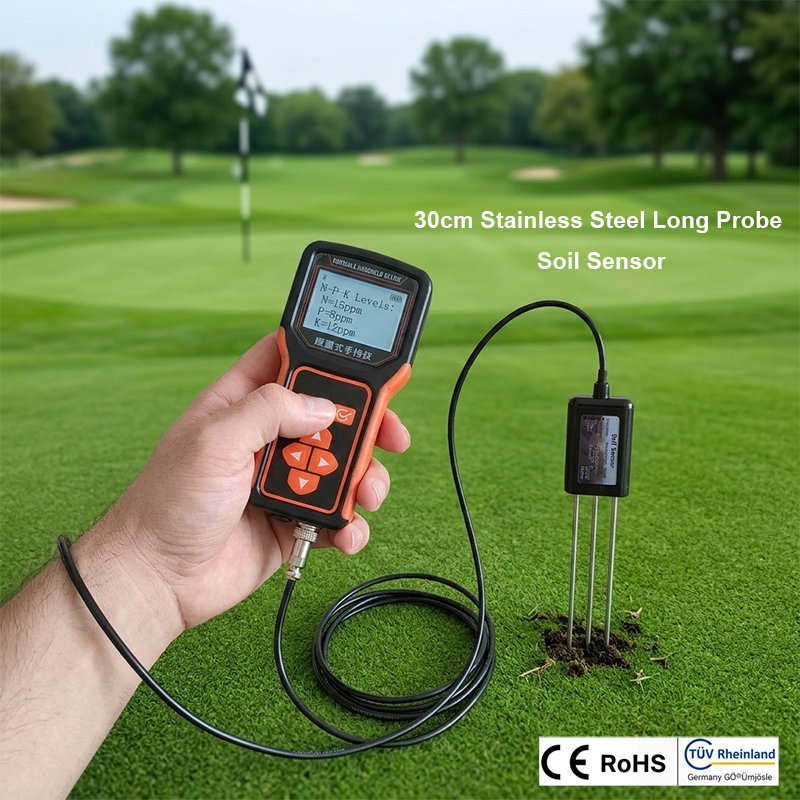
For real-time field diagnostics, we provide a Handheld Data Logger (Handmeter). This allows operators to insert a 30cm probe—ideal for golf course greens—and view NPK levels immediately on a portable display. Furthermore, our sensors feature Type-C connection compatibility, enabling direct data visualization via a mobile app for instant field checks.
Remote Cloud Integration
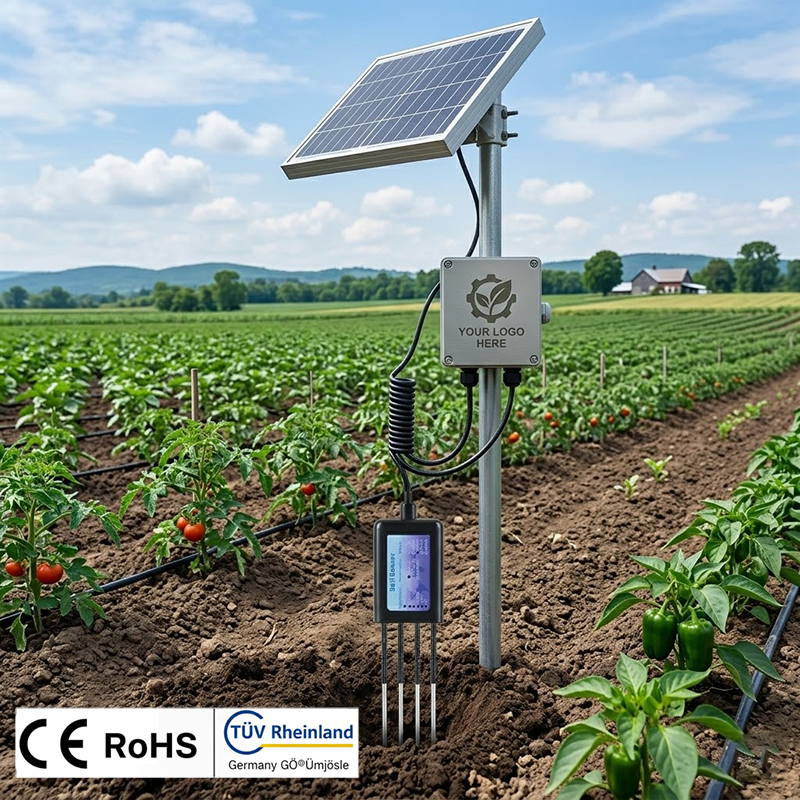
For large-scale infrastructure, the sensors utilize RS485 (Modbus-RTU) via rugged waterproof connectors. To support advanced IoT architectures, our systems fully support MQTT and JSON protocols for seamless data upload to private or cloud-based servers. [Explore Wireless Monitoring Solutions for Smart Farms] including:
- LoRa and LoRaWAN (Long-range, low-power)
- WiFi, 4G, and GPRS (High-bandwidth, real-time telemetry)
The Experience Factor: Built for Harsh Environments
In our manufacturing experience, the engineering challenge of a 30cm probe lies in maintaining high signal-to-noise ratios across eight parameters while ensuring structural integrity. We have solved this by utilizing 316 stainless steel for the probes, offering superior corrosion resistance even in high-salinity “Research Station” environments.
Our hardware carries the TÜV Rheinland certification—a global benchmark for safety and quality—alongside CE and RoHS ratings. With an IP68 waterproof rating, these sensors are designed to be fully buried or submerged for long-term soil profile monitoring without degradation. [Guide to IP68 Rated Agricultural Hardware].
Implementation Checklist: Before You Buy
Use this checklist to finalize your hardware specifications for large-scale procurement:
Conclusion
Selecting the correct probe length is a foundational requirement for effective precision agriculture. Honde Technology provides the customized hardware necessary to move beyond surface-level data and into deep-layer soil intelligence.
Contact our engineering team for a custom quote or technical specification sheet:
Honde Technology Co., Ltd.
Website: www.hondetechco.com
Email: info@hondetech.com
Post time: Jun-08-2026