

Why Solar Radiation Monitoring Matters in PV Power Plants
A PV power plant does not generate electricity based on solar panel specifications alone. Actual energy production is strongly influenced by the solar irradiance received by the photovoltaic array.
Reliable solar radiation data can support:
- PV performance monitoring
- Energy yield analysis
- Performance Ratio evaluation
- Solar resource assessment
- System fault analysis
- Operation and maintenance
- Long-term environmental monitoring
- Solar power forecasting
IEC 61724-1:2021 provides terminology, equipment guidance, and methods for photovoltaic system performance monitoring and analysis, including updated requirements related to irradiance sensors.
This makes the solar radiation sensor an important part of the environmental monitoring layer in a professional PV monitoring system.
What Is a Class A B C Pyranometer?
A pyranometer measures solar irradiance over a specified spectral range and is widely used for solar energy applications.
Under ISO 9060:2018, pyranometers are classified according to their performance characteristics. The appropriate class depends on the required measurement quality and the intended application.
For PV projects, buyers should therefore avoid choosing a sensor based only on the words “high accuracy.” Instead, they should evaluate the actual pyranometer classification, calibration, stability, response characteristics, installation conditions, and communication interface.
Class A vs Class B vs Class C
| Pyranometer Class | Typical Position | Recommended Application | Key Consideration |
|---|---|---|---|
| Class A | Highest-performance applications | PV research, advanced solar monitoring, high-accuracy measurement | Higher measurement performance and stricter requirements |
| Class B | Professional industrial monitoring | Commercial PV plants, solar resource assessment, weather stations | Balance between performance and cost |
| Class C | General monitoring | Basic solar radiation and environmental monitoring | Cost-effective monitoring solution |
Important: The exact performance of a sensor should always be verified from its datasheet and calibration documentation rather than inferred from the class name alone.
ISO also provides recommended practices for pyranometer use in solar energy applications, including PV testing and performance monitoring.
Class A, B or C: Which Solar Radiation Sensor Should You Choose?
The right sensor depends on the purpose of your PV monitoring system.
CLASS A Choose Class A When Measurement Quality Is the Priority
Class A instruments are suitable when high-quality solar radiation measurements are required.
Typical applications include:
- Solar research
- PV performance testing
- Advanced solar resource assessment
- Reference monitoring
- Professional energy analysis
For projects where measurement uncertainty has a significant impact on financial or engineering decisions, a higher-performance pyranometer can be justified.
CLASS B Choose Class B for Professional PV Monitoring
Class B can provide a practical balance between measurement performance and project cost.
It can be considered for:
- Utility-scale PV plants
- Commercial solar farms
- Solar monitoring stations
- Renewable energy projects
- Professional weather stations
For many commercial projects, Class B can be an attractive option when the project requires reliable irradiance monitoring without the full cost of the highest-performance instrumentation.
CLASS C Choose Class C for Cost-Sensitive Monitoring
Class C can be considered for applications where general solar radiation monitoring is required and the highest measurement performance is not the primary objective.
Typical applications include:
- Basic environmental monitoring
- Agricultural weather stations
- General solar radiation observation
- Demonstration projects
- Cost-sensitive IoT monitoring systems
The key is to match the sensor class to the actual measurement requirement rather than automatically selecting the most expensive instrument.
RS485 Modbus Makes PV Monitoring Integration Easier
A professional PV monitoring system usually needs to collect data from multiple field sensors.
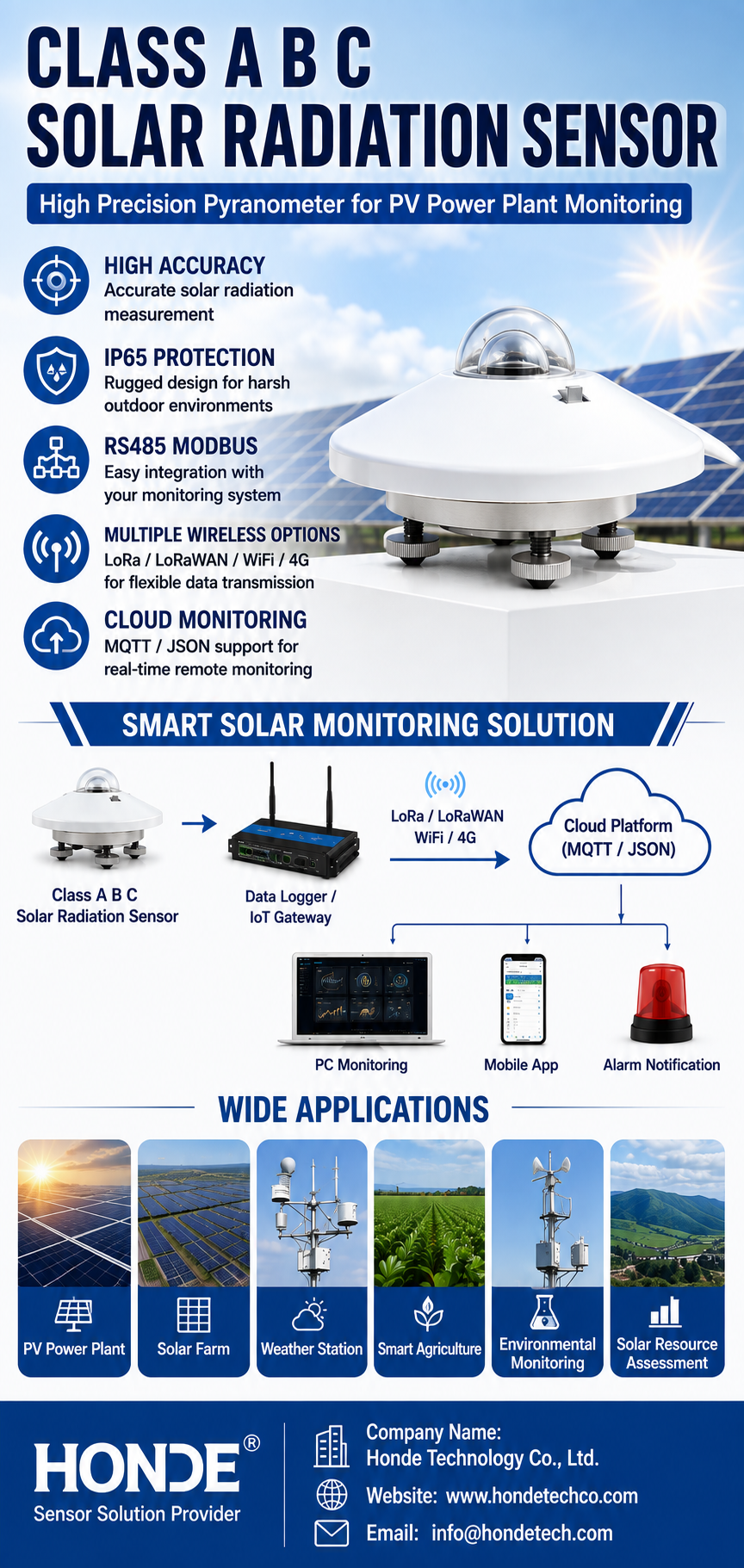
The Honde solar radiation sensor uses RS485 communication with Modbus protocol, providing a practical interface for integration with:
- Data loggers
- PLC systems
- SCADA systems
- Industrial gateways
- IoT controllers
- Weather stations
- Solar monitoring platforms
Typical Data Flow
This architecture allows solar radiation measurements collected in the field to become part of a larger PV monitoring network.
Wireless Solar Radiation Monitoring for Remote PV Sites
Large solar farms are often located in remote areas where wired communication is inconvenient or expensive.
For these applications, wireless communication can simplify deployment.
Depending on the project configuration, Honde can provide wireless communication options including:
- LoRa
- LoRaWAN
- 4G
- WiFi
- GPRS
Honde also provides matched cloud server and software solutions for selected wireless configurations, allowing users to view real-time data, download historical data, and configure alarm functions.
This creates a flexible architecture for both small distributed PV systems and larger renewable energy monitoring projects.
Key Parameters to Evaluate Before Buying a Pyranometer
Price should not be the only factor when selecting a solar radiation sensor.
Professional buyers should compare at least the following parameters:
| Parameter | Why It Matters |
|---|---|
| ISO 9060 Classification | Indicates the performance class of the pyranometer |
| Measurement Range | Determines the solar irradiance level that can be measured |
| Accuracy / Uncertainty | Determines measurement reliability |
| Spectral Range | Important for solar radiation measurement characteristics |
| Response Time | Important for dynamic irradiance changes |
| Non-Stability | Important for long-term monitoring |
| Temperature Response | Important for outdoor environmental conditions |
| Calibration | Helps maintain traceable measurement performance |
| Output Interface | Determines compatibility with monitoring systems |
| Protection Rating | Important for outdoor PV installations |
ISO 9060:2018 establishes the classification framework, while ISO 9847:2023 specifies methods for calibration of pyranometers by comparison with a reference pyranometer.
Why Calibration Is Important for PV Solar Radiation Measurement
A pyranometer can only provide useful monitoring data when its measurement characteristics are properly controlled.
Calibration helps establish the relationship between the sensor output and the measured solar irradiance.
ISO 9847:2023 describes preferred calibration methods using reference pyranometers and covers indoor and outdoor approaches. The standard also addresses traceability to the SI through appropriate reference instruments.
For PV projects, buyers should therefore ask suppliers for:
- 1 Calibration information
- 2 Sensor classification
- 3 Measurement specifications
- 4 Sensitivity information
- 5 Long-term stability data
- 6 Recommended installation conditions
This is especially important when irradiance data will be used for performance analysis or engineering decisions.
Honde Class A B C Solar Radiation Sensor: Designed for Flexible PV Monitoring
Honde Technology provides configurable solar radiation monitoring solutions for different project requirements.
The product configuration can be adapted according to:
- Pyranometer class
- Communication interface
- Monitoring architecture
- Wireless transmission requirements
- Installation environment
- Data platform requirements
Main Features
PV Power Plant Monitoring Application
A typical solar monitoring station can combine solar radiation measurement with additional environmental parameters.
For example:
| Monitoring Parameter | Application |
|---|---|
| Solar Radiation | Irradiance and energy yield analysis |
| Ambient Temperature | Environmental condition monitoring |
| Module Temperature | PV module performance analysis |
| Wind Speed | Weather and cooling condition analysis |
| Wind Direction | Environmental monitoring |
| Humidity | Weather condition analysis |
| Atmospheric Pressure | Meteorological monitoring |
Honde’s integrated PV environmental monitoring solutions can combine solar radiation with parameters such as temperature, humidity, atmospheric pressure, ultrasonic wind speed and wind direction, while supporting RS485 Modbus and multiple wireless transmission methods.
A Practical Buyer Checklist for PV Projects
Before purchasing a Class A, B or C solar radiation sensor, ask these questions:
- 1 Which ISO 9060 classification does the pyranometer meet?
- 2 What is the measurement range?
- 3 What is the spectral response range?
- 4 What is the calibration method?
- 5 Is calibration documentation available?
- 6 What communication protocol is supported?
- 7 Can it integrate with RS485 Modbus systems?
- 8 Can wireless communication be added?
- 9 Can the sensor connect to a cloud monitoring platform?
- 10 Is the sensor suitable for long-term outdoor PV deployment?
This checklist helps buyers compare suppliers based on engineering requirements rather than price alone.
Why Choose Honde Technology for Solar Radiation Monitoring?
Honde Technology Co., Ltd. focuses on environmental monitoring, smart agriculture, renewable energy monitoring, and IoT sensing solutions.
Our solar radiation monitoring solutions are designed to support applications such as:
- PV Power Plants
- Solar Farms
- Solar Resource Assessment
- Meteorological Stations
- Smart Agriculture
- Environmental Monitoring
- Renewable Energy Projects
We can provide sensor hardware, RS485 Modbus communication, wireless transmission options, and cloud monitoring solutions to help customers build a complete solar radiation monitoring system.
Frequently Asked Questions
FAQ What is a pyranometer used for?
A pyranometer is used to measure solar irradiance and is commonly applied in photovoltaic testing, solar energy monitoring, meteorological observation, and environmental research. ISO/TR 9901:2021 specifically addresses pyranometer use in solar energy applications, including PV performance monitoring.
FAQ What is the difference between Class A, Class B and Class C pyranometers?
They represent different performance classifications under the ISO 9060 framework. Buyers should select the class based on the required measurement performance, project objectives, and budget.
FAQ Is RS485 Modbus suitable for PV power plants?
Yes. RS485 Modbus is widely used as an industrial field communication interface because it can connect field sensors with data loggers, PLCs, gateways, and monitoring systems.
FAQ Can the solar radiation sensor use LoRa or 4G?
Yes. Honde provides optional wireless transmission configurations including LoRa, LoRaWAN, GPRS, 4G and WiFi for applicable monitoring solutions.
FAQ What standard should buyers check for pyranometer classification?
ISO 9060:2018 is the key international standard for classification and specification of instruments measuring hemispherical and direct solar radiation.
Conclusion: Choose the Right Pyranometer for Your PV Monitoring System
A reliable PV monitoring system starts with reliable environmental data.
When selecting a Class A B C Solar Radiation Sensor for PV Power Plant Monitoring, buyers should consider more than the sensor price. Pyranometer classification, calibration, measurement performance, RS485 Modbus integration, outdoor installation requirements, and wireless connectivity all influence the quality of the final monitoring system.
Honde Technology provides configurable Class A, Class B and Class C solar radiation monitoring solutions with RS485 Modbus communication and optional wireless/cloud connectivity for different PV and renewable energy applications.
Request a Solar Radiation Monitoring Solution
Contact Honde Technology for Class A/B/C pyranometer selection, RS485 Modbus integration, wireless communication, and customized PV power plant monitoring solutions.
Post time: Aug-17-2026