

Lead
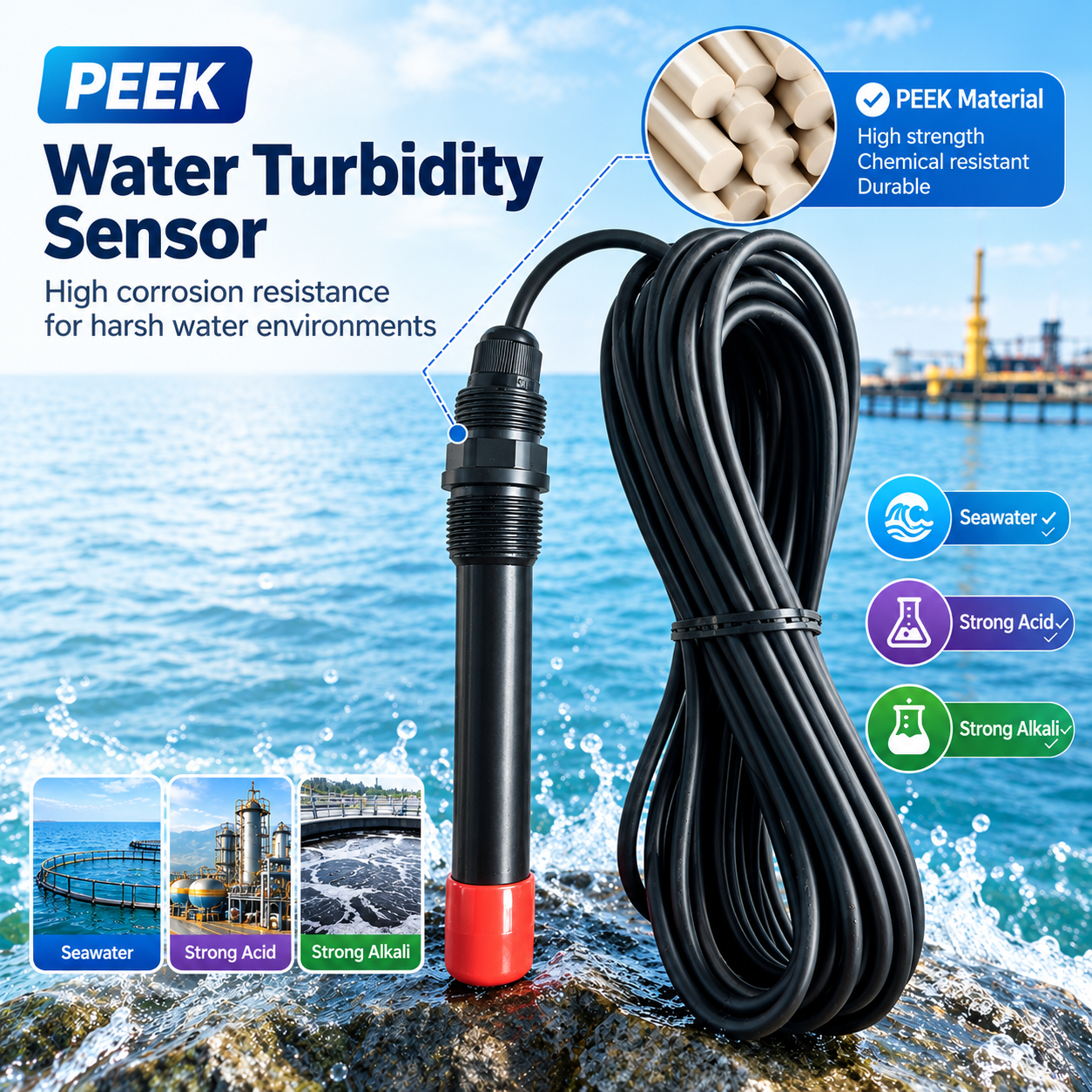
When industrial effluents reach extreme pH levels, high salinity, or elevated process temperatures, conventional stainless steel or PVC optical sensors degrade rapidly. In petrochemical refining, coastal desalination, and chemical wastewater streams, sensor corrosion leads to measuring drift, frequent replacement, and catastrophic compliance violations. The release of the Honde PEEK Water Turbidity Sensor (0–1000 NTU) addresses this critical industrial bottleneck. By encapsulating high-precision 90-degree infrared light scattering optics inside an ultra-durable Polyether Ether Ketone (PEEK) corrosion-proof body, plant operators can achieve 24/7 continuous turbidity tracking under conditions that destroy standard sensors within weeks.
The Global Water Quality & Turbidity Monitoring Market Landscape
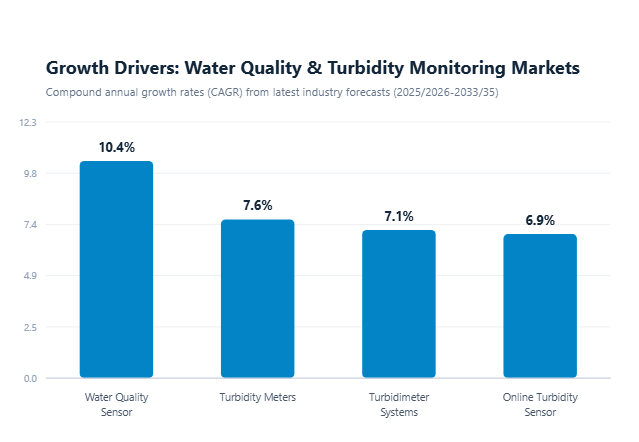
Rising environmental oversight and the global expansion of industrial wastewater reuse are accelerating demand for resilient water sensors:
- The broader water quality sensor market is projected to grow from $6.83 billion in 2026 to $12.46 billion by 2032, expanding at a 10.36% CAGR (Research and Markets).
- Dedicated turbidity meters and systems are advancing rapidly, valued at $1.3 billion in 2026 and forecasted to reach $2.1 billion by 2033 (7.1% CAGR) (Persistence Market Research), with the online instrumentation segment expanding at 7.6% CAGR (Maximize Market Research).
- The online turbidity analyzer market specifically targeted at municipal and industrial wastewater is expected to cross $1.04 billion by 2033 at a 6.9% CAGR (Dataintelo).
Industrial facilities across North America, the European Union, and the Asia-Pacific region are transitioning from periodic grab samples to real-time SCADA integration to comply with stringent discharge limits.
Why PEEK Material and Optical Scattering Redefine Reliability
Turbidity represents the optical cloudiness of a fluid caused by suspended solids. For industrial operators, monitoring turbidity across the 0–1000 NTU spectrum is indispensable:
| Regulatory & Process Stage | Turbidity Threshold | Standards / Guidelines | Operational Significance |
|---|---|---|---|
| Drinking water disinfection | < 1.0 NTU (often < 0.3 NTU) | WHO Guidelines / EPA Method 180.1 | Ensures effective pathogen inactivation |
| Clarifier & sedimentation effluent | 5.0 – 15.0 NTU | Industrial Reuse Guidelines | Validates coagulant dosing & solids settling |
| Municipal & industrial discharge | < 50.0 NTU | NPDES / EU Industrial Emissions Directive | Prevents heavy environmental penalty fines |
| Honde PEEK Sensor full range | 0.1 – 1000.0 NTU | ISO 7027 / 90° Infrared Nephelometry | Covers clear baseline up to storm or process surges |
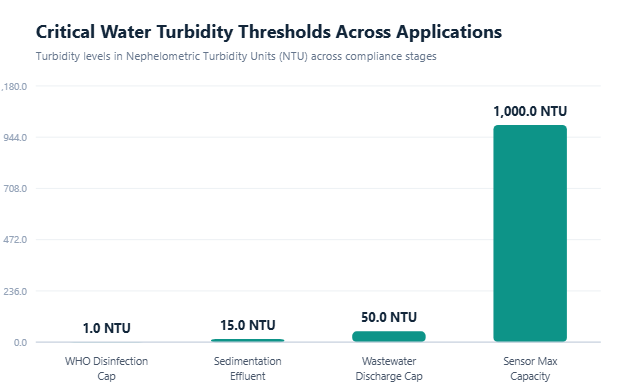
Sources: US EPA Method 180.1, WHO Guidelines for Drinking-water Quality, Persistence Market Research (2026).
The PEEK Engineering Advantage
Standard immersion sensors made of 304 or 316L stainless steel suffer from pitting corrosion when exposed to chloride ions in seawater desalination plants or strong acidic/alkaline wash solutions. In contrast, Polyether Ether Ketone (PEEK) delivers:
- Universal Chemical Inertness: Exceptional resistance to acids, alkalis, organic solvents, and concentrated chlorides.
- Thermal & Mechanical Toughness: Operates reliably under fluctuating process temperatures (0–60 °C) and high hydraulic pressure.
- Smooth Anti-Fouling Surface: Discourages biofilm accumulation and sediment adhesion on the optical window.
Product Architecture: Honde PEEK Water Turbidity Sensor (0–1000 NTU)
Manufactured by Honde Technology Co., Ltd., this digital turbidity sensor utilizes the 90-degree light scattering method (ISO 7027 standard). An internal infrared LED light source eliminates ambient light interference, enabling accurate measurement without light shielding.
| Parameter | Specification Details |
|---|---|
| Measurement Parameter | Water Turbidity (Nephelometric Turbidity Units) |
| Measurement Range | 0.1 – 1000.0 NTU |
| Resolution | 0.01 NTU |
| Accuracy | ±3% Full Scale |
| Enclosure Material | Corrosion-Resistant PEEK |
| Ingress Protection | IP68 (Fully submersible up to 10 m depth) |
Three Versatile System Deployment Solutions
To meet diverse industrial setups—from local skid testing to multinational cloud monitoring—Honde provides three turnkey system solutions:
1. Handmeter, Data logger with screen: For on-site field testing, environmental patrols, and spot verification, the sensor pairs directly with a portable Handmeter and data logger with screen.
2. Wireless Module (MQTT JSON): For remote rivers or aeration tanks, Honde integrates GPRS, 4G, WiFi, LoRa, or LoRaWAN wireless modules, allowing seamless integration into SCADA systems.
3. Cloud Server & Alarm Relay: For automated plants, the system records real-time data and trips an internal physical alarm relay if turbidity crosses pre-set discharge limits.
Real-World Case: Industrial Wastewater Discharge in Germany
A specialty chemicals manufacturer in Germany faced severe galvanic corrosion with 316 stainless steel probes. After implementing the Honde PEEK sensor, they achieved:
- Zero Corrosion: Eight months of submersion in pH 3–11 solutions with no housing degradation.
- High Accuracy: Maintained ±3% FS accuracy, eliminating false alarms.
- Efficiency: Reduced maintenance labor by 70%.
Summary
In modern industrial wastewater management, sensor failure is a primary contributor to regulatory fines and operational downtime. The Honde PEEK Water Turbidity Sensor (0–1000 NTU) delivers the chemical resilience, optical precision, and IoT connectivity required by global water engineers.
Contact Honde Technology
For more sensor information, please contact Honde Technology Co., LTD.
WhatsApp: +86-15210548582
Email: info@hondetech.com
Website: www.hondetechco.com
Post time: Sep-18-2026