

In recent years, the demand for accurate, real-time rainfall monitoring has expanded rapidly across Southeast Asia, Europe, and North America. Driven by climate change, urban flooding, agricultural optimization, and infrastructure resilience planning, governments and private sectors alike are turning toward advanced environmental sensing technologies. Among these, the tipping bucket rain gauge sensor has emerged as a reliable, cost-effective, and scalable solution.
This report examines how modern tipping bucket rain gauge sensors—integrated with wireless communication, cloud platforms, and intelligent alarm systems—are being deployed in real-world scenarios. It highlights a practical implementation in Southeast Asia while drawing comparisons to adoption trends in Western markets. The discussion also incorporates a complete solution ecosystem, including handheld meters, data loggers with screens, wireless transmission modules (GPRS/4G/WiFi/LoRa/LoRaWAN), and cloud-based monitoring software.
1. Technology Overview: Evolution of the Tipping Bucket Rain Gauge
The tipping bucket rain gauge is a mechanical rainfall measurement device that converts precipitation into quantifiable electrical signals. Its core structure consists of a funnel that collects rainwater and directs it into a tipping mechanism composed of two balanced chambers. Once a predefined volume—typically 0.2 mm or 0.5 mm—is collected in one chamber, it tips due to gravity, empties, and triggers a pulse signal. This process repeats continuously during rainfall events.
Modern designs have significantly improved upon traditional limitations:
- ✓ High precision (≤ ±3%)
- ✓ Multiple output options: Pulse, RS485 (Modbus-RTU), 4–20mA, 0–5V, 0–10V
- ✓ Durable ABS construction for harsh environments
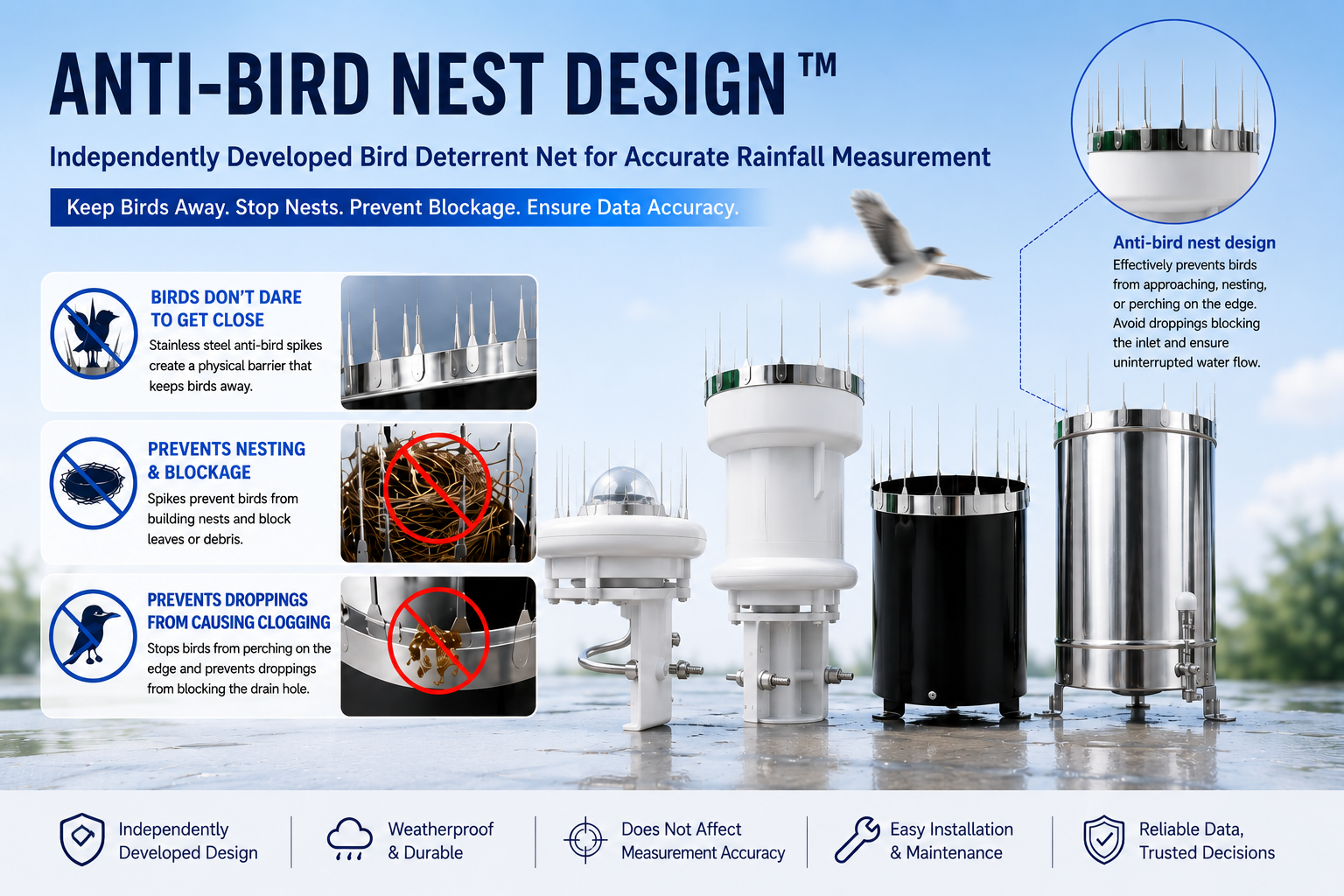
- ✓ Anti-bird nesting design with stainless steel spikes
- ✓ Low power consumption (~0.24W)
- ✓ Wide operating temperature range (0°C to 70°C)
One of the most critical innovations in recent models is the integration of anti-interference structural features. For example, sharp-edge funnel designs (40°–45°) ensure efficient water flow, while anti-bird spikes prevent nesting and debris accumulation, maintaining long-term measurement stability.
2. Market Drivers in Southeast Asia and Western Countries
Southeast Asia
Countries such as Indonesia, Thailand, Vietnam, and the Philippines face intense seasonal rainfall, frequent typhoons, and flash flooding. The need for localized, real-time rainfall data is crucial for:
- Flood early warning systems
- Agricultural irrigation scheduling
- Aquaculture water management
- Urban drainage optimization
Additionally, many rural or semi-urban regions lack stable infrastructure, making wireless, low-power, and autonomous systems essential.
Europe and North America
In contrast, Western markets emphasize:
- ► Smart city integration
- ► Climate research and environmental compliance
- ► Infrastructure monitoring (roads, bridges, drainage systems)
- ► Insurance and risk assessment modeling
These regions demand higher data interoperability, adherence to communication standards (e.g., MQTT, JSON), and seamless cloud integration.
3. Integrated Monitoring Solution Architecture
To meet diverse global requirements, the tipping bucket rain gauge is no longer deployed as a standalone instrument. Instead, it is part of a comprehensive monitoring ecosystem:
3.1 Handheld Meter and Data Logger with Screen
Field engineers and technicians often require on-site diagnostics and calibration. A portable handheld meter or a fixed data logger equipped with an LCD screen allows:
- Real-time rainfall display
- Historical data storage
- Sensor status monitoring
- Easy installation and troubleshooting
This feature is particularly valuable in remote areas where immediate cloud access may not be available.
3.2 Wireless Communication Modules
Modern systems support multiple communication protocols to adapt to different infrastructure environments:
The flexibility of communication options allows the same sensor hardware to be deployed globally with minimal modification.
3.3 Cloud Server and Monitoring Software
Cloud integration is the backbone of modern rainfall monitoring systems. A centralized platform provides:
- Real-time data visualization
- Historical data analysis
- Threshold-based alarm systems (SMS, email, relay output)
- Multi-site device management
- API integration for third-party systems
Alarm relay systems are particularly important in flood-prone regions, where immediate response can prevent significant damage.
4. Case Study: Flood Monitoring System in Indonesia
Background
In 2024, a regional government in Indonesia initiated a flood mitigation project in a coastal city prone to monsoon flooding. The area experienced frequent waterlogging due to inadequate drainage and unpredictable rainfall patterns.
Deployment
The project deployed a network of tipping bucket rain gauge sensors across 25 critical locations, including:
- Urban drainage channels
- Residential flood-prone zones
- Upstream watershed areas
Each sensor unit included:
- 0.5 mm resolution tipping bucket rain gauge
- RS485 output connected to a data logger
- 4G wireless transmission module
- Solar-powered battery system
- Anti-bird protection design
System Integration
Data from all nodes were transmitted via 4G to a centralized cloud server. The platform provided:
- Real-time rainfall maps
- Accumulated precipitation charts
- Automatic alerts when rainfall exceeded 4 mm/min
- Integration with local emergency response systems
Results
Within six months of operation:
Local authorities reported that the system enabled proactive drainage management, significantly reducing urban flooding incidents.
5. Application in Smart Agriculture: Thailand Smart Farm Project
In Thailand, a large-scale smart agriculture initiative integrated tipping bucket rain gauges into irrigation management systems.
Key Features
- LoRaWAN-based communication across 500 hectares
- Integration with soil moisture and temperature sensors
- Cloud-based irrigation scheduling algorithm
Impact
The tipping bucket rain gauge played a critical role in determining natural rainfall contribution, preventing over-irrigation.
6. Western Market Application: Urban Stormwater Management in Germany
A municipality in Germany implemented a smart stormwater monitoring system using tipping bucket rain gauges integrated with existing infrastructure.
System Characteristics
- High-resolution (0.2 mm) sensors
- RS485 Modbus integration with SCADA systems
- Ethernet/WiFi gateways for data transmission
- Cloud analytics for predictive modeling
Outcomes
- Improved drainage system efficiency
- Reduced overflow events
- Enhanced compliance with environmental regulations
The system demonstrated the importance of standardized communication protocols and high data accuracy in developed markets.
7. Engineering Advantages of Modern Tipping Bucket Design
7.1 Anti-Bird Nest Structure
One of the most overlooked challenges in outdoor sensors is biological interference. Birds often nest inside rain gauges, causing:
- Blocked funnels
- False readings
- Increased maintenance
The integration of stainless steel spikes and enclosed designs effectively eliminates this issue.
7.2 Mechanical Stability and Precision
The bistable tipping mechanism ensures:
- Consistent tipping volume
- Minimal wear over time
- Reliable pulse signal generation
Combined with magnetic reed switches, the system achieves high repeatability.
7.3 Multi-Signal Output Compatibility
The availability of multiple output signals allows seamless integration with:
- PLC systems
- IoT gateways
- SCADA platforms
- Analog monitoring equipment
This flexibility is essential for both legacy systems and modern digital infrastructures.
8. Future Trends and Industry Outlook
The tipping bucket rain gauge is expected to remain a dominant technology due to its simplicity and reliability. However, future developments will focus on:
- ◆ AI-based rainfall prediction using sensor networks
- ◆ Edge computing for local data processing
- ◆ Integration with satellite and radar data
- ◆ Enhanced self-cleaning mechanisms
In Southeast Asia, demand will continue to grow due to climate vulnerability. In Western markets, the focus will shift toward data integration and predictive analytics.
9. Conclusion
The tipping bucket rain gauge sensor has evolved into a sophisticated, globally adaptable solution for rainfall monitoring. Its integration with wireless communication, cloud platforms, and intelligent alarm systems makes it indispensable in modern environmental management.
From flood prevention in Indonesia to smart agriculture in Thailand and urban infrastructure monitoring in Germany, real-world deployments demonstrate its versatility and effectiveness. The addition of handheld meters, data loggers with screens, and MQTT-enabled wireless modules further enhances usability across diverse applications.
As climate challenges intensify, the need for accurate, real-time environmental data will only increase. The tipping bucket rain gauge—backed by robust engineering and smart connectivity—stands at the forefront of this transformation.
Post time: May-29-2026