

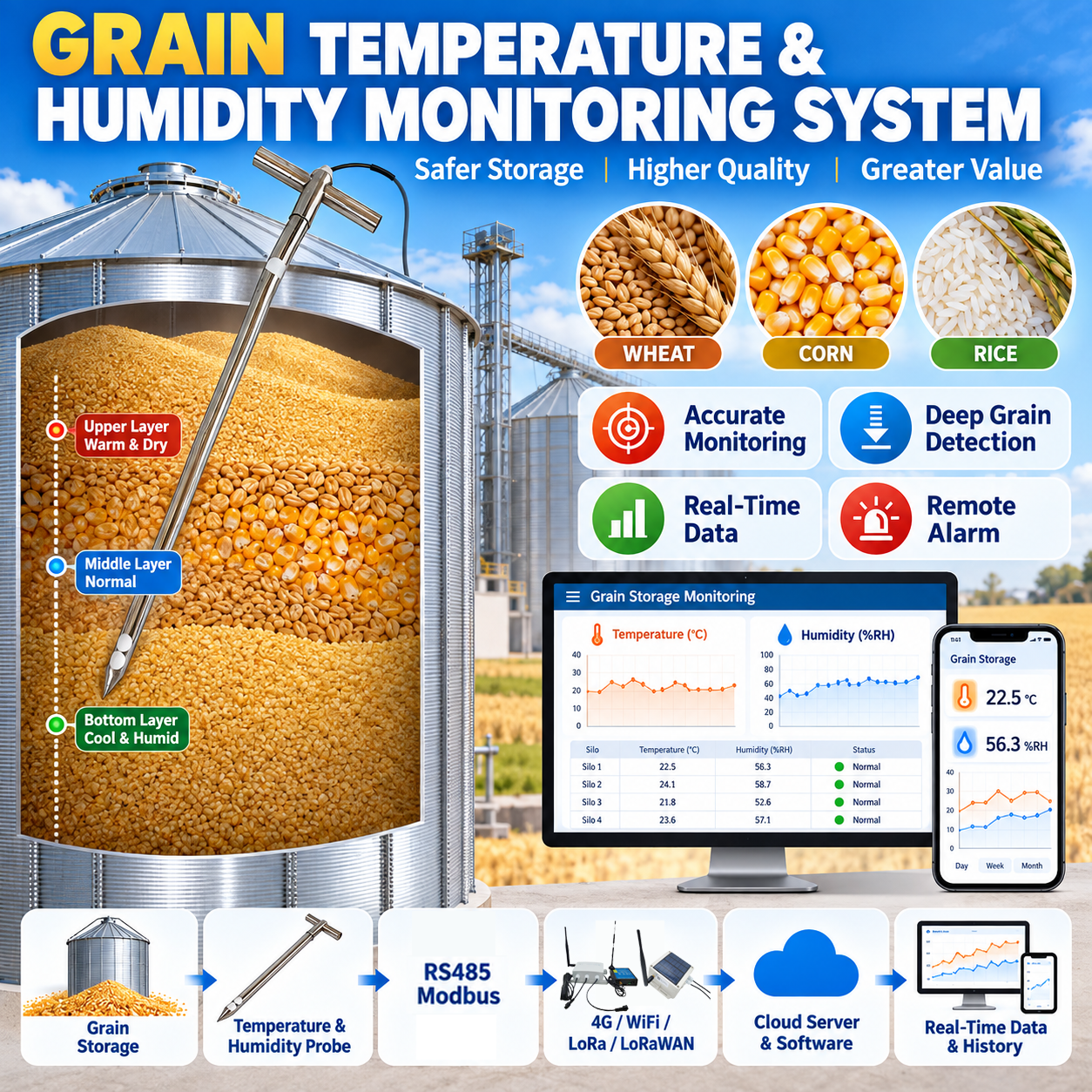
A grain temperature humidity sensor provides direct monitoring of temperature and humidity inside stored grain, helping grain storage operators identify abnormal conditions before they develop into mold, condensation, spoilage, or quality loss. For deep grain storage, a probe with customizable length and multi-level measurement can monitor conditions at different depths rather than measuring only the surface.
For modern grain silos and warehouses, the ideal monitoring solution combines a long insertion probe, reliable RS485 Modbus communication, and optional wireless or cloud connectivity for real-time data access.
This article explains how grain temperature and humidity sensors are used in practical grain storage applications and what buyers should consider when selecting a monitoring probe.
1. Why Monitor Temperature and Humidity Inside Stored Grain?
Grain is not a completely static material after entering storage. Temperature and moisture conditions can vary between different areas of a grain mass.
A surface measurement may therefore fail to reveal what is happening deeper inside the storage pile.
Important factors include:
A grain temperature humidity sensor inserted directly into the stored grain can provide more representative measurements.
Why Is Deep Measurement Important?
A grain silo can contain a large volume of wheat, corn, rice, soybean, or other agricultural products. Temperature and humidity may differ between the upper, middle, and lower layers.
A multi-level monitoring concept can therefore look like:
This makes it easier for operators to identify changes within the grain mass and take appropriate storage-management measures.
2. Direct-Insertion Grain Temperature Humidity Sensor
The sensor shown in this solution uses a long stainless-steel probe designed for insertion into stored grain.
Instead of measuring only the ambient air around the warehouse, the probe is positioned inside the grain.
This is particularly useful for:
The stainless-steel probe can be inserted into different depths according to the storage structure and monitoring requirements.
Key Design Advantage: Custom Probe Length
Different grain storage projects have different depths.
Therefore, a fixed-length probe may not be suitable for every application.
For customized projects, the probe length can be customized, allowing the sensor to better match the actual grain storage depth.
3. Multi-Level Depth Monitoring for Grain Silos
One of the most important application concepts is multi-level grain temperature and humidity monitoring.
For example, a large grain silo can be divided into several monitoring levels:
The exact number and spacing of measurement levels can be designed according to the project requirements.
This approach provides a more complete picture than relying on a single measurement point.
4. Grain Temperature Monitoring Range: -40.0~120.0°C
For projects requiring a broad operating measurement range, the sensor solution can support a temperature range of:
This wide range makes the sensing technology suitable for demanding agricultural and industrial monitoring environments.
For grain storage applications, however, the practical objective is not simply to measure extreme temperatures. The key objective is to continuously observe changes in the stored grain and identify abnormal trends as early as possible.
For B2B buyers, the temperature range should therefore be evaluated together with:
5. RS485 Modbus Communication for Grain Monitoring
For industrial grain-storage systems, RS485 Modbus is a practical communication method because it can integrate the sensor with controllers, gateways, data acquisition equipment, and monitoring systems.
A typical architecture can be:
This architecture allows the sensing device to become part of a larger agricultural IoT monitoring system rather than operating as an isolated sensor.
6. From Grain Silo to Cloud: Remote Monitoring
For large grain storage facilities, manually checking every monitoring point can be inefficient.
An IoT-based solution can transmit collected temperature and humidity data to a monitoring platform.
Operators can potentially view:
This creates a transition from traditional manual inspection to real-time grain storage monitoring.
For facilities managing multiple silos, remote monitoring can also make centralized management easier.
7. Practical Application Scenarios
Grain Silo Monitoring
Large cylindrical silos are one of the most important applications.
The long probe can be inserted into the grain mass to monitor internal conditions at selected depths.
Typical application: Wheat, corn, rice, soybean and other bulk grain storage.
Grain Warehouse Monitoring
For warehouses using piles or large quantities of bagged and bulk grain, temperature and humidity monitoring can help operators understand storage conditions.
The probe length can be selected according to the required measurement depth.
Corn Storage
Corn storage requires careful environmental management because temperature and moisture conditions can affect storage quality.
A dedicated grain temperature and humidity monitoring system provides direct measurement within the corn storage area.
Wheat Storage
For wheat silos and warehouses, multi-level monitoring allows operators to compare conditions at different depths.
This is particularly useful for large-volume storage facilities.
Rice Storage
Rice storage facilities can use temperature and humidity sensors to monitor storage conditions and maintain more consistent environmental control.
8. What Should Buyers Check Before Choosing a Grain Sensor?
When purchasing a grain temperature humidity sensor, looking only at the sensor itself is not enough.
A professional B2B buyer should evaluate the complete application.
1. Measurement Depth
Ask whether the probe can reach the required grain depth.
2. Custom Length
For different silo sizes, confirm whether the probe length can be customized.
3. Multi-Level Measurement
If the project requires monitoring different grain layers, confirm the available measurement-point configuration.
4. Temperature Range
For this solution: -40.0~120.0°C
5. Communication
For industrial integration, check whether RS485 Modbus is supported.
6. Wireless Connectivity
For remote monitoring projects, consider the required communication method, such as: 4G, WiFi, LoRa, LoRaWAN.
7. Software Integration
For large storage facilities, consider whether data can be connected to a cloud server, software platform, or existing agricultural IoT system.
9. Grain Temperature Humidity Sensor Specification Overview
Communication and system functions should be configured according to the selected product model and project requirements.
10. Why Choose a Custom-Length Multi-Level Probe?
A major challenge in grain-storage monitoring is that storage facilities are not identical.
A small storage bin and a large industrial silo may require completely different probe dimensions.
A custom-length grain temperature humidity sensor gives system integrators more flexibility when designing the monitoring architecture.
The project can be configured around:
This is particularly valuable for OEM projects, agricultural IoT integrators, grain-storage equipment manufacturers, and large storage facilities.
11. From Sensor Data to Grain Storage Management
The value of a grain sensor is not simply the temperature or humidity number displayed on a screen.
The real value comes from turning measurement data into actionable storage information.
A complete solution can follow this workflow:
Measure
The probe measures temperature and humidity inside the grain.
Transmit
RS485 Modbus transfers the measurement data to the collection device.
Connect
A gateway can connect the system to 4G, WiFi, LoRa, or LoRaWAN networks where applicable.
Analyze
Software stores and displays real-time and historical information.
Alert
Abnormal conditions can trigger configured alarms.
Manage
Storage operators can respond according to the actual grain conditions.
This is the foundation of a smart grain storage monitoring system.
12. Honde Technology Grain Monitoring Solution
Honde Technology Co., Ltd. develops and supplies agricultural and environmental monitoring sensors and IoT solutions for professional applications.
For grain-storage projects, the solution can be configured around the customer’s actual installation requirements, including probe length, monitoring depth, measurement levels, communication interface, and system integration.
This makes the solution suitable not only for standard grain storage applications but also for customized OEM and agricultural IoT projects.
Company Information
Company Name: Honde Technology Co., Ltd.
Website: www.hondetechco.com
Email: info@hondetech.com
13. Frequently Asked Questions
What is a grain temperature humidity sensor?
A grain temperature humidity sensor is a probe-based device designed to measure temperature and humidity associated with stored grain. A long probe can be inserted directly into the grain to obtain measurements at the required depth.
Can the probe length be customized?
Yes. Custom probe length is an important option for different grain silo and warehouse depths. The required length should be specified according to the actual installation environment.
Can grain temperature be measured at multiple depths?
Yes. A multi-level configuration can be used to monitor temperature and humidity at different positions within the grain mass.
What is the temperature range?
The specified temperature range for this solution is -40.0~120.0°C.
Does the sensor support RS485 Modbus?
Yes, the solution supports RS485 Modbus communication for integration with industrial data acquisition and IoT systems.
What grain types can be monitored?
The application can be used for common stored grains including wheat, corn, rice, and soybean, with the actual application depending on the storage environment and installation design.
Can the data be monitored remotely?
When integrated with an appropriate wireless gateway and cloud/software platform, the sensor data can be transmitted for remote monitoring through communication technologies such as 4G, WiFi, LoRa, or LoRaWAN.
Conclusion: Build a Smarter Grain Storage Monitoring System
For large grain-storage facilities, monitoring only the air around a silo is not enough. The critical information is often inside the stored grain.
A long Grain Temperature Humidity Sensor with customizable probe length and multi-level depth measurement provides a practical approach for monitoring different areas of a grain mass.
Combined with RS485 Modbus, wireless communication, cloud software, and real-time data monitoring, the sensor can become part of a complete smart grain-storage solution.
For projects requiring custom probe length, multiple measurement depths, RS485 Modbus integration, or IoT remote monitoring, contact Honde Technology for a project-specific configuration.
Post time: Sep-10-2026