

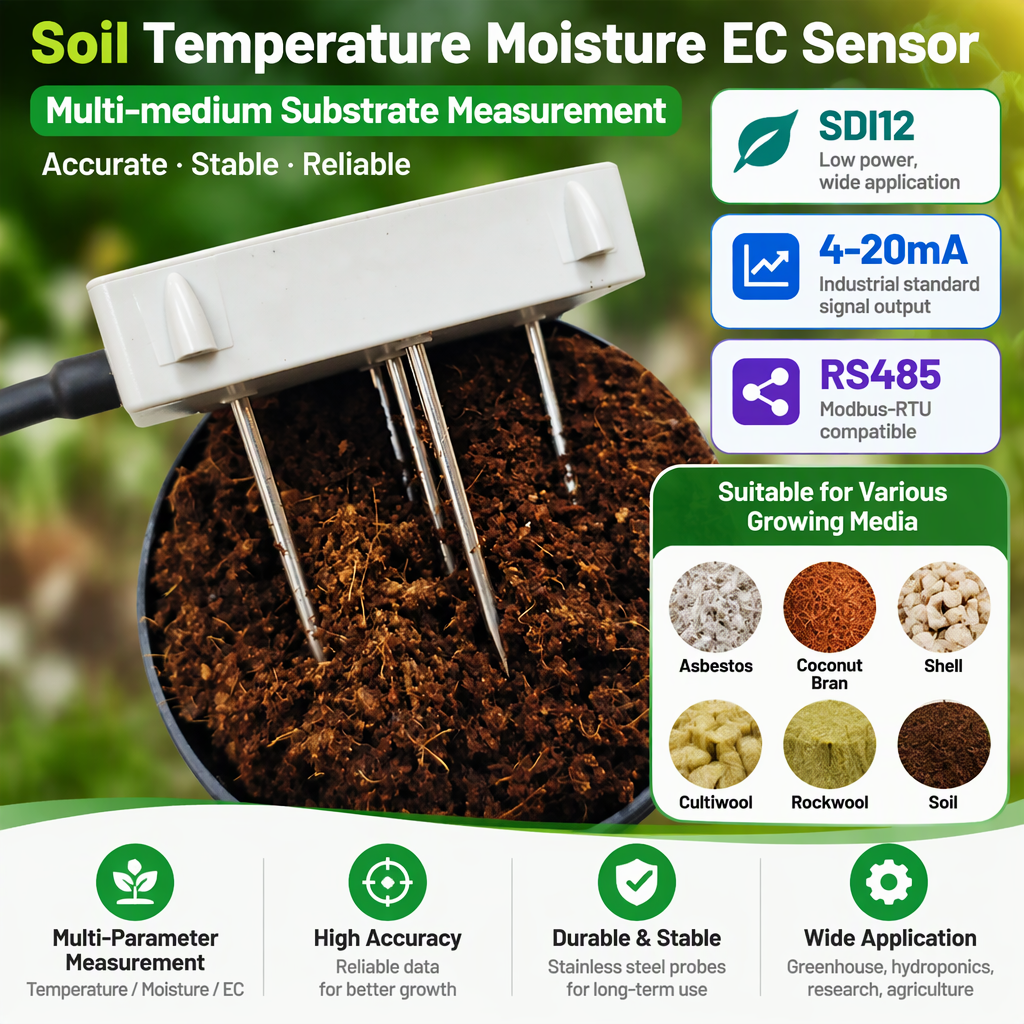
Quick Answer: What Is the HD-MTE-20 Industrial Soil Sensor?
The HD-MTE-20 Industrial Soil Temperature Moisture and EC Sensor is a multi-parameter monitoring device designed to measure soil temperature, moisture content and electrical conductivity (EC) simultaneously. It supports multiple output options, including RS485 Modbus-RTU, SDI-12 and 4-20mA, making it suitable for precision agriculture, greenhouse cultivation, soilless growing media monitoring and industrial data acquisition.
With an IP68 waterproof design, epoxy resin housing and customizable cable length, the HD-MTE-20 can be integrated into agricultural monitoring networks, PLC control systems, data loggers and wireless IoT platforms.
This guide explains its measurement capabilities, communication options, application scenarios and how to select the right configuration for your monitoring project.
1. Why Monitor Soil Temperature, Moisture and Electrical Conductivity Together?
Soil conditions directly affect plant root development, water absorption and nutrient availability. Monitoring only soil moisture may not provide enough information for professional agricultural management.
Three important parameters work together to provide a more complete picture of the growing environment.
1.1 Soil Moisture: Understanding Water Availability
Soil moisture monitoring helps growers understand the amount of water available in the root zone.
Applications include:
- Precision irrigation scheduling.
- Greenhouse water management.
- Drought monitoring and early warning.
- Irrigation system optimization.
- Monitoring moisture changes in growing substrates.
Real-time moisture data helps reduce unnecessary irrigation and identify potential water stress.
1.2 Soil Temperature: Monitoring Root-Zone Conditions
Soil temperature influences root activity, seed germination and nutrient absorption.
Continuous temperature monitoring can help users:
- Identify unfavorable root-zone temperature changes.
- Optimize greenhouse environmental management.
- Evaluate seasonal soil temperature variations.
- Support agricultural research and crop growth analysis.
1.3 Soil Electrical Conductivity (EC): Understanding Salinity and Nutrient Conditions
Electrical conductivity measures how easily an electrical current passes through a medium. In soil and growing substrates, EC is commonly used as an indicator of soluble ion concentration and salinity conditions.
EC monitoring is particularly useful for:
- Fertigation management.
- Soil salinity monitoring.
- Greenhouse nutrient solution management.
- Soilless cultivation.
- Evaluating changes in growing media.
Important: EC is not a direct measurement of individual nutrient concentrations such as nitrogen, phosphorus or potassium. Interpretation depends on the growing medium, water content, temperature and calibration method.
Why Combine These Three Parameters?
| Parameter | What It Measures | Main Agricultural Value |
|---|---|---|
| Soil Moisture | Water content | Irrigation management |
| Soil Temperature | Root-zone temperature | Crop growth monitoring |
| Soil EC | Electrical conductivity | Salinity and fertigation monitoring |
By combining these three measurements, the HD-MTE-20 provides more useful information than a single-parameter moisture sensor.
2. HD-MTE-20: Key Technical Features
The HD-MTE-20 is designed for users who need reliable multi-parameter measurement and flexible integration into existing monitoring systems.
Main Product Highlights
| Feature | HD-MTE-20 |
|---|---|
| Model | HD-MTE-20 |
| Measurement Parameters | Soil Temperature, Moisture and EC |
| Digital Output | RS485 Modbus-RTU |
| Additional Output Options | SDI-12 / 4-20mA |
| Protection Rating | IP68 |
| Housing Material | Epoxy Resin |
| Installation | Insert into Soil or Compatible Growing Media |
| Standard Cable Length | 2 m |
| Custom Cable Length | Available, up to 1200 m |
| Wireless Integration | GPRS / 4G / LoRa / LoRaWAN / WiFi |
| Cloud Platform | Server and Monitoring Software Available |
| Certification | CE |
Note: Output interfaces and wireless functions depend on the selected configuration. Please confirm the required interface, wiring, power supply and measurement specifications before ordering.
2.1 IP68 Waterproof Protection
The HD-MTE-20 features an IP68-rated sealed design for demanding monitoring environments.
It is suitable for long-term installation in soil and compatible growing media, subject to the specified operating conditions.
This design helps protect the sensing components against water and moisture exposure.
2.2 Epoxy Resin Housing
The epoxy resin housing provides a sealed structure designed for agricultural and environmental monitoring applications.
It helps protect the internal components during installation and routine operation.
2.3 Customizable Cable Length
The standard cable length is 2 meters, with customization available up to 1200 meters according to project requirements.
This flexibility helps accommodate different installation layouts, including:
- Greenhouse monitoring networks.
- Large agricultural fields.
- Remote soil monitoring stations.
- Industrial monitoring installations.
Always consider voltage drop, communication requirements and installation conditions when selecting long cable configurations.
3. Three Communication Options: RS485, SDI-12 and 4-20mA
One of the important advantages of the HD-MTE-20 is its flexible interface selection.
Different monitoring projects have different requirements. Some need digital communication, while others rely on existing analog input modules or environmental data loggers.
3.1 RS485 Modbus-RTU: Digital Industrial Communication
RS485 Modbus-RTU is suitable for integration with industrial automation systems.
Key advantages:
- Digital data transmission.
- Communication with PLC controllers.
- Integration with industrial data acquisition equipment.
- Multi-device networking.
- Compatibility with Modbus-based monitoring systems.
Typical system:
HD-MTE-20 → RS485 → PLC / Data Logger → Industrial Monitoring Software
RS485 provides a practical solution for greenhouse automation, agricultural monitoring stations and industrial environmental data acquisition.
For protocol implementation, refer to the official Modbus Organization Specifications.
3.2 SDI-12: Environmental Data Acquisition
SDI-12 stands for Serial Data Interface at 1200 baud. It is a communication standard developed for interfacing microprocessor-based sensors with battery-powered data recorders.
It is widely used in environmental data acquisition applications.
Typical applications include:
- Agricultural research.
- Soil monitoring stations.
- Hydrological observation.
- Environmental monitoring networks.
- Remote data logging projects.
Typical system:
HD-MTE-20 → SDI-12 → Data Recorder → Data Storage / Analysis Platform
SDI-12 is particularly useful when the project already uses compatible environmental data loggers.
Learn more about the protocol through the SDI-12 Support Group.
3.3 4-20mA: Analog Signal for Industrial Control
The 4-20mA current loop remains a widely used industrial signal interface.
Its advantages include:
- Good resistance to electrical noise.
- Suitability for long-distance signal transmission.
- Compatibility with PLC analog input modules.
- Simple integration into existing industrial control systems.
- Live-zero capability for identifying certain wiring faults.
Typical system:
HD-MTE-20 → 4-20mA → PLC Analog Input → SCADA System
For a three-parameter monitoring project, confirm the number of analog output channels required and the exact output configuration.
For more information, see National Instruments’ guide to 4-20mA Current Loop Fundamentals.
Communication Interface Comparison
| Interface | Signal Type | Suitable Equipment | Main Advantage |
|---|---|---|---|
| RS485 Modbus-RTU | Digital | PLC, RTU, Data Logger | Digital multi-device communication |
| SDI-12 | Digital | Environmental Data Logger | Environmental data acquisition |
| 4-20mA | Analog | PLC Analog Input, DCS | Industrial analog integration |
How to choose?
- Choose RS485 Modbus when your project uses PLCs or industrial monitoring software.
- Choose SDI-12 when integrating with compatible environmental data loggers.
- Choose 4-20mA when your existing control system relies on analog input channels.
The three interfaces should be treated as configuration options rather than assumed simultaneous outputs.
4. Compatible Growing Media: Beyond Traditional Soil Monitoring
Modern agriculture increasingly uses different cultivation substrates instead of conventional field soil.
The HD-MTE-20 product series is intended for monitoring applications involving soil and compatible growing media, including coconut coir, coconut bran, shell-based substrates, cultiwool and nutrient solutions.
4.1 Traditional Soil Monitoring
In open-field agriculture, the sensor can be inserted into the root-zone soil to monitor changes in moisture, temperature and EC.
Potential applications:
- Vegetable cultivation.
- Fruit orchards.
- Agricultural demonstration fields.
- Irrigation research.
- Soil environmental monitoring.
4.2 Coconut Coir and Coconut-Based Growing Media
Coconut coir is widely used in greenhouse cultivation and soilless farming.
Its moisture retention and electrical conductivity characteristics influence irrigation and nutrient management.
Monitoring moisture, temperature and EC together can help growers understand changes in the root-zone environment.
4.3 Cultiwool and Other Soilless Substrates
In controlled-environment agriculture, growing media require regular monitoring to maintain suitable water and nutrient conditions.
The HD-MTE-20 can be considered for compatible substrate monitoring projects, subject to application-specific calibration and validation.
Engineering note: Different substrates have different physical structures and electrical properties. Soil calibration should not automatically be applied to coconut coir, rockwool or other growing media. Users should establish suitable calibration procedures for their actual medium.
5. Wireless IoT Integration: From Soil Sensor to Cloud Monitoring
For remote agricultural projects, collecting sensor data is only the first step. Users also need a convenient way to transmit, store and analyze the information.
Honde can provide wireless communication solutions to connect compatible sensor configurations to remote monitoring platforms.
5.1 Available Wireless Communication Options
Depending on the selected system configuration, wireless communication options include:
| Wireless Technology | Typical Application |
|---|---|
| GPRS | Remote monitoring |
| 4G | Cellular IoT data transmission |
| WiFi | Greenhouses and local networks |
| LoRa | Long-range, low-power communication |
| LoRaWAN | Large-area agricultural IoT networks |
5.2 Three-Level Monitoring Architecture
Level 1: Field Measurement
HD-MTE-20 measures:
- Soil moisture.
- Soil temperature.
- Soil EC.
Level 2: Wireless Data Transmission
The sensor connects to a compatible wireless data acquisition module.
Depending on the configuration, communication can use 4G, WiFi, LoRa or LoRaWAN.
Level 3: Cloud Server and Monitoring Software
Users can access the collected data through a monitoring platform.
Available system functions can include:
- Real-time data viewing.
- Historical data records.
- Remote monitoring.
- Data analysis.
- Alarm settings.
Honde can provide its own server and web monitoring software or support MQTT-based data integration with a customer’s server and software.
This architecture allows agricultural operators and system integrators to build monitoring solutions according to their project requirements.
6. Typical Applications of the HD-MTE-20
Precision Agriculture
Monitor root-zone moisture, temperature and EC to support irrigation scheduling and agricultural management.
Smart Greenhouse Monitoring
Combine soil and growing media data with greenhouse environmental monitoring systems to improve crop management.
Soilless Cultivation
Monitor moisture and EC changes in coconut coir and other compatible growing substrates.
Agricultural Research
Collect continuous soil data for crop growth experiments, irrigation studies and substrate performance evaluation.
Environmental Monitoring
Integrate soil measurement devices into environmental data acquisition networks and remote observation systems.
7. How to Select the Right Soil Sensor Configuration
Before purchasing an industrial soil sensor, buyers should evaluate several technical requirements.
Step 1: Confirm the Measurement Parameters
Determine whether the project requires:
- Soil moisture only.
- Soil temperature and moisture.
- Soil temperature, moisture and EC.
For simultaneous monitoring of all three parameters, the HD-MTE-20 is a suitable model to evaluate.
Step 2: Select the Communication Interface
Check the input interface of your existing equipment.
| Existing Equipment | Recommended Interface |
|---|---|
| PLC / Industrial Controller | RS485 Modbus or 4-20mA |
| Environmental Data Logger | SDI-12 |
| Analog Acquisition System | 4-20mA |
Step 3: Confirm the Growing Medium
Specify whether the sensor will be installed in:
- Agricultural soil.
- Coconut coir.
- Other soilless growing media.
- Nutrient solutions.
Ask about calibration suitability for the selected medium.
Step 4: Determine Cable Length and Installation Conditions
Consider the distance between the sensor and the data acquisition equipment.
The HD-MTE-20 offers a standard 2-meter cable with customized lengths available up to 1200 meters. Confirm the electrical and communication requirements for your selected length.
Step 5: Decide Whether Wireless Monitoring Is Required
For projects involving remote agricultural fields or multiple monitoring sites, consider adding a compatible wireless module and cloud monitoring platform.
8. Why Choose Honde Technology for Soil Monitoring Solutions?
Honde Technology Co., Ltd. was founded in 2011 and specializes in the research, development, production and sales of smart water equipment, smart agriculture equipment and smart environmental monitoring equipment.
Our products and solutions serve customers in more than 70 countries.
We focus on providing practical monitoring equipment and customized IoT solutions for different project requirements.
Our capabilities include:
- Multiple soil monitoring sensor configurations.
- RS485, SDI-12 and analog interface options.
- 4G, WiFi, LoRa and LoRaWAN wireless integration.
- MQTT data transmission and API integration.
- Custom cable lengths and project configurations.
- Cloud server and web monitoring software.
- CE, RoHS and TÜV Rheinland certified products and solutions.
Whether you are an agricultural equipment distributor, greenhouse system integrator, research institution or environmental monitoring contractor, Honde can help you select a suitable soil monitoring configuration.
9. Frequently Asked Questions (FAQ)
Q1: What parameters does the HD-MTE-20 measure?
The HD-MTE-20 measures soil temperature, soil moisture and electrical conductivity (EC) simultaneously.
Q2: Does the HD-MTE-20 support RS485 Modbus-RTU?
Yes. RS485 Modbus-RTU is one of its available digital communication options, suitable for PLCs, industrial controllers and compatible data acquisition systems.
Q3: What is the difference between SDI-12 and RS485?
SDI-12 is commonly used for communication between environmental sensors and compatible data recorders. RS485 is an electrical communication interface frequently used with industrial protocols such as Modbus-RTU.
The best choice depends on the data acquisition equipment used in your project.
Q4: Can the HD-MTE-20 provide a 4-20mA output?
Yes. A 4-20mA output configuration is available. Please confirm the required channel arrangement and measurement mapping before ordering.
Q5: Can the HD-MTE-20 be used in coconut coir or rockwool?
The product series is intended for compatible growing media, including coconut-based substrates and cultiwool. Please confirm the specific medium and calibration requirements with Honde before deployment.
Q6: Is the HD-MTE-20 waterproof?
Yes. The product features an IP68 protection rating, making it suitable for demanding wet monitoring environments when installed and operated according to its specifications.
Q7: Can the sensor transmit data wirelessly?
Yes. It can be integrated with compatible GPRS, 4G, WiFi, LoRa or LoRaWAN wireless modules, depending on the selected system configuration.
Q8: Can I view soil data remotely?
Yes. Honde can provide a compatible server and web monitoring software for real-time data viewing and historical data management. MQTT integration with customer platforms is also available.
Q9: Can the cable length be customized?
Yes. The standard cable length is 2 meters, and customized lengths up to 1200 meters are available subject to project requirements.
Q10: Can I order a customized soil monitoring solution?
Yes. Honde can discuss different measurement, communication, cable and wireless monitoring requirements according to your project.
10. Get a Quote for Your HD-MTE-20 Soil Monitoring Project
Looking for an industrial soil temperature, moisture and EC sensor with flexible communication options?
The Honde HD-MTE-20 offers a practical solution for precision agriculture, greenhouse monitoring, soilless cultivation and industrial environmental data acquisition.
Product Model: HD-MTE-20
Product Details:
https://www.alibaba.com/product-detail/Industrial-SDI12-4-20mA-RS485-Asbestos_1601033792258.html
Product Introduction Video:
https://youtu.be/IDJzJeJSk6Q
Contact Honde to discuss your project requirements, technical specifications and customized monitoring solutions.
Contact Honde Technology Co., Ltd.
Company: Honde Technology Co., Ltd.
Website: https://www.hondetechco.com/
Email: info@hondetech.com
Tell us your measurement requirements, preferred communication interface and application environment. Our team will help you select the right configuration for your project.
Post time: Nov-16-2026