

Quick Answer: What Is the HD-WSM-UTR-17IN1 17-in-1 Weather Station?
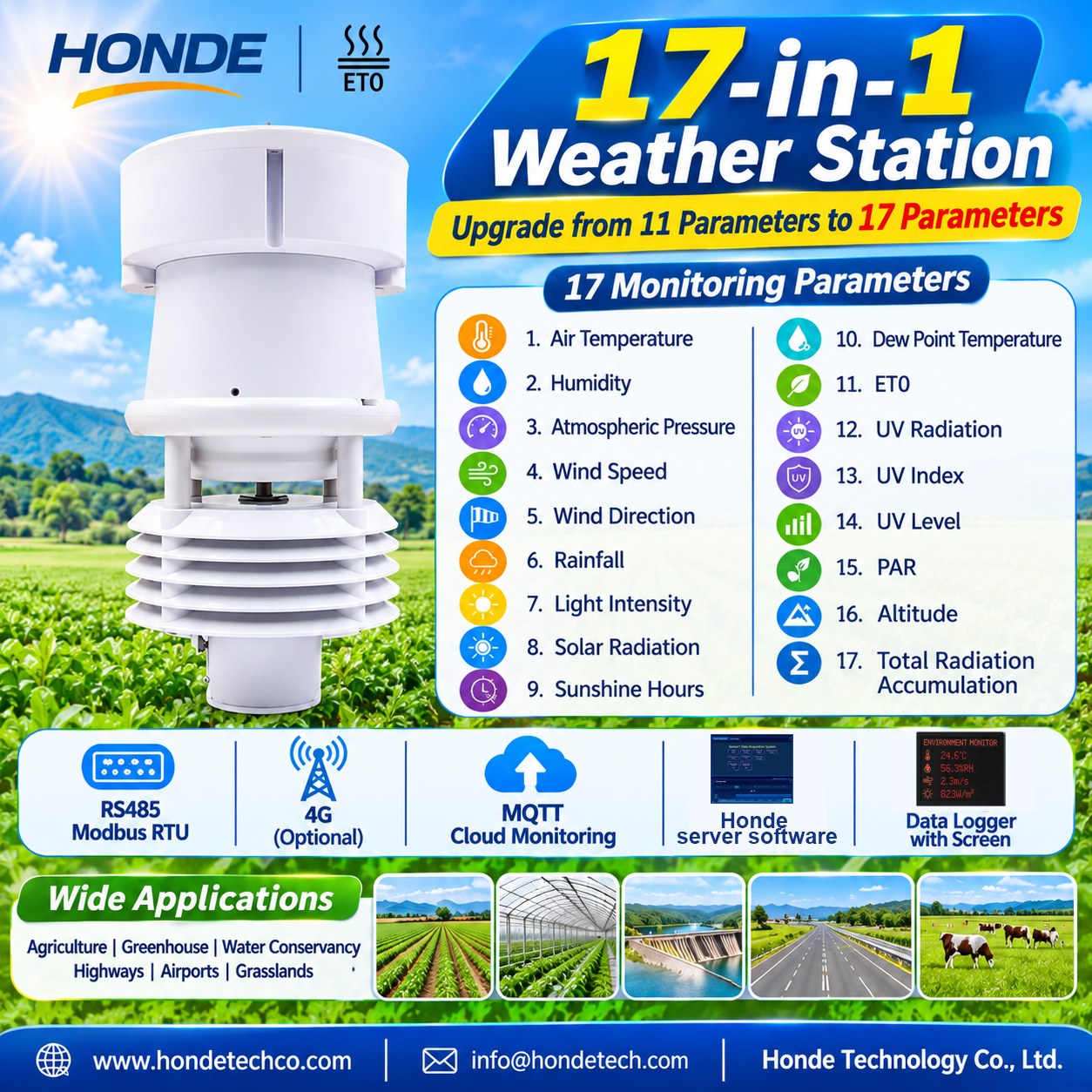
The Honde HD-WSM-UTR-17IN1 is an integrated weather monitoring station designed to measure up to 17 environmental parameters in one compact unit. It upgrades monitoring capability from 11 to 17 parameters, combining conventional weather measurements with solar radiation, sunshine duration, dew point, reference evapotranspiration (ET0), UV indicators, photosynthetically active radiation (PAR), altitude and cumulative radiation data.
The standard communication interface is RS485 with the Modbus RTU protocol. Depending on project requirements, users can select a handheld meter, a data logger with a screen, or wireless communication modules such as GPRS, 4G, WiFi, LoRa and LoRaWAN. With a compatible wireless configuration, MQTT JSON data transmission and cloud server software can support remote access to real-time data, historical records and alarm functions.
This makes the HD-WSM-UTR-17IN1 a flexible monitoring option for smart agriculture, greenhouse projects, environmental monitoring, water conservancy and other outdoor applications.
1. Upgrade from 11 to 17 Monitoring Parameters
A weather station should provide more than basic temperature and rainfall readings when a project requires detailed environmental analysis.
The HD-WSM-UTR-17IN1 expands monitoring capability to 17 parameters, bringing conventional meteorological measurements and additional environmental indicators together in one integrated instrument.
Complete List of 17 Monitoring Parameters
| No. | Monitoring Parameter | Typical Application |
|---|---|---|
| 1 | Atmospheric Temperature | Monitoring local air temperature and crop microclimate |
| 2 | Relative Humidity | Understanding atmospheric moisture conditions |
| 3 | Atmospheric Pressure | Meteorological observation and weather analysis |
| 4 | Wind Speed | Monitoring wind conditions in fields and open areas |
| 5 | Wind Direction | Understanding wind patterns and direction changes |
| 6 | Rainfall | Precipitation monitoring and water management |
| 7 | Light Intensity / Illumination | Monitoring ambient light conditions |
| 8 | Solar Radiation | Evaluating incoming solar energy |
| 9 | Sunshine Duration | Recording sunshine hours |
| 10 | Dew Point Temperature | Assessing atmospheric moisture conditions |
| 11 | Reference Evapotranspiration (ET0) | Supporting irrigation planning and agricultural water management |
| 12 | Ultraviolet Radiation | Monitoring UV radiation levels |
| 13 | UV Index | Evaluating ultraviolet exposure conditions |
| 14 | UV Level | Providing an additional UV classification indicator |
| 15 | Photosynthetically Active Radiation (PAR) | Monitoring light relevant to photosynthesis |
| 16 | Altitude | Providing altitude information for environmental monitoring |
| 17 | Daily / Total Radiation Accumulation | Analyzing accumulated solar radiation |
Configuration note: The standard product measures seven parameters: atmospheric temperature, relative humidity, wind speed, wind direction, atmospheric pressure, illumination and rainfall. Solar radiation, sunshine duration, dew point temperature and ET0 are optional functions. The additional UV, PAR, altitude and radiation accumulation functions are included in the overall 17-parameter capability. Please confirm the exact enabled functions in the selected product configuration before ordering.
Why Are These Additional Parameters Important?
Solar Radiation and Sunshine Duration
Solar radiation and sunshine duration provide information about solar energy availability and daily light conditions. They can support agricultural environmental studies, greenhouse research and crop-growth analysis.
Dew Point Temperature
Dew point temperature helps describe the moisture condition of the air. Together with temperature and relative humidity, it provides additional information for analyzing local atmospheric conditions.
ET0 – Reference Evapotranspiration
ET0 is an important indicator in agricultural water management. It estimates the evapotranspiration of a standardized reference surface and can help support irrigation planning.
ET0 is not the same as the actual water consumption of a particular crop. Actual crop water requirements also depend on crop type, growth stage and other factors.
UV Radiation, UV Index and UV Level
These three indicators provide different ways to describe ultraviolet conditions. They can be useful in environmental observation, agricultural research and outdoor monitoring projects.
PAR – Photosynthetically Active Radiation
PAR refers to the light used by plants for photosynthesis. It is especially relevant to greenhouse monitoring, crop-light studies and agricultural research.
For more information about agricultural weather station selection and installation, see the University of Florida farm weather station installation and maintenance guidelines.
2. Multiple Data Reading and Collection Options
Different users have different requirements for local data reading, field inspection, data recording and remote monitoring.
The HD-WSM-UTR-17IN1 can be configured with different supporting devices according to the project.
Option 1: Handheld Meter
A handheld meter provides a convenient way to read weather station data locally.
It is suitable for users who need to check measurements during field inspections, equipment commissioning or routine monitoring.
Potential benefits include:
- Convenient local data viewing.
- Useful for field inspection and troubleshooting.
- Helps users check sensor readings without relying entirely on a remote platform.
- Suitable for on-site monitoring tasks.
Option 2: Data Logger with Screen
A data logger with a screen provides a local display and data collection option.
It is useful when operators need to view readings directly at the monitoring site.
Typical project considerations include:
- Local display of collected measurements.
- Convenient field data checking.
- Data collection for subsequent analysis.
- Integration with the selected monitoring architecture.
The exact storage capacity, export method and display functions should be confirmed according to the selected data logger model.
Option 3: Wireless Remote Monitoring
For remote agricultural fields and distributed monitoring projects, wireless communication can connect the weather station to a remote data platform.
Depending on the selected configuration, available wireless communication options include:
- GPRS
- 4G
- WiFi
- LoRa
- LoRaWAN
The appropriate option depends on network coverage, transmission distance, site conditions, power availability and the project’s data transmission requirements.
3. From RS485 Modbus to MQTT Cloud Monitoring
Communication is a key part of an IoT weather monitoring project.
The HD-WSM-UTR-17IN1 adopts RS485 with the Modbus RTU protocol as standard. Wireless modules and matching server and software solutions can be selected for projects requiring remote data access.
Standard Communication: RS485 Modbus RTU
The standard RS485 interface supports integration with compatible data acquisition devices, industrial controllers and monitoring systems.
A typical wired architecture is:
HD-WSM-UTR-17IN1 → RS485 → Modbus RTU Controller / Data Acquisition Device → Monitoring Software
This configuration is suitable for projects where a wired communication connection is available and the receiving equipment supports Modbus RTU.
Wireless Communication: GPRS / 4G / WiFi / LoRa / LoRaWAN
For remote monitoring, the weather station can be matched with a compatible wireless module.
The wireless communication method can be selected according to the project environment.
| Communication Method | Typical Project Consideration |
|---|---|
| GPRS | Cellular data transmission where supported |
| 4G | Remote monitoring through compatible cellular networks |
| WiFi | Local wireless network environments |
| LoRa | Long-range, low-power wireless sensor communication |
| LoRaWAN | LoRa-based network architecture for distributed IoT devices |
Not every communication method is included in every standard unit. Confirm the selected wireless module, frequency, network compatibility and system architecture before purchase.
MQTT JSON Data Transmission
For IoT applications, MQTT provides a communication option between compatible devices and servers.
With the appropriate wireless module and system configuration, the monitoring architecture can support MQTT JSON data transmission.
A typical system workflow is:
Weather Station → Wireless Module → Network → MQTT Server → Cloud Software → PC / Mobile Monitoring
MQTT integration can be useful for system integrators and customers who want to connect environmental monitoring devices to their own IoT platforms.
Before deployment, confirm the required MQTT connection settings, data format, server address, communication frequency and integration interface.
Cloud Server and Monitoring Software
A matching cloud server and software solution can help users manage weather monitoring data remotely.
Depending on the selected configuration, the monitoring platform can support:
- Real-Time Data: View current weather station readings remotely.
- Historical Data: Review previous measurements and environmental trends.
- Alarm Relay System: Support alarm-related functions according to the selected hardware and software configuration.
- Remote Monitoring: Access available monitoring information through a PC or mobile device.
- IoT Integration: Connect compatible monitoring data to a configured server or software platform.
For B2B customers, this provides more flexibility than simply collecting measurements at the sensor. It creates a path from field measurement to remote data management.
4. How to Build a Complete Weather Monitoring System
The HD-WSM-UTR-17IN1 can be used as the measurement unit in different system architectures.
Architecture A: Basic RS485 Monitoring
Weather Station → RS485 Modbus RTU → Data Acquisition Device → Local Software
Recommended for:
- Industrial monitoring systems.
- Projects with existing RS485 networks.
- Local data acquisition.
- Customers with their own Modbus-compatible controllers.
Architecture B: Weather Station with Handheld Meter or Data Logger
Weather Station → Compatible Data Connection → Handheld Meter / Data Logger with Screen
Recommended for:
- Field inspection.
- Local data viewing.
- On-site monitoring.
- Projects requiring a local display or data collection device.
Architecture C: Wireless Weather Station with Cloud Software
Weather Station → GPRS / 4G / WiFi / LoRa / LoRaWAN Module → Network → Cloud Server → PC / Mobile
Recommended for:
- Remote agricultural fields.
- Distributed environmental monitoring.
- Greenhouse monitoring projects.
- Locations where users need remote access to measurements.
Architecture D: MQTT-Based Customer Server Integration
Weather Station → Compatible Wireless Module → MQTT JSON → Customer Server → Customer Software
Recommended for:
- IoT platform developers.
- Agricultural technology companies.
- System integrators.
- Customers with an existing cloud platform or monitoring application.
The actual system configuration should be selected according to the communication hardware, network environment, data format and software integration requirements.
5. Typical Applications of the 17-in-1 Weather Station
The combination of conventional weather measurements and additional environmental indicators makes the HD-WSM-UTR-17IN1 suitable for a range of outdoor monitoring projects.
Precision Agriculture and Open Fields
Agricultural operators can collect temperature, humidity, rainfall, wind and light information to understand local field conditions.
When the relevant optional functions are enabled, solar radiation, sunshine duration, PAR and ET0 can provide additional information for agricultural research and irrigation planning.
Greenhouse Monitoring
Greenhouse operators and agricultural researchers may need to monitor light, temperature, humidity and radiation-related conditions.
PAR and solar radiation data can be useful for studying crop-light environments and comparing conditions at different monitoring locations.
Water Conservancy Projects
Weather measurements such as rainfall, wind, temperature and atmospheric pressure can complement water conservancy monitoring projects.
The weather station can serve as one part of a broader environmental data collection system.
Grasslands and Environmental Protection
Open-field weather monitoring can provide environmental observations for grassland management, ecological research and environmental protection projects.
Highways, Airports and Railways
Weather information such as wind speed, wind direction, rainfall, temperature and atmospheric pressure can be collected for outdoor meteorological observation.
The station’s actual suitability for each project should be assessed against the required measurement accuracy, installation standards and site conditions.
Oceans and Other Outdoor Locations
For coastal and other exposed outdoor sites, project planners should assess environmental exposure, mounting conditions, communication coverage and maintenance requirements before selecting the equipment configuration.
6. Technical Considerations Before Purchasing
A 17-parameter weather station should be selected according to the actual project requirements, not just the total number of parameters.
Before placing an order, consider the following points.
| Selection Item | What Buyers Should Confirm |
|---|---|
| Measurement Parameters | Which of the 17 parameters are required? |
| Optional Functions | Are solar radiation, sunshine hours, dew point and ET0 enabled? |
| Communication | Is standard RS485 Modbus RTU sufficient, or is wireless transmission required? |
| Wireless Network | Is GPRS, 4G, WiFi, LoRa or LoRaWAN suitable for the site? |
| Data Reading | Is a handheld meter or data logger with a screen required? |
| Cloud Platform | Do you need Honde’s matching server and software or customer-server integration? |
| Data Format | Is MQTT JSON required? |
| Alarm Function | Is an alarm relay or software alarm function required? |
| Power Supply | Does the installation site meet the device’s power requirements? |
| Installation Environment | Are the temperature, humidity, mounting and exposure conditions suitable? |
Installation and Data Quality Matter
Even a multi-parameter weather station needs proper installation to produce useful data.
Consider the following:
- Select a location that represents the environmental conditions being monitored.
- Avoid unnecessary obstruction around wind and rainfall measurements.
- Follow the recommended mounting and exposure requirements for each measurement.
- Check that the installation is stable and suitable for outdoor use.
- Keep relevant sensing surfaces clean and follow the maintenance guidance.
- Confirm communication and data recording before leaving the installation site.
The University of Florida’s farm weather station installation and maintenance guide emphasizes sensor accuracy, suitable siting and maintenance as important factors in obtaining reliable weather observations.
For irrigation-related projects, the University of Arizona Cooperative Extension guide also discusses selecting weather station measurements according to crop and irrigation management objectives.
7. Why Choose Honde HD-WSM-UTR-17IN1?
The HD-WSM-UTR-17IN1 is designed for projects that need multiple environmental measurements in one integrated instrument.
Key product advantages include:
- 17-Parameter Monitoring: Expanded monitoring capability from 11 to 17 parameters.
- Integrated Design: Multiple environmental measurements in one compact structure.
- Standard RS485 Modbus RTU: Supports connection with compatible industrial data acquisition systems.
- Flexible Wireless Options: Optional GPRS, 4G, WiFi, LoRa and LoRaWAN configurations.
- Multiple Data Reading Options: Handheld meter and data logger with screen can be selected.
- MQTT JSON Support: Supports IoT data transmission with a compatible wireless and server configuration.
- Cloud Monitoring: Matching server and software options can support real-time data, historical data and alarm relay functions.
Watch the Product Introduction Video
See the HD-WSM-UTR-17IN1 in the product introduction video:
Watch HD-WSM-UTR-17IN1 Weather Station on YouTube
View Product Details
For product information and purchasing inquiries:
Honde HD-WSM-UTR-17IN1 17-in-1 Weather Station – Alibaba Product Page
8. Frequently Asked Questions
1. What are the 17 parameters measured by the HD-WSM-UTR-17IN1?
The 17 parameters are atmospheric temperature, relative humidity, atmospheric pressure, wind speed, wind direction, rainfall, light intensity, solar radiation, sunshine duration, dew point temperature, reference evapotranspiration (ET0), UV radiation, UV index, UV level, photosynthetically active radiation (PAR), altitude and total radiation accumulation.
2. Are all 17 parameters standard?
No. The standard product measures seven parameters: atmospheric temperature, relative humidity, wind speed, wind direction, atmospheric pressure, illumination and rainfall. Some additional measurement functions are optional or configuration-dependent. Confirm the exact parameter list in your quotation.
3. Does the weather station support RS485 Modbus?
Yes. RS485 with the Modbus RTU protocol is the standard communication configuration.
4. Can the weather station transmit data wirelessly?
Yes. Compatible wireless configurations can be selected, including GPRS, 4G, WiFi, LoRa and LoRaWAN. Availability depends on the selected hardware and project requirements.
5. Does it support MQTT JSON?
MQTT JSON data transmission is supported with a compatible wireless module and server configuration. Customers should confirm the required communication settings and integration details before deployment.
6. Can I use a handheld meter or a data logger with a screen?
Handheld meter and data logger with screen configurations can be selected for local data reading and collection. Confirm the compatible model and required functions when ordering.
7. Can I view real-time and historical data remotely?
With a compatible wireless module and matching cloud server and software configuration, users can access real-time data and historical records remotely. Alarm relay functions can also be supported according to the selected system configuration.
8. Is the HD-WSM-UTR-17IN1 suitable for smart agriculture?
It can be used in agricultural monitoring projects that require weather information such as temperature, humidity, rainfall, wind, light and optional radiation-related measurements. ET0 and PAR can provide additional information for suitable irrigation and crop-light research applications.
Conclusion: One Integrated Weather Station, Flexible Monitoring Options
The Honde HD-WSM-UTR-17IN1 combines up to 17 environmental monitoring parameters in one integrated weather station.
With standard RS485 Modbus RTU communication and optional handheld meter, data logger, GPRS, 4G, WiFi, LoRa, LoRaWAN and MQTT cloud monitoring configurations, it can be adapted to different agricultural and environmental monitoring projects.
Whether you are building a precision agriculture system, greenhouse monitoring project, environmental observation network or remote weather monitoring solution, the key is to select the right measurement parameters, communication method and data platform for your application.
Contact Honde Technology Co., Ltd. for product specifications, configuration recommendations and project quotations.
Company Information
- Company Name: Honde Technology Co., Ltd.
- Website: www.hondetechco.com
- Email: info@hondetech.com
Tell us your required parameters, communication method, installation location and server requirements. Our team can help you evaluate a suitable HD-WSM-UTR-17IN1 configuration.
Post time: Nov-13-2026