

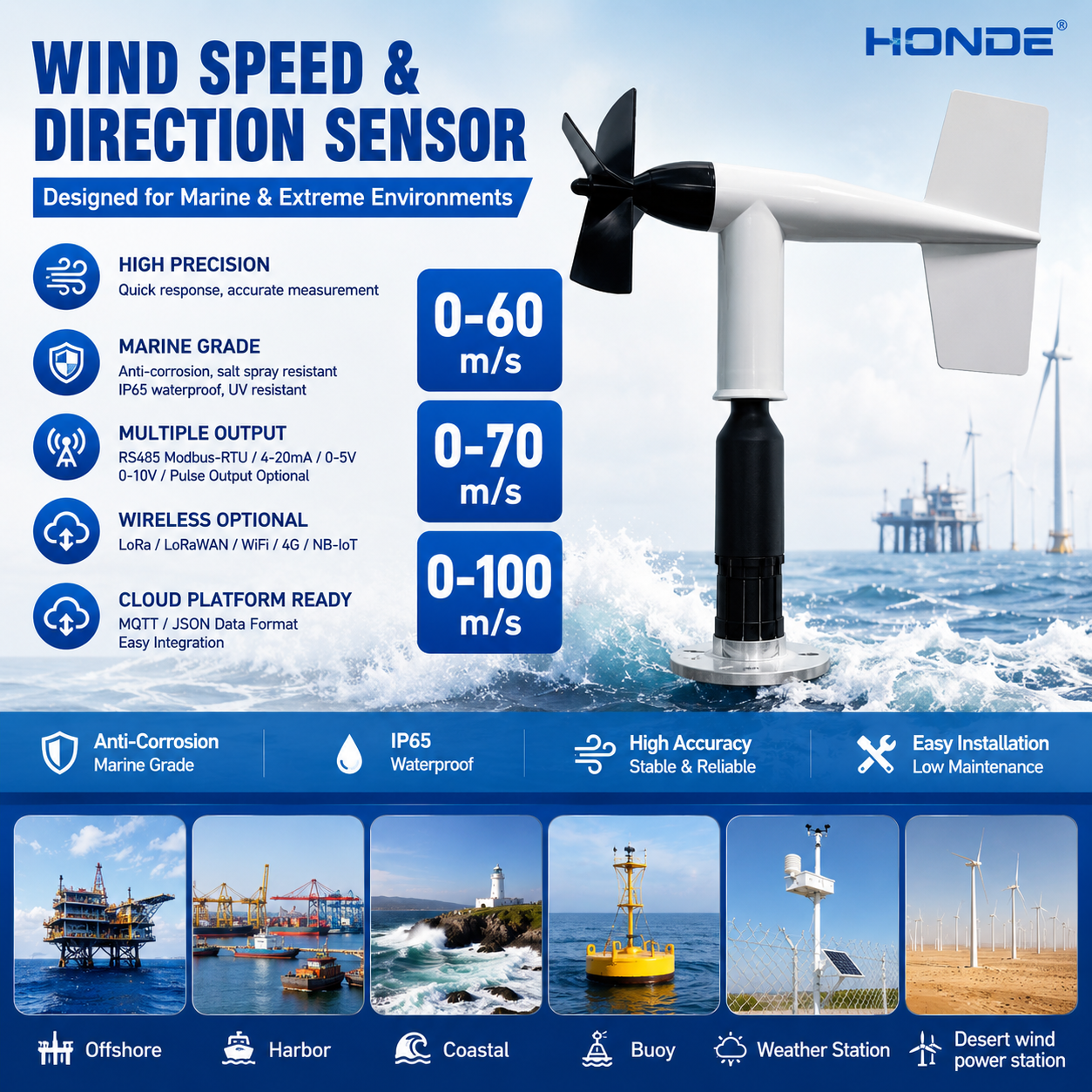
The integrated wind speed and direction sensor with tail fin by Honde Technology Co., Ltd. is a heavy-duty meteorological instrument engineered for high-velocity measurements in extreme environments. Featuring a propeller-style rotor and a high-stability tail fin, it supports a standard measurement range of 0–60 m/s, customizable up to 0–70 m/s. Optimized for marine environments and wind generator efficiency, the unit utilizes specialized anti-corrosion bearings in both sensing components. Its primary advantage is its ability to maintain accuracy under extreme aerodynamic loading where traditional cup anemometers typically fail or suffer from inertia-driven overspeeding.
Why Environmental Resilience Matters in Wind Sensing
In industrial meteorology, the “cup-and-vane” configurations often utilized in terrestrial stations frequently fail when deployed in coastal or sand-heavy regions. Salt-mist saturation and abrasive particulate matter act as grinding agents, quickly degrading standard bearings and leading to significant data drift or total mechanical seizure. For the Senior Engineer, durability is a functional prerequisite for data integrity.
High-velocity environments (exceeding 50 m/s) subject sensors to massive aerodynamic loading. Traditional cup anemometers are prone to “overspeeding”—a phenomenon where the inertia of the cups causes them to continue spinning at high rates even after a gust has subsided, leading to artificially inflated averages. The Honde propeller design mitigates this inertia, providing a more responsive and accurate profile. Furthermore, the large-surface-area tail fin is designed to provide a higher restoring moment, ensuring the sensor remains perfectly aligned with the wind vector even in turbulent marine air. This precision is critical for the yaw control of wind turbines; if the sensor is misaligned due to corrosion or poor design, the turbine will not face the wind optimally, resulting in substantial power loss and unnecessary mechanical stress on the nacelle.
Technical Specifications: Honde New Type Wind Sensor
| Feature | Specification |
|---|---|
| Measurement Range | 0 to 60 m/s (Standard); Customizable up to 0 to 70 m/s |
| Integrated Functions | Combined Wind Speed and Wind Direction |
| Output Signals | RS485 (Digital), 4-20mA (Analog), Customizable |
| Internal Components | Built-in anti-corrosion bearings in both speed and direction rotors |
| Housing Material | High-grade molded polymer/composite body with metal mounting base |
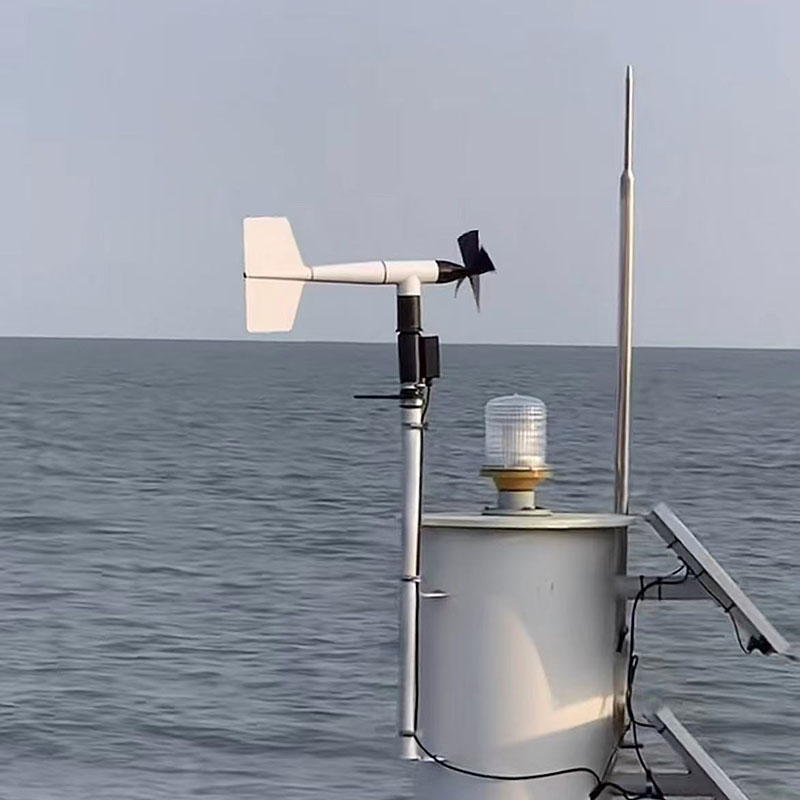
| Environment Suitability | Marine (salt mist), Sand/Dust, Wind Generator (Yaw Control) |
Key Features for Industrial & Marine Applications
-
Propeller Dynamics vs. Traditional Cup Anemometers
The propeller-style rotor is engineered for high-velocity capacity and responsiveness. By minimizing the “overspeeding” common in cup anemometers, this sensor provides a more accurate representation of gust profiles in storm-prone marine areas. [Internal Link: Propeller Anemometer vs. Cup Anemometer]
-
Dual-Section Anti-Corrosion Bearings
Longevity in sea environments is achieved through specialized industrial bearings integrated into both the wind speed and wind direction components. These bearings are specifically treated to resist the corrosive effects of salt spray and humidity, ensuring the sensor remains operational in harsh offshore conditions for extended service cycles.
-
Customizable Industrial Integration
To ensure seamless compatibility with various PLC and SCADA architectures, the sensor supports a range of customizable outputs. Whether a facility requires RS485 for long-distance digital networking or 4-20mA for standard analog loops, the hardware is tailored to the specific electrical requirements of the project. [Internal Link: Industrial RS485 Sensor Integration]
Step-by-Step Installation & Calibration Guide
Precision in the field is predicated on rigorous installation protocols. Follow these steps to ensure maximum accuracy and operational longevity:
-
1
Mounting
Insert the sensor’s metal base into the designated stand pole. Secure the unit using the provided high-torque fixing components to ensure the device remains stationary during high-velocity wind events (up to 70 m/s).
-
2
Leveling
Accuracy is dependent on a perfectly vertical axis. Use the matching leveling tools provided by Honde to verify the installation position. A non-level sensor increases bearing wear and introduces directional bias.
-
3
Geographic Orientation (North)
Locate the physical “North Arrow” marked directly on the sensor body. This arrow must be aligned precisely with geographic North. This physical calibration ensures that the wind direction data output remains accurate relative to the site’s coordinates.
-
4
Wiring and Connection
Refer to the color-coded label affixed to the cable. Utilize the provided tools to secure the connection. Honde provides clear cable definitions to prevent electrical errors during the integration of RS485 or 4-20mA loops.
E-E-A-T Verification: The Honde Advantage
Honde Technology Co., Ltd. designs its instruments for professional environments where downtime is a significant financial liability. Unlike consumer-grade sensors, these units are purpose-built for “wind generators” and “sea environments.” The inclusion of matching installation tools and clearly labeled cable definitions reflects a commitment to technical accuracy and field-serviceability. By focusing on the specific aerodynamic and corrosive challenges of industrial sites, Honde ensures their sensors provide the reliable data required for critical yaw control and marine safety operations.
Conclusion
For industrial applications requiring precise wind telemetry in ranges up to 0–70 m/s, the Honde tail-fin integrated sensor represents the current industry standard for reliability. Its combination of specialized anti-corrosion hardware and high-stability aerodynamic design makes it the premier choice for the world’s most demanding marine and wind power environments.
Contact Information
- Company: Honde Technology Co., Ltd.
- Website: www.hondetechco.com
- Email: info@hondetech.com
Send an inquiry today for a custom quote or to download the detailed specification sheet.
Post time: Jun-23-2026