

Date: June 10, 2026
Keywords: Urban Drainage Monitoring, Black-Smelly Water Sensors, 80GHz Radar Level Sensor, Non-contact Flow Meter, Manhole Gas Safety, RS485 COD NH3-N.
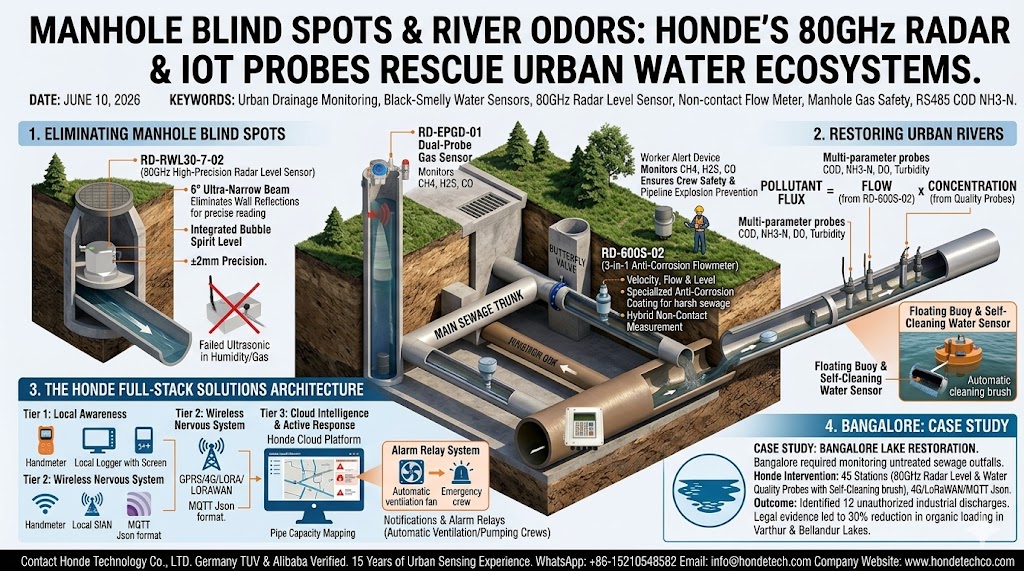
The Underground Crisis: Why Urban Drainage is the “Front Line” in June
As of June 2026, the arrival of the summer monsoon and rising temperatures has put immense pressure on urban infrastructure in rapidly urbanizing regions, specifically India (Mumbai, Bangalore), Vietnam (Ho Chi Minh City), and Thailand (Bangkok).
Urban water managers in these cities face three compounding June challenges:
- Combined Sewer Overflows (CSO): Heavy rainfall quickly exceeds pipe capacity, leading to raw sewage discharging into urban canals.
- Black-Smelly Water Acceleration: Rising temperatures speed up the anaerobic decomposition of organic matter in stagnant urban rivers, creating the dreaded “black-smelly” water condition and releasing toxic H₂S gas.
- Sensor Failure in Manholes: High humidity and corrosive sewer gases destroy traditional ultrasonic or contact-based sensors within months.
The consensus among 2026 Smart City planners is clear: Underground networks need high-frequency radar, and urban rivers need self-cleaning intelligence.
Part 1: Eliminating Manhole Blind Spots with 80GHz Precision
In the narrow, cramped environment of a city manhole, standard 24GHz radar or ultrasonic sensors often fail due to “wall reflections”—the signal bouncing off the side of the pipe or a rusty ladder instead of the water.
Honde Technology’s Urban Hydrology Series solves this with the RD-RWL30-7-02 (80GHz High-Precision Radar Level Sensor):
- ◆ 6° Ultra-Narrow Beam: By using a high-frequency 80GHz millimeter-wave signal, the beam is so focused it can “see” down a narrow manhole without touching the walls, providing ±2mm precision.
- ◆ Bubble Spirit Level Design: To ensure easy underground installation, the sensor body features an integrated physical spirit level, helping field crews ensure a perfect vertical alignment in seconds.
- ◆ Corrosion Resistance: The RD-600S-02 Black Anti-Corrosion Flowmeter is finished with a specialized industrial coating designed to survive the high H₂S concentrations typical of urban sewage.
Part 2: Restoring Urban Rivers with Autonomous Water Quality Monitoring
Treating black-smelly water requires more than just dredging; it requires tracking the Pollutant Flux (Flow Rate × Concentration).
For river outfalls and stagnant urban ponds, we deploy an integrated sensing shield:
- ◆ Nutrient Tracking: Multi-parameter probes monitor COD, Ammonia Nitrogen (NH3-N), Dissolved Oxygen (DO), and Turbidity in real-time.
- ◆ The Mover’s Edge: Our RD-EPGD-01 Dual-Probe Gas Sensors are mounted at manhole exits to monitor CH₄ and H₂S, protecting maintenance crews from explosion risks and toxic exposure.
The Honde Full-Stack Solutions Architecture
To manage thousands of manholes across a sprawling metropolis, Honde provides a tiered digital architecture:
Real-World Case Study: Combating Black-Smelly Water in Bangalore, India
Bangalore, the “Silicon Valley of India,” has faced severe pollution in its Varthur and Bellandur lakes due to untreated sewage entering the storm drains. The municipal authority required a network that could monitor outfall quality and pipe capacity simultaneously.
The Honde Intervention:
- ▶ The Network: 45 stations were deployed at critical outfalls using 80GHz Radar Level Sensors and multi-parameter quality probes.
- ▶ The Hardware: Sensors were equipped with the Automatic cleaning brush to handle the high suspended solids in the sewage.
- ▶ Transmission: Data was sent via 4G and LoRaWAN (to penetrate dense urban canyons) utilizing the MQTT Json format.
- ▶ The Outcome: Within 6 months, the Alarm Relay System helped identify 12 unauthorized industrial discharge points by tracking real-time COD/Ammonia spikes. The history data provided the “Digital Evidence” needed for legal action, leading to a 30% reduction in organic loading into the lake system.
Contact Honde Technology for Urban Water Tenders
For more sensor information and customized IoT solutions, please contact Honde Technology Co., LTD.
- WhatsApp: +86-15210548582
- Email: info@hondetech.com
- Company Website: www.hondetechco.com
Post time: Jun-12-2026