

The Seasonal Crisis: Why June Rain is a Financial Threat
By mid-July 2026, aquaculture operators in Vietnam (Ca Mau, Bac Lieu) and Thailand (Chachoengsao) are in their highest-risk production window. The arrival of monsoon rains triggers two immediate chemical failures in high-density shrimp ponds:
- 1
pH-Ammonia Flip: Heavy rain drops the pond pH, which suddenly shifts the balance of non-toxic ammonium (
NH4+) into toxic, non-ionized ammonia (
NH3). This “Ammonia Shock” can wipe out a $20,000 pond in under four hours.
- 2
Bio-fouling Speed: Warm, nutrient-rich water accelerates algae growth, which “blinds” standard sensors within 48 hours. When the sensor reports a “safe” 5.0 mg/L DO while the actual level is 1.5 mg/L, the biological collapse is invisible until the crop is lost.
Honde Technology’s Aquaculture Monitoring Series was engineered to solve these “Invisible Killers” through physical defense and digital compensation.
The Perception Layer: Built for “Sludge and Salt”
Standard industrial sensors fail in aquaculture due to biofilm accumulation and corrosive salinity. Honde bypassed these failures with three core instruments:
1. Titanium-Alloy Optical DO Sensor (RD-WQ-DO)
Traditional membrane-based sensors consume oxygen during measurement, creating a “low-oxygen shadow” in stagnant ponds.
- The Difference: Honde’s Fluorescence Quenching probe consumes zero oxygen and requires zero water flow for accuracy.
- Response Time: Stabilization within 10-15 seconds, making it the only viable choice for solar-powered stations running on 15-minute duty cycles.
- Corrosion Resistance: The full Titanium body survives high-salinity seawater and
H2S exposure where stainless steel would pit and fail.
2. Self-Cleaning 6-in-1 Nutrient Sensor (RD-ANBTNP-01)
This probe measures Ammonia Nitrogen (
NH4+), Nitrate (
NO3−), pH, and Temperature simultaneously.
- The ROI Edge: It features an Integrated Automatic Cleaning Brush that physically wipes the ion-selective membranes every 15 minutes. This prevents the biofilm “blindness” that makes uncleaned sensors useless in three days.
- TAN Calculation: Built-in algorithms use real-time pH and temperature data to calculate Total Ammonia Nitrogen (TAN) toxicity in real-time.
3. 5-in-1 Conductivity/Salinity Probe (RD-PETSTS-01)
Tracks Salinity and TDS changes after heavy rainfall, providing the data needed to manage osmotic stress in sensitive shrimp species.
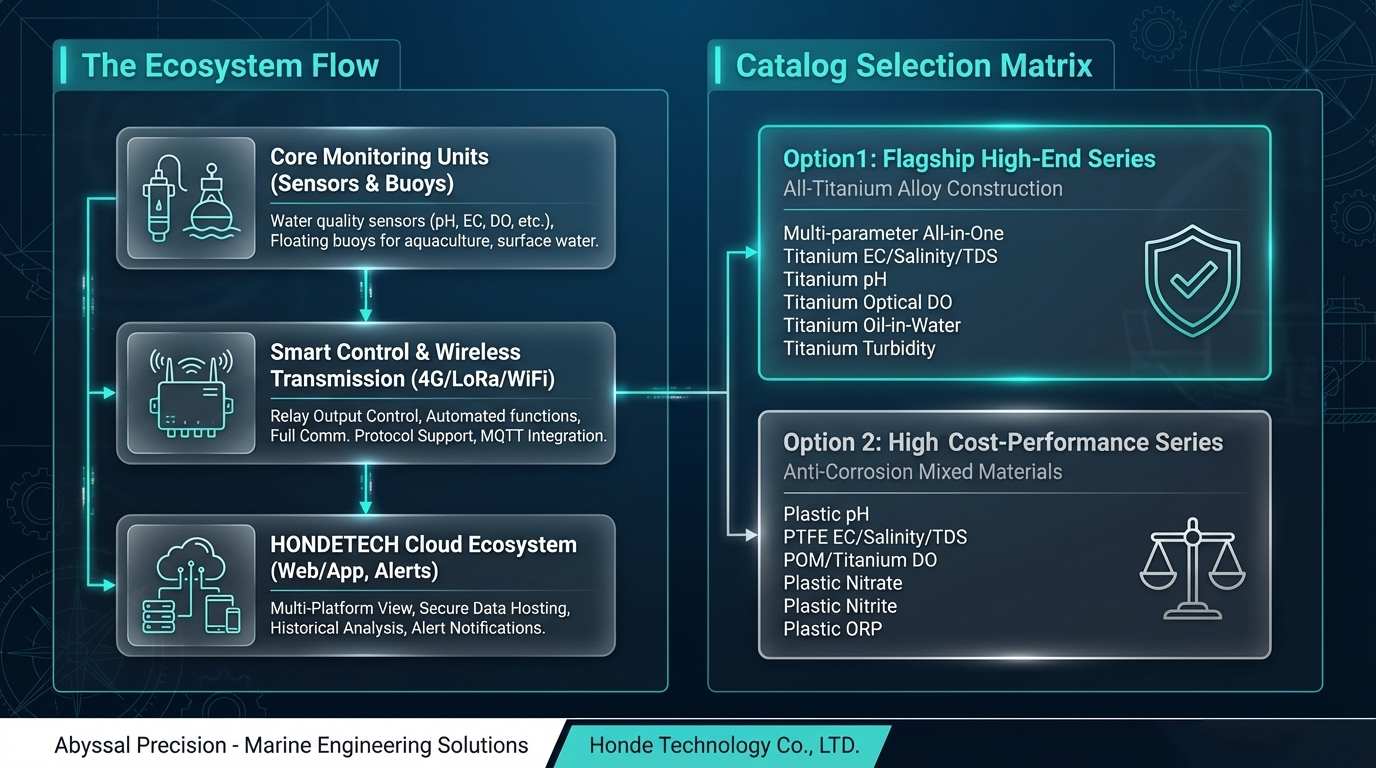
The Honde Full-Stack Solutions Architecture
Managing a farm of 50 remote ponds requires a resilient, tiered data loop:
Tier 1: Local Control & Maintenance
- Field Audit Tools: Technicians utilize our Handmeter for rapid pond-side spot-checks during daily rounds.
- Station Persistence: Each pond cluster is anchored by our Data Logger with screen, providing local farm managers with real-time graphs and 30-day history on-site—critical for manual intervention when the cellular network is down.
- Deployment: For large open-water cages, we utilize the Floating Buoy system to keep the multi-parameter probes suspended at the optimal biological depth, ensuring the Automatic cleaning brush remains effective against algae.
Tier 2: Wireless Transmission Backbone
- Remote Connectivity: Data is transmitted from remote coastal sites using GPRS, 4G, WIFI, LoRa, or LoRaWAN wireless modules.
- The MQTT Logic: For Smart Farm platforms, data is packetized in MQTT Json format. This ensures the water quality data feeds directly into the farm’s automated feeding and aeration software without custom drivers.
Tier 3: Cloud Management & Automation (The Safety Loop)
- All data is centralized on the Cloud server and software, visualizing the real-time “Risk Map” of the entire farm.
- The Alarm Relay System: This is the ultimate life-saver. If DO levels drop below the critical 4.0 mg/L threshold or Ammonia spikes, the cloud triggers a physical Alarm Relay system on-site. This automatically activates the Paddlewheel Aerators or oxygen injection pumps—responding 30 minutes faster than any human watchman.
Real-World Case Study: Super-Intensive Shrimping in Ca Mau, Vietnam
A B2B aquaculture group in Vietnam’s Ca Mau province required a scalable monitoring grid for 25 super-intensive ponds. High temperatures and rainwater runoff were causing 15% mortality per cycle.
The Honde Intervention:
- Hardware: Deployed Titanium Optical DO Sensors and Self-Cleaning Ammonia Probes on Floating Buoy systems.
- Transmission: Used LoRaWAN to transmit data over 10km to a central 4G gateway, utilizing the MQTT Json format.
- The Outcome: The Automatic cleaning brush reduced manual pond visits by 80%. During the June 2026 monsoon start, the Alarm Relay System intercepted 12 critical hypoxia events at 2 AM by automatically triggering aerators. The group reported a 100% survival rate and a 15% reduction in electricity costs by only running aerators when the real-time data required it.
Contact Honde Technology for Aquaculture Tenders
We provide the sensors, the software, and the “Micro-Engineering” needed to turn high-risk farming into a predictable, high-yield business.
For more sensor information and customized IoT solutions, please contact Honde Technology Co., LTD.
WhatsApp: +86-15210548582
Email: info@hondetech.com
Company Website: www.hondetechco.com
Post time: Jul-23-2026