

Australia’s public aquatic centre operators have a staffing problem that intersects directly with a compliance problem. Victorian Health Regulations require free chlorine levels between 1.0 and 3.0 mg/L in pools and 3.0 to 5.0 mg/L in spas, tested at minimum every two hours — more frequently during peak bather load. A council aquatic centre running six pool zones across an eight-hour operating day generates at least 24 manual test records per day, every day of the year.
The person doing those tests is the same person supervising the water, instructing the learn-to-swim classes, and managing the front desk during the morning rush. When the February 2026 Public Spectrum analysis of smart monitoring adoption in council aquatic facilities documented that manual testing was the single largest time sink in facility water management — consuming 45 minutes of staff time daily at a medium-sized centre — the finding was not surprising. It was simply the first time anyone had counted it.
The draft AS 3633 standard revision, currently in public comment through October 2026, will for the first time distinguish between facilities using continuous automated monitoring and those relying on manual testing — with proportionally relaxed manual verification requirements for the former. The standard revision is the regulatory signal that Australian aquatic centre operators have been waiting for: automated monitoring is not just a convenience, it is the direction of travel.
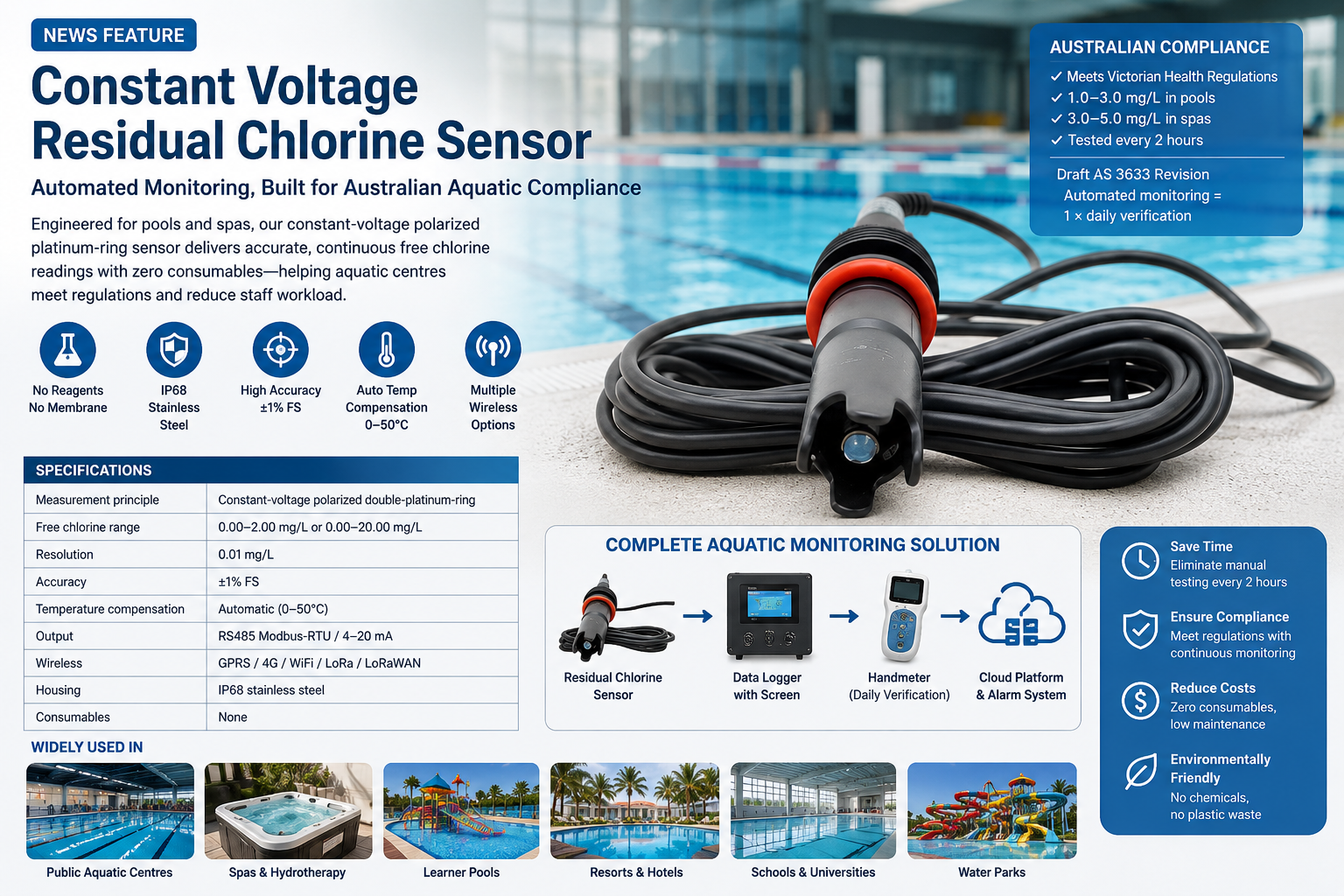
The Sensor in a Pool Environment
The constant-voltage residual chlorine sensor operates by applying a fixed potential across two platinum rings immersed in the pool return water. Free chlorine reacts at the electrode surface, generating a current proportional to its concentration. The sensor outputs a continuous, calibrated free chlorine reading with no reagent, no membrane, and no electrolyte.
The absence of consumables is the governing specification for an aquatic facility deployment. Pool water is not gentle. Cyanuric acid (stabilizer), salt (in salt-chlorinated pools), pH buffers, and bather-introduced organics create an aggressive chemical environment. Membrane-based sensors designed for drinking water service last months in pool water before the membrane degrades. Reagent-based colorimetric analyzers consume DPD tablets, require weekly chemical replenishment, and generate plastic waste — an increasingly scrutinized sustainability metric for council facilities.
The constant-voltage platinum-ring sensor has no membrane to degrade and no reagent to replenish.
| Specification | Value |
|---|---|
| Measurement principle | Constant-voltage polarized double-platinum-ring |
| Free chlorine range | 0.00–2.00 mg/L or 0.00–20.00 mg/L |
| Resolution | 0.01 mg/L |
| Accuracy | ±1% FS |
| Temperature compensation | Automatic (0–50°C) |
| Output | RS485 Modbus-RTU / 4–20 mA |
| Wireless | GPRS / 4G / WiFi / LoRa / LoRaWAN |
| Housing | IP68 stainless steel |
| Consumables | None |
Australian Regulatory Thresholds
| Facility type | Free chlorine minimum | Free chlorine maximum | Testing frequency (manual) |
|---|---|---|---|
| Swimming pool (Victoria) | 1.0 mg/L | 3.0 mg/L | Every 2 hours |
| Spa/hydrotherapy (Victoria) | 3.0 mg/L | 5.0 mg/L | Every 30 min (bather load) |
| Outdoor pool (NSW, summer peak) | 1.0 mg/L | 5.0 mg/L | Every 1 hour |
| Learner pool (heated) | 1.0 mg/L | 3.0 mg/L | Every 2 hours |
| With automated monitoring (draft AS 3633) | As above | As above | 1 × daily verification |
The Solution Architecture
The sensor mounts in a bypass line on each pool’s return circuit — a small tee off the main pipe feeding a flow cell with isolation valves. The pool operator does not need to stop the pool to install, calibrate, or replace the sensor. A Data logger with screen in the plant room displays current free chlorine, pH (from a co-located pH sensor), and water temperature for each pool zone — all visible during the morning start-up check. The facility’s supervisor uses the Handmeter daily for the required manual verification, comparing the portable DPD or electronic reference against the installed sensor reading and logging the comparison in the compliance record.
Sensors at each pool zone connect via WiFi or 4G modules to the centre’s building management system or the council’s cloud platform. Remote facilities — outdoor pools in regional Victoria and rural NSW — use LoRaWAN or GPRS where municipal WiFi is unavailable. All data is packetized in MQTT Json format, feeding both the local management dashboard and the council’s centralized compliance reporting platform.
The Cloud server and software consolidates chlorine data from all pool zones and all facilities in the council portfolio, showing real-time data and history data. The Alarm relay system operates on three thresholds for each zone:
| Threshold | Trigger | Relay action |
|---|---|---|
| Low alert | Free Cl < 1.2 mg/L | Notify duty supervisor (SMS/app) |
| Low alarm | Free Cl < 1.0 mg/L | Increase dosing pump rate; log event |
| Critical | Free Cl < 0.8 mg/L for > 5 min | Suspend lane access; alert manager; continue dosing |
The high-side alarms mirror the low-side logic — over-chlorination above 3.5 mg/L triggers dosing pump shutdown and an operator notification.
Field Results: Victorian Council Aquatic Centre Portfolio, 2026
A regional Victorian council operating three aquatic centres deployed Honde constant-voltage chlorine sensors across 14 pool zones between January and March 2026 — the peak summer season where bather load is highest and chlorine demand most variable.
Six-month operational comparison — January–June 2026:
| Metric | Manual testing baseline (Jan–Jun 2025) | Automated sensor network (Jan–Jun 2026) |
|---|---|---|
| Manual chlorine tests performed | 2,184 | 186 (daily verification only) |
| Staff time for water testing (hours) | 273 | 23 |
| Compliance exceedances (< 1.0 mg/L recorded) | 14 | 2 |
| DPD tablet expenditure | AU$2,100 | AU$0 |
| Events caught between manual test cycles | 0 (undetectable) | 31 |
| Dosing pump failures detected within 15 min | 0 (undetectable) | 8 |
Operational outcomes:
- 31 chlorine events caught between test cycles — including 8 dosing pump failures — represent the category of exceedance that manual testing can never detect. Each lasted between 8 and 94 minutes in the 2026 data. Three lasted long enough that, had the centre been operating a manual-only regime, they would have met the definition of a compliance breach.
- Staff time for water testing dropped from 273 to 23 hours — equivalent to one part-time pool technician position redirected to patron supervision and maintenance. The council cited this as the primary financial justification for the installation, before accounting for the compliance-risk reduction.
- Compliance exceedances fell from 14 to 2. Both 2026 exceedances occurred at a spa zone during a mechanical dosing failure — the automated relay caught both within 4 minutes and suspended bather access before the council’s environmental health officer was required to intervene.
- The council’s 2026 compliance submission to the Victorian Department of Health included continuous 15-minute chlorine data for all 14 zones — the most complete chlorine compliance record the council had ever produced, and the first accepted without any supplementary manual records attached.
Contact Honde Technology for Aquatic Facility Monitoring
Honde Technology is a Germany TUV & Alibaba verified manufacturer. We supply the reagent-free chlorine monitoring hardware, the pool-environment-rated flow-cell installation kits, and the multi-site management platform required by council and commercial aquatic facility operators.
For more sensor information and customized IoT solutions, please contact Honde Technology Co., LTD.
- WhatsApp: +86-15210548582
- Email: info@hondetech.com
- Company Website: www.hondetechco.com
The Demand Map Across Developed Aquatic Markets
The same automation driver — staff time, reagent cost, and continuous detection of events between manual tests — applies across every developed country operating a public pool network under health regulation. New Zealand’s territorial authority pools operate under similar Ministry of Health guidelines to Victoria’s, and several district health board networks are evaluating smart monitoring under the same draft standard framework. Japan’s Ministry of Health, Labour and Welfare regulations for public bathing facilities (including hotel pools and onsen facilities) require minimum 0.4 mg/L residual at all times, with a 13,000-facility market that has adopted automated monitoring in major urban chains since 2024. South Korea’s K-Water smart aquatic program mandates continuous water quality monitoring in all public pools operated by local government authorities from 2027. Germany’s DIN 19643 standard for pool water treatment has always required continuous online measurement — the reagent-free sensor is the specification that eliminates the reagent supply chain from compliance. Each market’s regulatory direction converges on the same outcome: the facility that monitors continuously is the one that demonstrates compliance, and the sensor that does it without consumables is the one that survives in a pool-water environment for the full service interval.
Post time: Aug-31-2026