

A LoRaWAN soil and weather monitoring system combines soil sensors, an integrated weather station, a LoRaWAN collector, and a wireless gateway to provide remote environmental monitoring for agriculture.
The system collects important soil and meteorological data from the field, transmits sensor information through a low-power wireless network, and sends the collected data to a cloud server for remote monitoring and analysis.
A typical system can include a multi-parameter soil sensor, a 7 in 1 weather station, a LoRaWAN collector, and a 4G or Ethernet gateway. This architecture helps farms, greenhouses, agricultural projects, and environmental monitoring stations reduce wiring complexity while improving the efficiency of data collection.
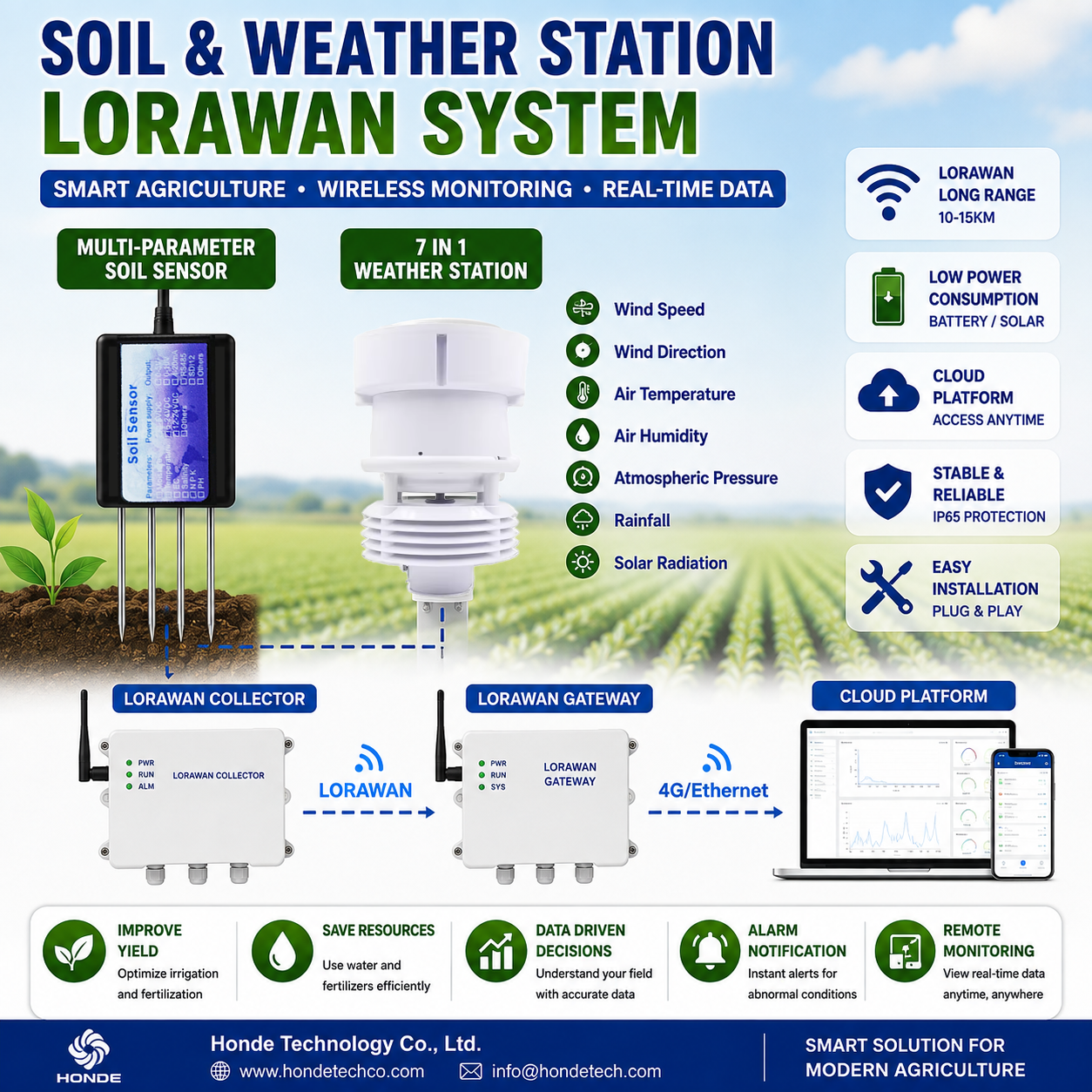
What Is a LoRaWAN Soil and Weather Monitoring System?
A LoRaWAN soil and weather monitoring system is an IoT-based environmental monitoring solution designed to collect agricultural and meteorological data from multiple sensors and transmit the information wirelessly over long distances.
The complete system usually includes four layers:
- Soil Monitoring Layer
- Weather Monitoring Layer
- LoRaWAN Data Collection Layer
- Gateway and Cloud Transmission Layer
Instead of installing separate communication equipment for every sensor, multiple monitoring devices can be connected to a collector and integrated into a centralized wireless monitoring network.
System Architecture
This architecture is particularly suitable for agricultural environments where sensors may be installed across large fields and traditional communication wiring is difficult or expensive.
Core Components of the Agricultural Monitoring System
1. Multi-Parameter Soil Sensor
The soil sensor is responsible for monitoring important soil conditions.
Depending on the selected configuration, a multi-parameter soil sensor can measure:
- ✓ Soil Moisture
- ✓ Soil Temperature
- ✓ Soil EC
- ✓ Soil Salinity
- ✓ Soil pH
- ✓ Nitrogen
- ✓ Phosphorus
- ✓ Potassium
These parameters provide important information for irrigation management, fertilizer management, and crop growth analysis.
A multi-parameter soil sensor can reduce the need to install multiple independent sensors in the same monitoring location.
The soil sensor shown in this system uses a probe structure designed for direct insertion into the soil.
2. 7 in 1 Compact Weather Station
The weather station provides real-time information about the environmental conditions surrounding crops.
A typical 7 in 1 weather station can monitor:
| Parameter | Application |
|---|---|
| Wind Speed | Weather and crop environment monitoring |
| Wind Direction | Local wind condition analysis |
| Air Temperature | Crop climate monitoring |
| Air Humidity | Greenhouse and field management |
| Atmospheric Pressure | Local weather analysis |
| Rainfall | Irrigation and rainfall monitoring |
| Solar Radiation / Illumination | Crop growth environment monitoring |
The compact design integrates multiple environmental sensors into one device, reducing installation complexity compared with traditional weather monitoring equipment.
Many configurations also support RS485 Modbus communication and optional wireless transmission technologies.
Why Combine Soil Sensors and Weather Stations?
Soil data alone cannot provide a complete picture of agricultural conditions.
For example:
- Soil moisture may be affected by rainfall.
- Soil temperature can change with air temperature and solar radiation.
- Crop water demand is influenced by temperature, humidity, wind, and sunlight.
- Fertilizer management requires understanding both soil conditions and environmental conditions.
By combining soil monitoring and weather monitoring, agricultural managers can collect more complete environmental data.
Example Monitoring Combination
| Monitoring Area | Typical Parameters |
|---|---|
| Soil | Moisture Temperature EC Salinity NPK |
| Weather | Wind Temperature Humidity Rainfall Radiation |
| Communication | LoRa / LoRaWAN |
| Data Transmission | 4G / Ethernet |
| Data Platform | Cloud Server |
| Application | Smart Agriculture |
This integrated approach is useful for building a more complete precision agriculture monitoring system.
How Does the LoRaWAN Collector Work?
The LoRaWAN collector acts as the connection point between field sensors and the wireless communication network.
Its main functions include:
- Connecting multiple sensors
- Reading sensor data
- Collecting RS485 information
- Packaging environmental data
- Transmitting data wirelessly
The collector can connect monitoring devices such as:
- Soil Sensors
- Weather Stations
- Water Quality Sensors
- Environmental Sensors
After receiving sensor information, the collector transmits the data through the LoRa wireless network.
This design can significantly reduce communication wiring requirements in large agricultural monitoring projects.
What Does the LoRaWAN Gateway Do?
The LoRaWAN gateway is responsible for receiving wireless data from the collector and forwarding the information to a remote server.
The communication process is:
The gateway can provide the connection between the field monitoring network and the Internet.
Depending on the project configuration, the gateway may support:
- 4G Communication
- Ethernet Communication
- MQTT Protocol
- Cloud Server Connection
- Private Server Connection
This allows users to access environmental monitoring information remotely.
Why Is LoRaWAN Suitable for Smart Agriculture?
LoRaWAN is widely used for remote IoT monitoring applications because agricultural projects often require sensors to operate across large areas.
Key Advantages
Long-Distance Communication
LoRa technology is designed for long-range wireless communication, making it suitable for distributed agricultural monitoring points.
Low Power Consumption
Low-power communication is important for remote monitoring systems, particularly in locations using solar power or independent power systems.
Flexible Sensor Deployment
Sensors can be installed at different locations throughout:
- Farms
- Orchards
- Greenhouses
- Plantations
- Agricultural Research Stations
Reduced Wiring
Wireless communication can reduce the amount of communication cable required between distributed monitoring points.
The exact communication distance depends on installation conditions, terrain, buildings, vegetation, and other environmental factors.
LoRaWAN Soil and Weather Monitoring System Workflow
The following process explains how the complete system works.
Step 1: Sensors Collect Environmental Data
The soil sensor measures underground conditions.
The weather station monitors atmospheric conditions.
Step 2: The Collector Reads Sensor Data
The collector receives information from connected monitoring devices.
Step 3: Data Is Transmitted Through LoRa
The collector sends environmental information wirelessly to the LoRaWAN gateway.
Step 4: The Gateway Connects to the Internet
The gateway forwards the received data through available communication methods such as 4G or Ethernet.
Step 5: Data Is Sent to the Cloud
Users can access monitoring information through a server or software platform.
The complete workflow creates an automated environmental monitoring network.
Main Applications of LoRaWAN Agricultural Monitoring Systems
Precision Agriculture
Monitor soil conditions and weather conditions to support agricultural management decisions.
Greenhouse Agriculture
Monitor environmental parameters inside and around agricultural production areas.
Orchards
Install distributed sensors to monitor soil moisture and local weather conditions.
Large Farms
Build multiple remote monitoring points across large agricultural areas.
Forestry
Monitor environmental conditions in remote locations.
Irrigation Management
Use soil moisture and rainfall data to support irrigation planning.
Agricultural Research
Collect environmental data for crop research and field experiments.
LoRaWAN System vs Traditional Wired Monitoring
| Feature | LoRaWAN Monitoring System | Traditional Wired System |
|---|---|---|
| Communication | Wireless | Cable |
| Installation | Flexible | More complex |
| Large Area Deployment | Suitable | Cable-dependent |
| Sensor Expansion | Easier | May require additional wiring |
| Remote Monitoring | Supported | Depends on system design |
| Agricultural Applications | Highly suitable | Suitable for fixed locations |
For large agricultural projects, wireless communication can provide more flexibility when monitoring points are distributed over a wide area.
How to Choose the Right LoRaWAN Soil Monitoring System?
Before purchasing a complete monitoring system, consider the following questions.
1. What Parameters Do You Need?
Choose only the parameters required by your project.
For example:
Basic Soil Monitoring
- Soil Moisture
- Soil Temperature
Advanced Soil Monitoring
- Moisture
- Temperature
- EC
- Salinity
- pH
- NPK
2. How Large Is the Monitoring Area?
The size and terrain of the project influence the communication architecture.
Consider:
- Distance between sensors
- Buildings
- Trees
- Mountains
- Signal obstacles
3. What Communication Method Do You Need?
Possible communication options include:
- RS485
- LoRa
- LoRaWAN
- WiFi
- 4G
- GPRS
The best solution depends on the local infrastructure and project requirements.
4. Do You Need Cloud Monitoring?
For remote projects, cloud software can allow users to view:
- Real-Time Data
- Historical Data
- Data Trends
- Downloaded Records
Common Mistakes When Building a Smart Agriculture Monitoring System
Based on practical system design considerations, buyers should avoid selecting sensors based only on the number of parameters.
Mistake 1: Ignoring Communication Architecture
A high-quality sensor is not enough if the communication system cannot reliably transmit data.
Always consider:
Mistake 2: Installing Too Many Separate Devices
Using multiple independent communication systems can increase installation complexity.
An integrated system can simplify the overall architecture.
Mistake 3: Ignoring Future Expansion
Agricultural projects may later need additional sensors.
It is better to consider future requirements such as:
- Additional Soil Sensors
- Water Sensors
- Weather Sensors
- Radiation Sensors
Mistake 4: Selecting the Wrong Wireless Technology
Communication technology should be selected according to:
- Monitoring distance
- Power availability
- Internet coverage
- Installation environment
Honde Technology LoRaWAN Agricultural Monitoring Solutions
Honde Technology Co., Ltd. provides environmental monitoring solutions that combine sensors, weather stations, wireless communication equipment, gateways, and remote data platforms.
The system architecture can be customized according to project requirements.
Available monitoring equipment can include:
- Soil Sensors
- Multi-Parameter Soil Sensors
- Compact Weather Stations
- LoRa Collectors
- LoRaWAN Gateways
- 4G Communication Systems
- Cloud Monitoring Software
The goal is to provide a complete solution from environmental sensing to remote data transmission.
For more environmental monitoring solutions, visit:
Honde Technology Official Website
The company also provides product demonstration videos and system introductions:
Frequently Asked Questions
What is a LoRaWAN soil monitoring system?
A LoRaWAN soil monitoring system uses soil sensors and low-power wireless communication technology to transmit soil data from the field to a gateway and remote monitoring platform.
Can one system monitor both soil and weather conditions?
Yes. A complete agricultural monitoring system can integrate soil sensors and weather stations into the same communication network.
What parameters can a soil sensor measure?
Depending on the model, parameters may include soil moisture, temperature, EC, salinity, pH, nitrogen, phosphorus, and potassium.
Why use a LoRaWAN collector?
A collector can gather data from connected sensors and transmit the information wirelessly, helping simplify communication architecture.
Can the system support remote monitoring?
Yes. When connected through a gateway and Internet communication system, monitoring data can be transmitted to a cloud server or compatible software platform.
Build Your Smart Agriculture Monitoring System
A modern agricultural IoT system should not simply collect isolated sensor data.
The real value comes from connecting:
A properly designed LoRaWAN soil and weather monitoring system can help create a scalable environmental monitoring network for farms, greenhouses, orchards, research projects, and other agricultural applications.
If you are planning a custom agricultural monitoring project, Honde Technology can provide different combinations of:
Get a Custom Solution for Your Project
Company Name: Honde Technology Co., Ltd.
Website: www.hondetechco.com
Email: info@hondetech.com
Post time: Sep-01-2026