

The Egypt Reality: Salinity is Not an Event — It’s a Velocity
By mid-2026, Egypt’s agricultural heartland — the Nile Delta — is confronting a slow-moving crisis that no single storm or policy can reverse. Over 35% of the Delta’s irrigated land now registers soil salinity above 4 dS/m, the threshold at which most staple crops begin losing yield. The primary driver is secondary irrigation-driven salinization: as water flows through the Delta’s 33,000-kilometer canal network, it picks up dissolved salts from soil, fertilizer runoff, and shallow saline groundwater. By the time it reaches the terminal drains and is recirculated for reuse, the EC has often climbed from 500 µS/cm at the main canal intake to 2,500–5,000 µS/cm at the tail-end farm gate.
The Egyptian government’s Water Strategy 2050 and the Nile Delta Water Management Programme (NDWM) mandate real-time salinity monitoring at hundreds of canal junctions and drainage mixing stations. The engineering constraint is not sensor availability — it is infrastructure compatibility. Egypt’s irrigation control infrastructure spans four decades of technology generations. Many pump stations use PLCs and RTUs from the 1990s and 2000s that accept only 4-20mA analog inputs. Ripping out these working systems for a “pure digital” upgrade is budgetarily impossible.
Honde Technology’s IoT Dual-Output EC Sensor was specified for NDWM pilot deployments because it provides a single hardware unit that talks to both worlds: legacy analog PLCs and modern IoT cloud platforms — simultaneously.
The Hardware: Dual-Output Engineering for Mixed-Generation Infrastructure
The sensor addresses three specific failure modes that kill standard conductivity probes in Delta conditions within months.
1. Graphite Electrodes — Anti-Polarization, Anti-Fouling
- Cheap metal electrodes (copper, nickel-plated brass) fail in the Delta through electrolytic corrosion and polarization artifact. When DC excitation is applied to a metal electrode in saline water, ions accumulate at the electrode surface, creating a measurement error that grows over time.
- Honde uses high-grade graphite electrodes with high-frequency AC excitation. The alternating current prevents ion accumulation, and the graphite material does not corrode in the pH 7.2–8.5 range typical of Delta drainage water.
- The result: ±1% FS accuracy maintained over a 12-month calibration cycle, not the 30–60 day drift typical of metal-electrode probes.
2. 4-20mA + RS485 Simultaneous Output — The “Bridge” Architecture
This is the procurement decision-maker.
- 4-20mA analog output: Connects directly to the existing PLC analog input card at the pump station. Zero protocol conversion hardware required. The station operator sees the EC value on the same panel they have used for 15 years.
- RS485 Modbus-RTU digital output: Simultaneously transmits the full data packet — EC, temperature, TDS, salinity conversion, sensor diagnostics — to the IoT communication module.
- Why this matters in Egypt: The Ministry of Water Resources and Irrigation (MWRI) can deploy digital telemetry at its own pace, node by node, without disrupting the analog control loop that keeps pumps running. This is the technical path that government tenders specify because it eliminates “rip-and-replace” political risk.
3. 0–5,000 ppm Range with ATC
The sensor’s measurement span covers the critical Delta range: from fresh Nile water (200–400 µS/cm, approximately 100–200 ppm TDS) through blended drainage water (1,500–3,000 µS/cm) to severely degraded tail-end water (5,000+ µS/cm).
- Built-in automatic temperature compensation (ATC) corrects for the 15°C–35°C seasonal temperature swing in Delta canals, which would otherwise produce a ±12% error in uncompensated readings.
The Honde Full-Stack Architecture for Delta Deployments
A conductivity reading at a canal junction is a data point. A Honde Solution is a water-allocation decision system.
Tier 1: Local Verification & Legacy Integration
- Field technicians from the MWRI’s Mechanical and Electrical Department use the Handmeter for rapid spot-checks against the installed sensors during quarterly calibration rounds.
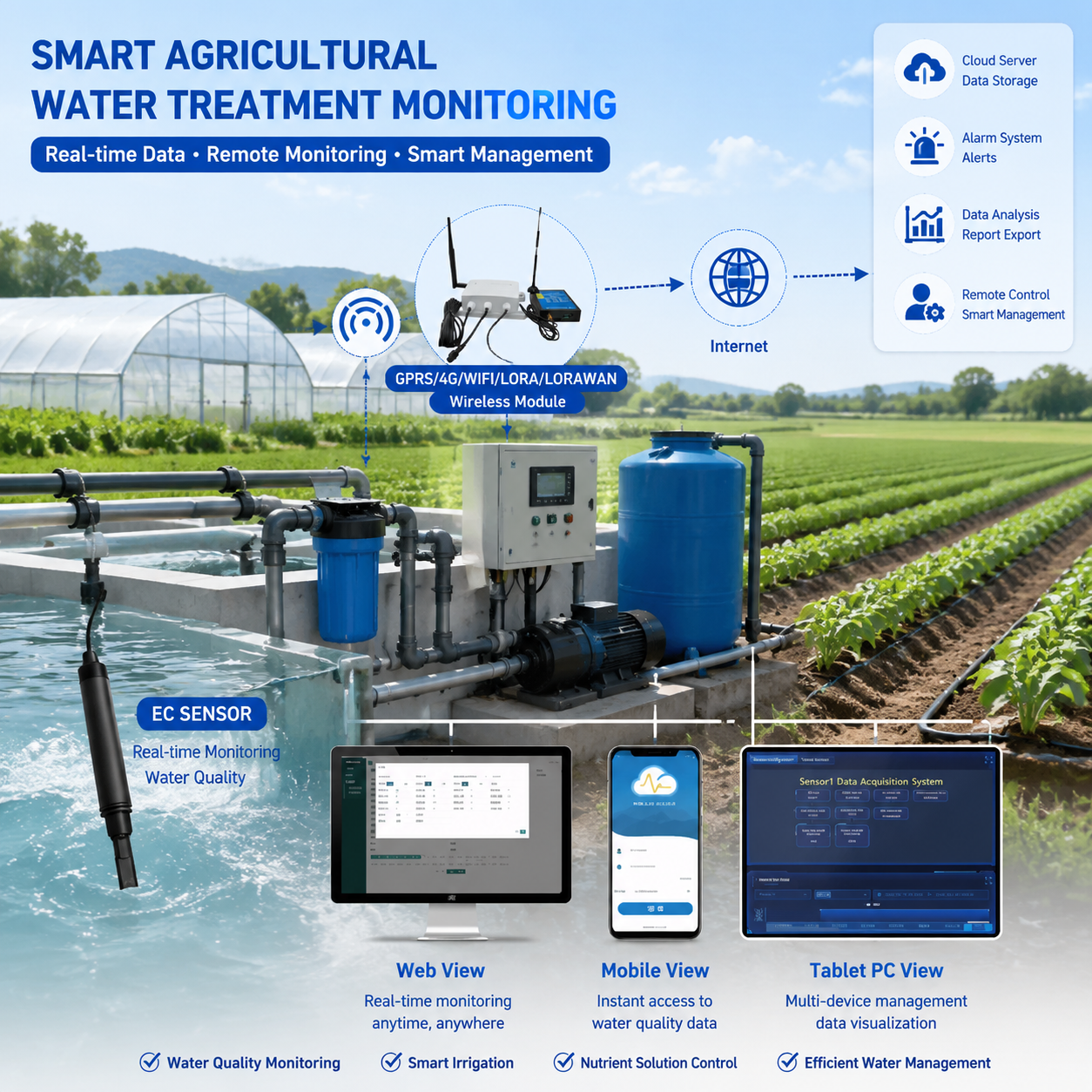
- Each monitoring station connects to a Data Logger with screen, giving the local canal operator real-time EC, temperature, and 30-day graphical history on-site — even during the frequent power outages that interrupt SCADA connectivity in rural Delta villages.
Tier 2: Wireless Transmission Backbone
- Station communication modules support GPRS, 4G, WIFI, LoRa, or LoRaWAN, selected based on cellular coverage at each site. In the Delta’s more remote western fringes, LoRaWAN provides 8–10km range to a gateway at the nearest district office.
- All digital data is packetized in MQTT Json format, feeding directly into the MWRI’s central telemetry platform at the National Water Research Center in Qanater.
Tier 3: Cloud Management & Salinity-Driven Intervention
- The Cloud server and software consolidates EC data from every canal node into a real-time “Salinity Map” of the Delta, showing real-time data and history data.
- The Alarm Relay System operates on a single critical parameter: blending ratio safety. At drainage mixing stations where fresh Nile water is blended with agricultural drainage water for reuse, the cloud monitors the EC of the blended output. If the blended EC exceeds the crop-specific salinity threshold (e.g., 1,500 µS/cm for maize), the relay automatically adjusts the motorized mixing gate to increase the fresh-water ratio — preventing an entire irrigation district from receiving toxic-salinity water due to a manual gate-setting error.
Field Results: NDWM Pilot, Kafr El-Sheikh Governorate, July 2026
A pilot deployment of 35 Honde dual-output EC sensors was commissioned in June 2026 across three irrigation districts in Kafr El-Sheikh Governorate — one of the Delta’s most salinity-affected zones.
Operational outcomes after 45 days (June–July 2026):
- The network identified 6 canal segments where salinity was climbing above 3,000 µS/cm — locations previously invisible to the MWRI’s quarterly manual sampling program. Three were traced to illegal drainage-water pumping into irrigation canals, enabling targeted enforcement.
- At the 12 automated mixing stations, the Alarm Relay System corrected blending ratios 18 times during the pilot — events where a manual gate-setting error would have delivered water above the crop-salinity threshold to downstream farms.
- The dual-output architecture enabled zero disruption to existing pump-station operations during installation. The 4-20mA signal simply paralleled onto the existing PLC input card. The digital telemetry was commissioned separately, three weeks later, without affecting the analog control loop.
- Based on crop-yield modeling from the corrected blending events, the pilot is estimated to have protected approximately $120,000 in crop value across the three irrigation districts in its first 45 days of operation.
Contact Honde Technology for Irrigation Water Tenders
Honde Technology is a Germany TUV & Alibaba verified manufacturer. We provide the sensors, the dual-output architecture, and the telemetry logic required for mixed-generation irrigation infrastructure in the world’s most water-stressed regions.
For more sensor information and customized IoT solutions, please contact Honde Technology Co., LTD.
- WhatsApp: +86-15210548582
- Email: info@hondetech.com
- Company Website: www.hondetechco.com
Post time: Jul-28-2026