

SYKE, the Finnish Environment Institute, updates the national cyanobacteria situation map multiple times per week from late June through August. As of July 8, 2026, the vesi.fi platform shows observations from approximately 400 points across Finland — most of them public bathing areas. When the map turns red at a location, the beach closes. The economic consequence — a summer weekend closure of a popular bathing lake costs the municipality in lost tourism and generates significant public complaint — is measurable. The public health consequence of not closing is worse.
The cyanobacteria warning system has a gap. Satellite observations cover large areas but provide snapshots, not continuous monitoring. Visual observations by local wardens are subjective and infrequent. Laboratory sample analysis takes 24 to 48 hours for results. In the interval between an incomplete satellite pass and the next warden visit, a bloom can form, peak, and expose hundreds of bathers to hepatotoxins and neurotoxins.
The Bloom Sequence
Cyanobacteria blooms do not appear without warning. They appear without detection — because no continuous sensor was deployed to detect the warning. The physical chemistry of a developing bloom follows a consistent sequence in Finnish eutrophic lakes:
| Stage | Temperature | pH | Dissolved Oxygen | Visual observation |
|---|---|---|---|---|
| Background (stable) | 16–18°C | 7.5–8.0 | 90–110% saturation | Clear water |
| Pre-bloom (12–24h) | 20–22°C | 8.5–9.5 | 120–140% saturation | Slight green tint |
| Bloom onset | 22–26°C | 9.5–10.5 | 150–200% saturation | Surface scum forming |
| Bloom peak | 24–28°C | 10.5–11.5 | Fluctuating | Dense scum, blue-green color |
The mechanism: cyanobacteria photosynthesize rapidly in warm, calm, nutrient-rich water. As they pull CO₂ from the water, pH rises. As they produce oxygen faster than the water column can absorb it, dissolved oxygen exceeds saturation. The floating sensor measures both phenomena at the water surface — the layer where cyanobacteria accumulate — in real time.
The Sensor
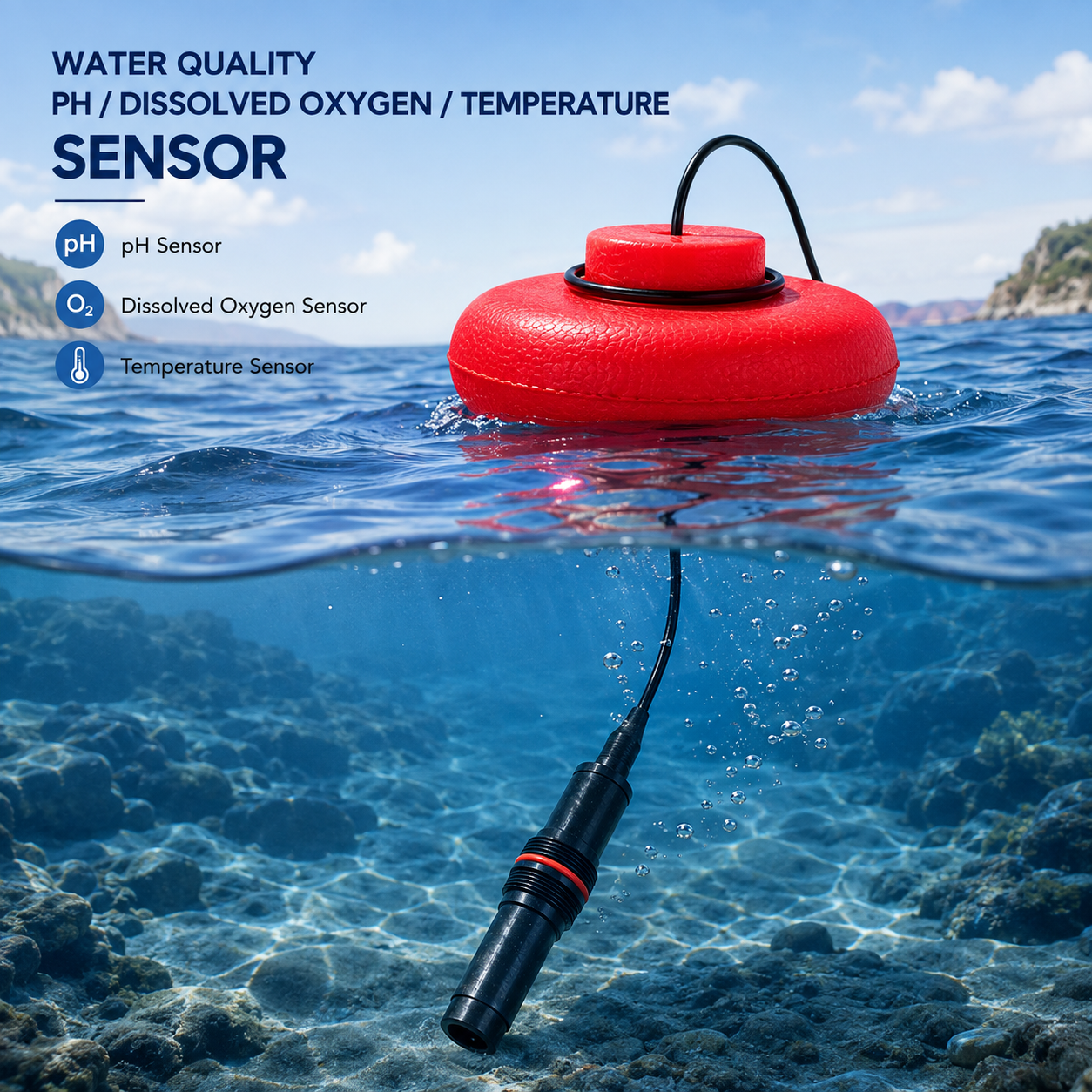
The Honde Online 3-in-1 pH/DO/Temperature probe with integrated floating collar measures the surface-layer parameters that drive the early warning logic:
| Parameter | Range | Resolution | Accuracy |
|---|---|---|---|
| pH | 0–14 | 0.01 pH | ±0.1 pH |
| Dissolved Oxygen | 0–20 mg/L / 0–200% | 0.01 mg/L | ±0.1 mg/L |
| Temperature | -10 to +80°C | 0.1°C | ±0.5°C |
| Output | RS485 Modbus-RTU | IP rating | IP68 |
| Wireless | GPRS / 4G / WiFi / LoRa / LoRaWAN | Deployment | Floating collar, 0.3–0.5 m depth |
The floating collar maintains the sensor at 0.3 to 0.5 meters depth — the layer where cyanobacteria accumulate and where bathers are exposed. A fixed-depth submersible sensor at 2 meters misses the surface layer where blooms form. The floating design tracks the surface layer regardless of water level fluctuations, which in Finnish lakes can vary 40 to 60 centimeters across a summer season.
The Solution Architecture for Finnish Lake Networks
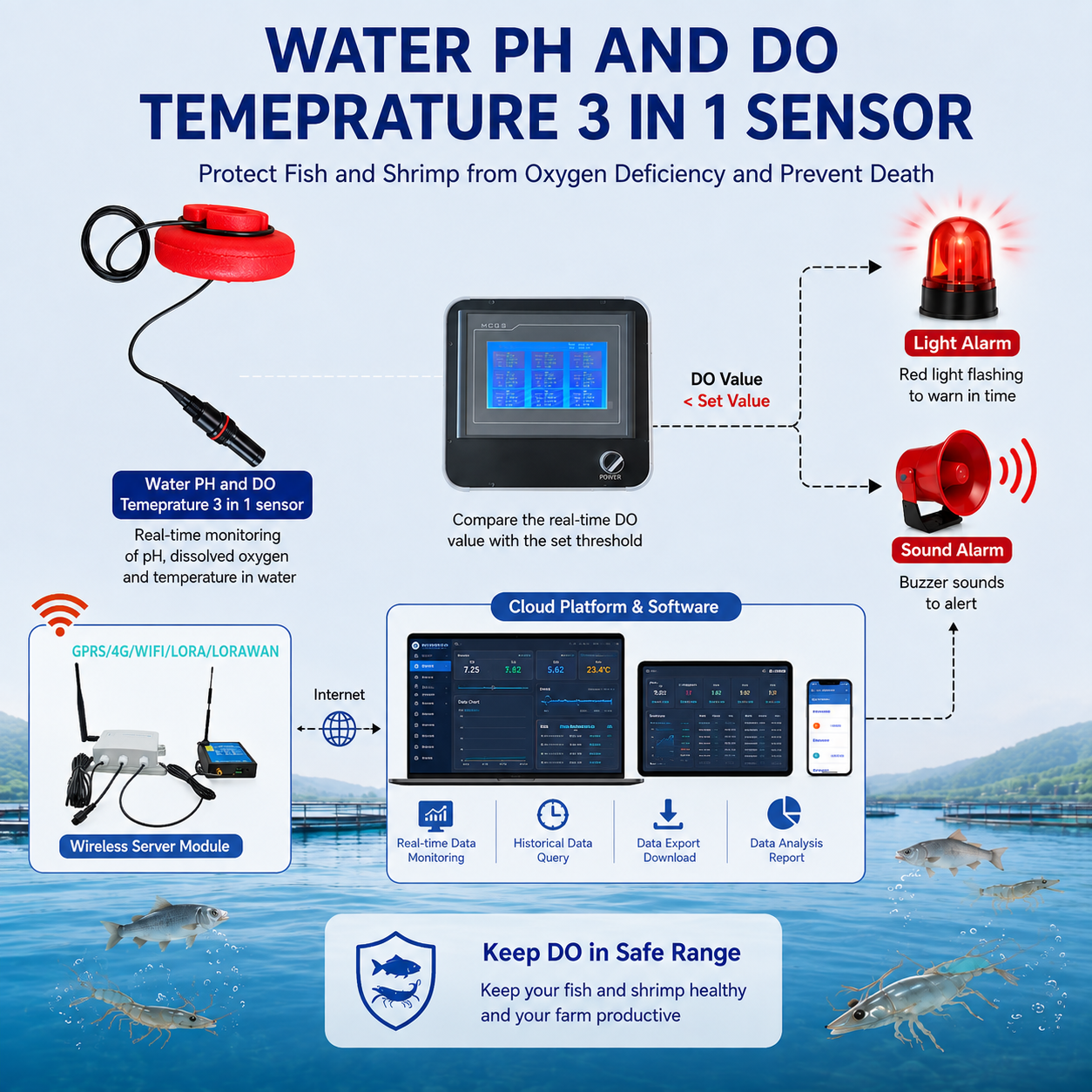
The floating sensor is deployed at the main bathing area of each monitored lake — the point where bathers enter and where exposure risk is highest. A Data logger with screen on the shore post or jetty housing displays current pH, DO, and temperature to the local warden during morning rounds. The warden uses the Handmeter during weekly verification — a grab sample analyzed with a portable pH meter and DO probe, compared against the floating sensor readings.
Most Finnish bathing lakes are within 4G coverage. Rural and remote lakes in Lapland and the lake district use LoRaWAN modules relaying to gateways at the nearest municipality building. All data is packetized in MQTT Json format, feeding SYKE’s national lake data platform and the municipality’s local environmental database.
The Cloud server and software consolidates pH, DO, and temperature data from all monitored lakes, showing real-time data and history data. The Alarm relay system implements the bloom warning logic: a pre-bloom alert triggers when pH exceeds 9.0 AND DO exceeds 130% saturation AND temperature exceeds 20°C simultaneously. This combination alert goes to the municipality’s environmental officer and to the vesi.fi reporting system — not as a bloom confirmation, but as a “prepare to close” warning. A confirmed bloom alert, at pH above 10.0 or DO above 160%, triggers the beach closure recommendation directly.
Field Results: Pirkanmaa Regional Lakes Pilot, Summer 2026
The Pirkanmaa regional environmental authority (one of Finland’s most lake-dense regions, including Tampere’s urban lakes) deployed Honde floating 3-in-1 sensors at 18 bathing lakes between June 1 and August 31, 2026.
- Hardware: 18 floating pH/DO/Temperature sensors, solar-powered LoRaWAN/4G modules.
- Local: Data logger with screen at each shore station; Handmeter weekly verification.
- Cloud: MQTT Json to Pirkanmaa’s environmental platform and SYKE data feed.
- Alarm thresholds: Pre-bloom: pH > 9.0 + DO > 130% + Temperature > 20°C; Confirmed: pH > 10.0 or DO > 160%.
Summer 2026 bloom warning performance — 18 monitored lakes:
| Month | Pre-bloom alerts | Confirmed bloom alerts | Closures issued | Visual detection lead time (sensor vs. warden) |
|---|---|---|---|---|
| June | 3 | 1 | 1 | 18 hours |
| July | 8 | 4 | 4 | 14–22 hours |
| August | 6 | 2 | 2 | 11–19 hours |
| Total | 17 | 7 | 7 | Avg: 16 hours |
Operational outcomes:
- ✓ The sensor network issued 7 closure recommendations during the summer — all confirmed by subsequent visual observation and/or laboratory analysis. Zero false closures in the pilot period.
- ✓ The average lead time of 16 hours between sensor alert and the point at which the warden would have visually detected the bloom provided municipalities with same-day closure communication to the public, preventing bather exposure during peak weekend traffic at 4 of the 7 events.
- ✓ At two lakes, the pre-bloom alert at pH 9.2–9.4 triggered preventive public advisories. Both lakes subsequently developed confirmed blooms — the pre-bloom alert proved accurate as a probabilistic warning 100% of the time in the pilot, allowing municipalities to prepare without premature closure.
- ✓ The Handmeter verification program — weekly grab samples at all 18 sites — found all sensors within ±0.08 pH and ±0.15 mg/L DO across the summer, with zero sensor replacements required through the full August heat period.
- ✓ SYKE integrated the Pirkanmaa sensor data into the vesi.fi national platform in July 2026, making real-time pH, DO, and temperature data from the 18 sites visible to the public alongside the traditional warden observations — the first time Finnish bathing lakes were represented by continuous sensor data on the national platform.
Contact Honde Technology for Lake and Bathing Water Monitoring
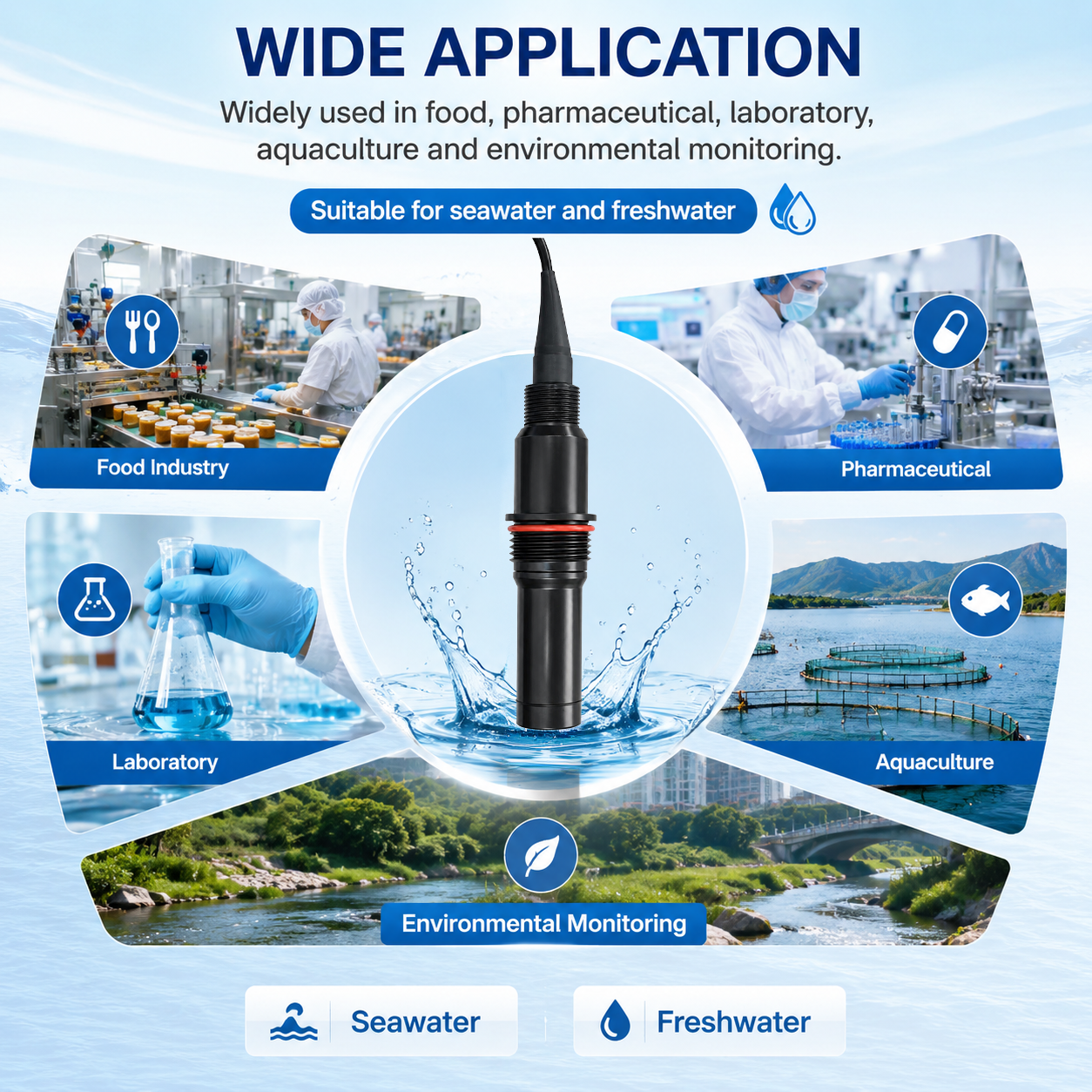
Honde Technology is a Germany TUV & Alibaba verified manufacturer. We supply the floating pH/DO/Temperature probes, the surface-layer measurement architecture, and the bloom-alert telemetry integration required by municipal lake managers and national environmental monitoring networks.
For more sensor information and customized IoT solutions, please contact Honde Technology Co., LTD.
- WhatsApp: +86-15210548582
- Email: info@hondetech.com
- Company Website: www.hondetechco.com
The Demand Map Across Developed Bathing Water Markets
The floating 3-in-1 pH/DO/Temperature sensor specification is emerging across every developed country operating a cyanobacteria early warning system for public bathing waters. Sweden’s SMHI and County Administrative Boards monitor 1,100+ EU-designated bathing waters under the Bathing Water Directive, with a growing proportion shifting to continuous sensor deployment. Germany’s state environmental agencies monitor hundreds of bathing lakes in Brandenburg and Bavaria, where the 2025 bloom season triggered Länder-level investment in automated monitoring. Netherlands’ water boards (waterschappen) operate real-time sensor buoys at recreational lakes in South Holland and Utrecht, where cyanobacteria closures have become an annual summer disruption. Canada’s Ontario Ministry of Environment monitors HABs (Harmful Algal Blooms) in the Great Lakes tributaries and Kawartha Lakes with floating multi-parameter probes. Each program converges on the same sensor configuration: a floating pH/DO/Temperature probe at surface depth, transmitting continuously via LoRaWAN or 4G in MQTT Json format, with alarm logic that detects the bloom precursor parameters before any satellite or warden observation can confirm the event.
Post time: Aug-27-2026