

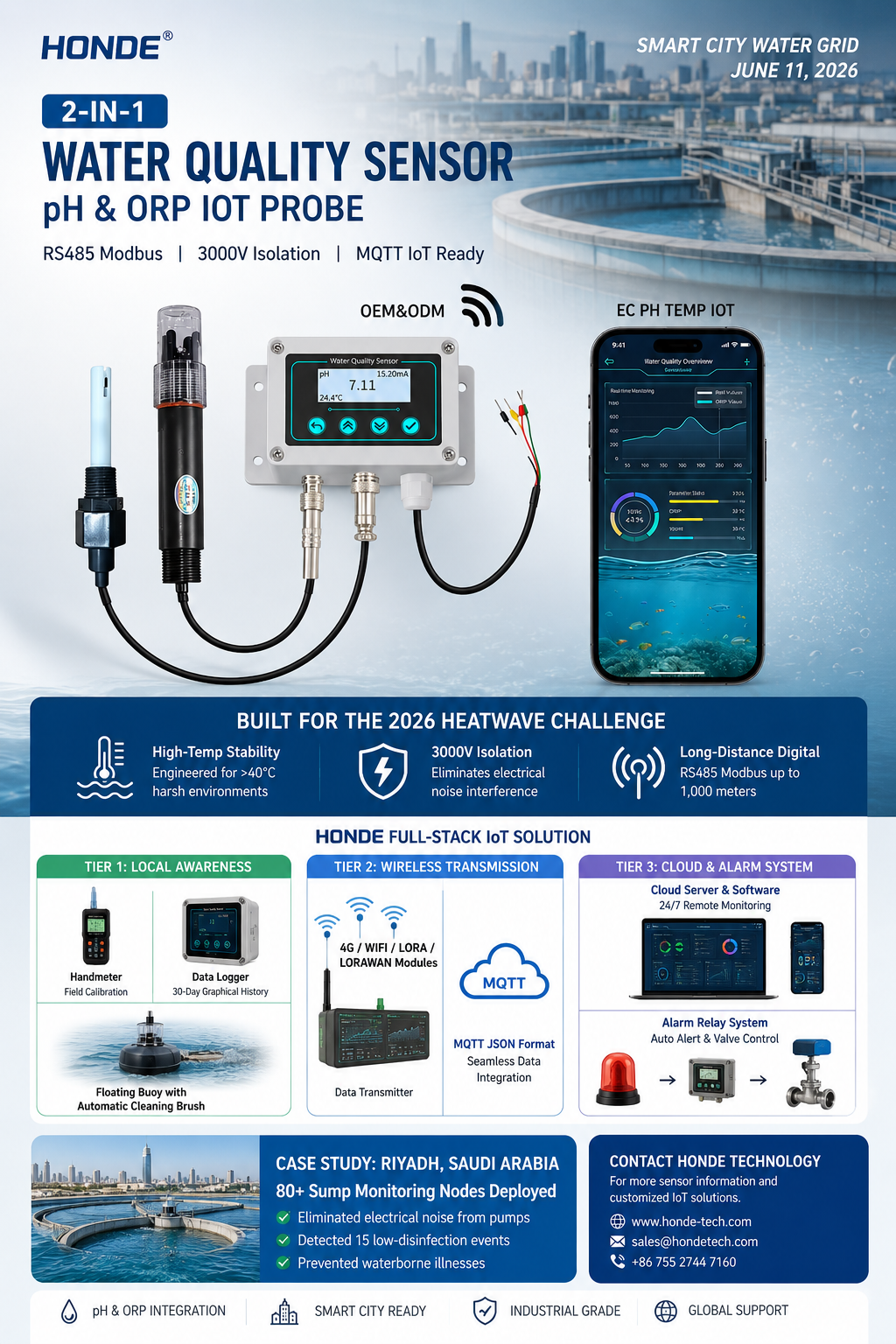
The Mid-Year Challenge: Heatwaves and Chemical Volatility
As of June 2026, the arrival of record-breaking summer temperatures across Saudi Arabia, the UAE, and Northern India has created a crisis in water chemistry management. In these regions, water in secondary distribution tanks often exceeds 40°C. This heat causes two immediate failures in traditional monitoring systems:
- Accelerated pH Drift: Standard sensors lack the thermal isolation required to maintain a stable reference potential at high temperatures.
- Disinfection Decay: In drinking water sumps, high heat accelerates the decay of residual chlorine, making real-time pH and ORP (Redox) tracking the only way to verify that the water remains biologically safe.
The Perception Layer: Honde 2-in-1 Digital Architecture
Honde Technology’s RS485 IoT 2-in-1 Series is engineered to survive the “Digital Sump” of a 2026 Smart City:
1 1. Integrated pH & ORP (or Temperature)
By housing two high-precision electrodes in a single 316L Stainless Steel or PPS body, we reduce the installation footprint by 50%.
- The Advantage: The sensor utilizes a Double Junction Reference System, which prevents electrode “poisoning” in water containing high levels of sulfides or heavy metals—a common issue in aging municipal pipes.
2 2. 3000V Electrical Isolation
Ground loops in industrial pumping stations are the #1 killer of digital water sensors. Our 2-in-1 probes feature four-fold electrical isolation with a power isolation rating of 3000V, ensuring the RS485 signal remains clean even next to high-power VFD motors.
3 3. True Digital Output
Unlike analog probes that lose accuracy over 5-meter cables, our native RS485 Modbus-RTU output allows for 1,000-meter cable runs with zero signal degradation.
The Honde Full-Stack Solutions Architecture
To manage 500+ monitoring nodes across a metropolitan area, Honde provides a tiered digital nervous system:
Tier 1: Local Awareness & Resilient Deployment
- Handheld Verification: Field maintenance crews utilize our Handmeter for rapid cross-calibration during quarterly audits.
- On-Site Persistence: Each pumping station is equipped with our Data Logger with screen, providing local operators with real-time graphs and 30-day graphical history on-site—essential for audits during cloud outages.
- Deep Sump & Reservoir Setup: In open storage reservoirs or large cooling towers, we deploy the Floating Buoy system integrated with the Automatic cleaning brush for multi-parameter water sensor. The brush physically clears the electrode surface every 15 minutes, neutralizing the biofilm growth that typically causes “pH lag” in warm water.
Tier 2: The Wireless Nervous System (Transmission)
- Urban-Ready Modules: Data is transmitted from deep underground sumps or remote desert sites using GPRS/4G/WIFI/LORA/LORAWAN wireless modules.
- The MQTT Standard: All modules transmit in MQTT Json format. This standardized format allows the water data to feed directly into the municipal “Digital Twin” dashboard or corporate ESG platforms without custom drivers.
Tier 3: Cloud Management & Active Warning (The Safety Loop)
- All data is centralized on the Cloud server and software, offering 24/7 visibility into the city’s water safety status.
- The Alarm Relay System: This is the critical safety loop. If pH levels move outside the 6.5–8.5 range or if ORP drops below the disinfection threshold, the cloud platform triggers an Alarm Relay system to automatically shut off the intake valve or alert the municipal health department—preventing contaminated water from reaching households.
Real-World Case Study: Securing Secondary Water in Riyadh, Saudi Arabia
A B2B infrastructure contractor in Riyadh required a scalable monitoring grid for 80 residential underground water sumps. The high ambient heat was causing frequent sensor failures and bacteria outbreaks.
The Honde Intervention:
- Hardware: Deployed 80 units of the Honde 2-in-1 pH/ORP Sensors.
- Connectivity: Used 4G wireless modules transmitting in MQTT Json format to the central water utility dashboard.
- Outcome: The 3000V isolation eliminated the electrical noise from the submersible pumps. The Alarm Relay System helped the utility identify 15 “low-disinfection” events during the June 2026 heatwave, allowing for targeted re-chlorination and preventing any reported waterborne illnesses in those districts.
Contact Honde Technology for Smart City Sourcing
For more sensor information and customized IoT solutions, please contact Honde Technology Co., LTD.
- WhatsApp:+86-15210548582
- Email: info@hondetech.com
- Company Website: www.hondetechco.com
Post time: Jun-29-2026