

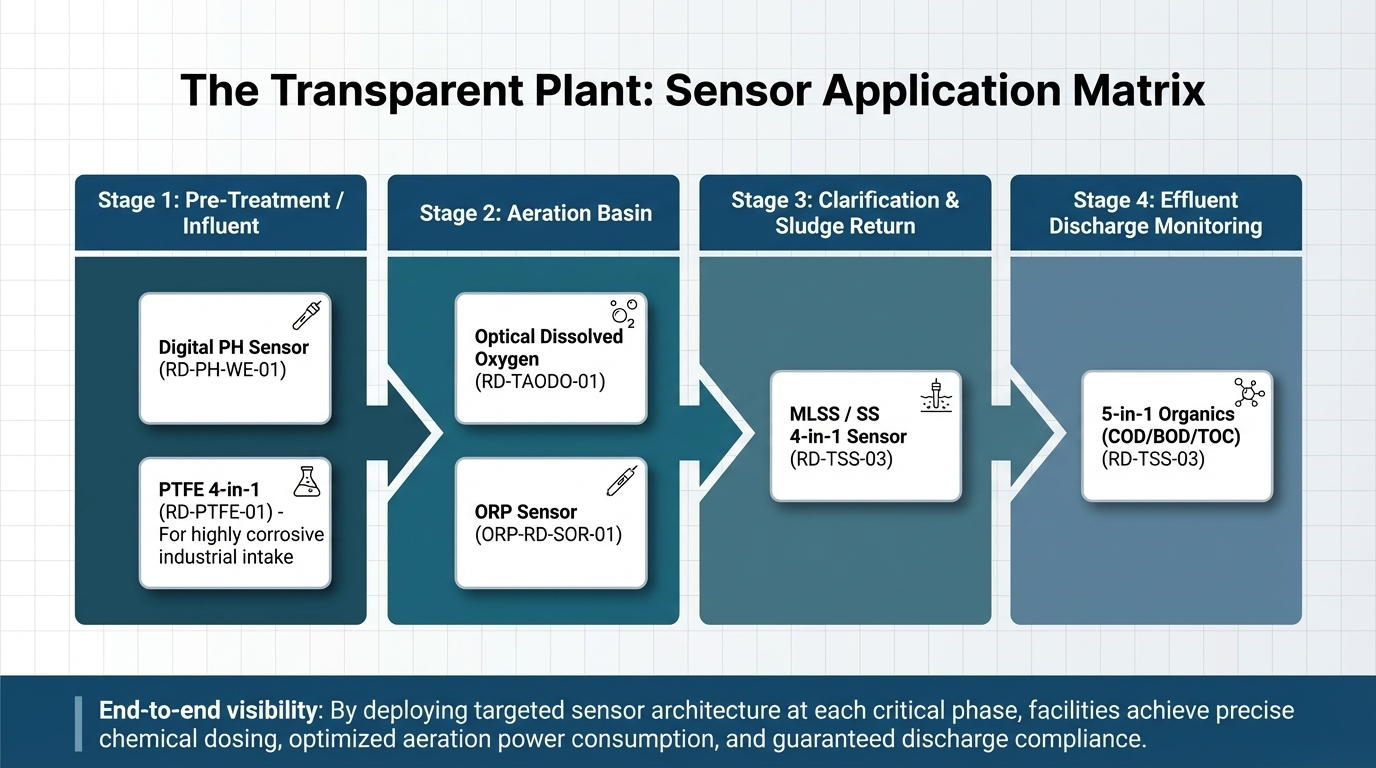
The Binh Duong Reality: Over-Aeration is a Financial Leak
By mid-July 2026, industrial parks in Vietnam’s Binh Duong province — home to over 2,500 factories producing electronics, textiles, and processed food — are operating their centralized wastewater treatment plants at peak load. High ambient temperatures (34°C+) accelerate microbial metabolism in aeration basins, driving oxygen demand sharply upward. The standard operator response — run the blowers at maximum capacity 24/7 — carries a hidden cost that most plant managers discover too late.
The arithmetic is blunt. Aeration accounts for 50–65% of a treatment plant’s total electricity consumption. A mid-sized plant in Binh Duong running four 75kW blowers spends approximately
8,200permonthonaerationelectricity.Over−aeratingbyjust201,640 per month. Across an industrial park with 15 such plants, the aggregate waste exceeds $295,000 annually.
The root cause is rarely the blower hardware. It is the sensor layer. Standard electrochemical DO probes in activated sludge fail through two mechanisms: membrane fouling from grease and biofilm, and electrolyte depletion in warm water. When the sensor drifts, the operator loses trust in the data and reverts to manual over-aeration. When the sensor fails completely, the operator is blind — and the biological process can collapse within hours.
Honde Technology’s Wastewater Treatment Series was deployed in Binh Duong specifically to break this cycle.
The Hardware: Three Sensors That Control the Energy Balance
Titanium-Alloy Optical DO Sensor (RD-WQ-DOTI)
The oxidation ditch and aeration basin are the two most sensor-hostile environments in any treatment plant. High turbulence, suspended solids at 3,000–8,000 mg/L, and grease accumulation destroy standard probes.
- Fluorescence quenching principle. No electrolyte, no membrane, no oxygen consumption during measurement. The sensor reads accurately in stagnant zones and turbulent zones alike.
- Titanium alloy body with POM integration. Resistant to the weak acids and industrial solvents present in mixed-source effluent. IP68-rated for continuous submersion.
- 3-year luminophore cap lifespan. In the Binh Duong deployment, this translated to one calibration visit per quarter instead of weekly membrane replacements.
MLSS/Suspended Solids Sensor with Built-in Brush (RD-TSS-03-SS)
The Mixed Liquor Suspended Solids concentration is the single most important operational parameter for aeration control. Too low, and treatment efficiency collapses. Too high, and the secondary clarifier overloads.
- 140° infrared scattering principle. Measures MLSS up to 120,000 mg/L without interference from sludge color or ambient light.
- Integrated automatic cleaning brush. A 15-minute wipe cycle prevents the biofilm accumulation that causes optical sensors to drift upward by 10–15% within 72 hours — a drift that, in practice, causes operators to wastefully increase return activated sludge (RAS) pumping rates.
PTFE 4-in-1 Probe for Inlet Monitoring (RD-PTFE-01)
The raw influent from Binh Duong’s mixed industrial parks contains pH swings from 4.5 to 11, conductivity spikes during dye-batch discharges, and intermittent solvent contamination.
- Full PTFE (Teflon) encapsulation. Resists chemical attack from the acids, bases, and organic solvents that dissolve standard PVC and ABS sensor bodies within months.
- Simultaneous EC, Temperature, TDS, and Salinity output. A conductivity spike at the inlet provides 30–60 minutes of advance warning before the shock load reaches the biological treatment stage — time to adjust return sludge rates or divert to the balancing tank.
The Honde Full-Stack Architecture for Industrial WWTPs
1 Tier 1: Local Verification & Process Visibility
- Plant operators use the Handmeter for rapid DO cross-checks during morning rounds — verifying the online sensor against a calibrated portable unit in under 30 seconds.
- Each treatment stage connects to a Data Logger with screen, giving shift operators real-time MLSS trends, DO curves, and 30-day history on-site. When the SCADA network is down for maintenance, the aeration control logic continues to function from local data.
2 Tier 2: Wireless Transmission Backbone
- All sensor nodes transmit via GPRS, 4G, WIFI, LoRa, or LoRaWAN wireless modules, selected based on the plant’s physical layout and EMI environment.
- Data is packetized in MQTT Json format, feeding directly into the industrial park’s centralized environmental monitoring platform — the same system that reports to Vietnam’s MONRE (Ministry of Natural Resources and Environment).
3 Tier 3: Cloud Management & Aeration Automation
- The Cloud server and software consolidates DO, MLSS, inlet EC, and effluent COD into a unified dashboard showing real-time data and history data.
- The Alarm Relay System operates on two independent triggers:
- Process protection: If DO drops below 1.5 mg/L in the aeration basin — indicating insufficient oxygen for nitrification — the relay activates a backup blower or triggers an SMS alert to the plant manager.
- Inlet shock load defense: If inlet conductivity spikes by more than 200% within 5 minutes — indicating a chemical batch discharge — the relay automatically diverts flow to the emergency balancing tank, protecting the biological stage from toxic shock.
Field Results: VSIP II Industrial Park, Binh Duong, July 2026
A centralized WWTP serving 180 factories in the Vietnam-Singapore Industrial Park II (VSIP II) deployed the Honde system across all biological treatment stages in June 2026.
Hardware deployed:
- 12 Titanium Optical DO Sensors across 6 aeration basins.
- 12 MLSS Sensors with auto-cleaning brushes co-located at the same basins.
- 4 PTFE 4-in-1 Probes at the raw influent channel.
- 4G modules transmitting MQTT Json to the park’s central SCADA system.
Operational outcomes after 45 days (June–July 2026):
- Aeration electricity consumption dropped 18% — from a monthly average of
8,200to6,724 — by replacing continuous maximum blower output with MLSS-guided variable-speed control. The DO sensors maintained ±0.3 mg/L accuracy throughout the trial without a single membrane replacement.
- The PTFE inlet probes detected 3 chemical shock load events before they reached the biological stage. The relay system diverted flow to the balancing tank each time, preventing what the plant manager estimated would have been 5–7 days of biological recovery per event.
- The auto-cleaning brushes on the MLSS sensors eliminated the twice-weekly manual cleaning routine that previously consumed 6 technician-hours per week.
- Zero effluent compliance violations during the trial period — the first quarter with a perfect record in the plant’s 4-year operating history.
Contact Honde Technology for Wastewater Treatment Tenders
For more sensor information and customized IoT solutions, please contact Honde Technology Co., LTD.
- WhatsApp: +86-15210548582
- Email: info@hondetech.com
- Company Website: www.hondetechco.com
Post time: Jul-21-2026