

Date: June 9, 2026
Keywords: Canal Flow Measurement, Open Channel Flow Meter, 3-in-1 Radar Flowmeter, Smart Irrigation Scheduling, Volumetric Water Billing, RS485 Modbus Flow Meter.
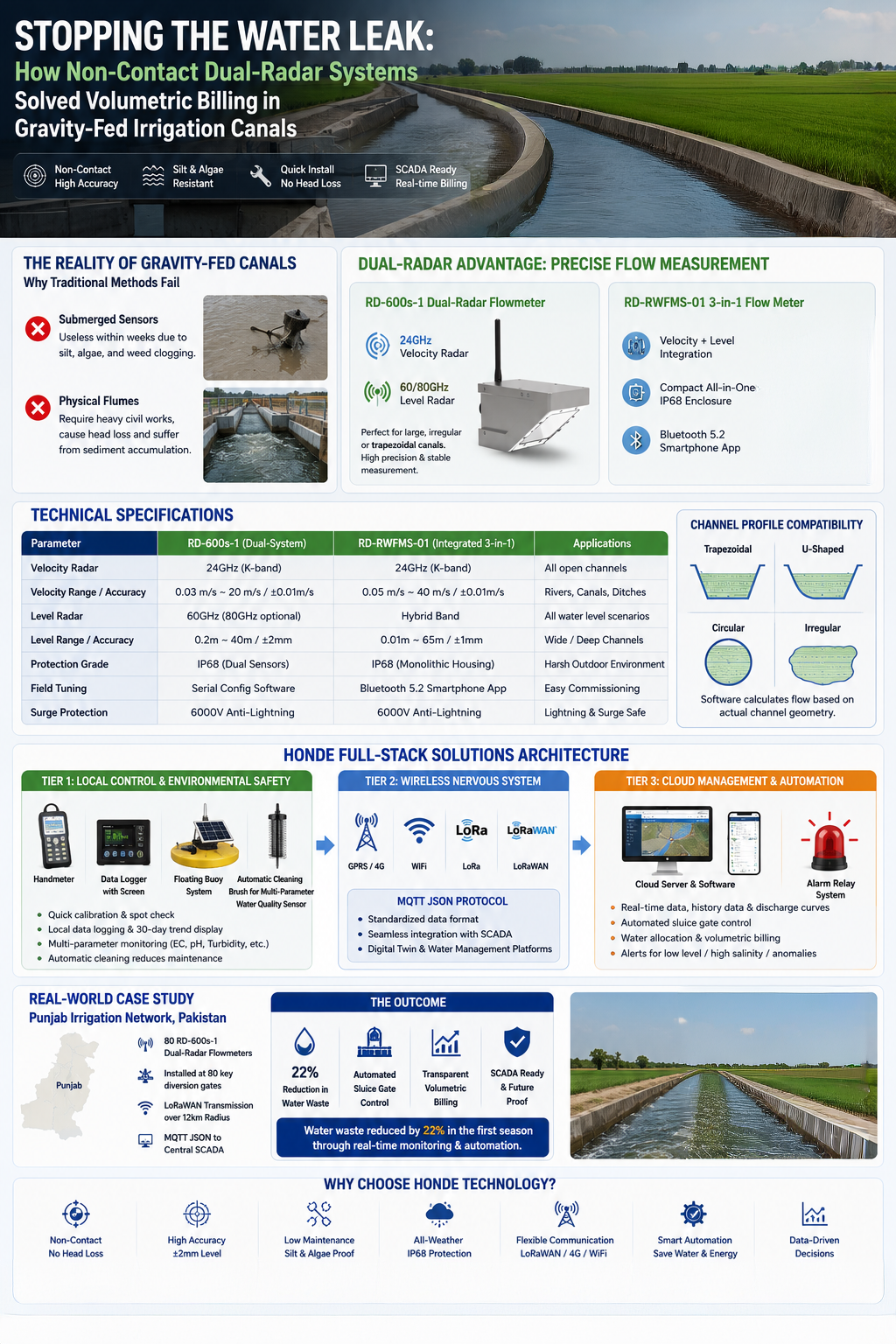
1.The Reality of Gravity-Fed Canals: Why Traditional Flumes and Submerged Sensors Fail
In the world’s largest contiguous irrigation networks—such as the Indus Basin in Pakistan’s Punjab province, the Fergana Valley in Uzbekistan, and the Nile Delta in Egypt—water is gold. Historically, water distribution in these massive concrete or earthen channels relied on “estimated” flow rates based on gate openings or manual staff gauge readings.
When operators tried to digitalize, they faced immediate physical bottlenecks:
- Submerged Doppler and Ultrasonic Sensors: These became useless within weeks due to high silt loads, algae growth, and weed clogging.
- Physical Flumes (e.g., Parshall Flumes): Building these structures requires heavy civil construction, introduces significant hydraulic head loss, and is highly prone to sediment accumulation.
With global development banks (such as the World Bank and Asian Development Bank) mandating SCADA-ready, real-time volumetric billing in 2025-2026, water authorities require a solution that measures flow without restricting the channel or touching the silt.
This is where the transition to Non-Contact Dual-Radar systems has become the industry standard.
2.The Dual-Radar Advantage: Precisely Mapping Complex Canals
Honde Technology’s Open Channel Flow Catalog focuses on two high-accuracy non-contact radar instruments engineered to solve these exact agricultural constraints:
1. The RD-600s-1 Dual-Radar Flowmeter (The SCADA Standard)
For large, irregular, or trapezoidal concrete canals, a single sensor cannot capture the flow profile. The RD-600s-1 utilizes a split-architecture approach:
- Velocity Tracking: A 24GHz Doppler radar tracks surface velocity.
- Level Tracking: A 60GHz (or optional 80GHz) FMCW radar measures water level with ±2mm precision.
- Channel Profiling: Dedicated configuration software allows operators to input the exact geometry of the canal—whether U-shaped, trapezoidal, circular, or irregular. The internal microprocessor then integrates the level and velocity data to calculate Instantaneous Flow Rate (
m3/h) in real-time.
2. The RD-RWFMS-01 Integrated 3-in-1 Flow Meter
For smaller branch canals and farm turnouts, the RD-RWFMS-01 provides an all-in-one compact solution.
- Features: It houses both velocity and level radars in a single IP68-rated, 304 stainless steel enclosure.
- Field Calibration: Equipped with Bluetooth 5.2, field engineers can calibrate the sensor and review discharge profiles directly from their smartphones via a local APP, avoiding the need to climb over wet banks or carry heavy laptops into the field.
3.Technical Specifications: RD-600s-1 & RD-RWFMS-01
| Parameter | RD-600s-1 (Dual-System) | RD-RWFMS-01 (Integrated 3-in-1) |
|---|---|---|
| Velocity Radar | 24GHz (K-band) | 24GHz (K-band) |
| Velocity Range / Accuracy | 0.03 m/s ~ 20 m/s / ±0.01m/s | 0.05 m/s ~ 40 m/s / ±0.01m/s |
| Level Radar | 60GHz (80GHz optional) | Hybrid Band |
| Level Range / Accuracy | 0.2m ~ 40m / ±2mm | 0.01m ~ 65m / ±1mm |
| Protection Grade | IP68 (Dual Sensors) | IP68 (Monolithic Housing) |
| Field Tuning | Serial Config Software | Bluetooth 5.2 Smartphone App |
| Surge Protection | 6000V Anti-Lightning | 6000V Anti-Lightning |
4.The Honde Full-Stack Solutions Architecture
In vast agricultural plains spanning hundreds of kilometers, getting data from a canal gate to the district water office requires a resilient three-tier architecture:
Tier 1: Local Control & Environmental Safety
- Handmeter & Local Loggers: Field technicians utilize our Handmeter for spot-checking discharge rates, while each gate station is equipped with our Data Logger with screen for local data logging and 30-day graphical trends on-site.
- In-Canal Water Quality: At regional junctions where agricultural runoff must be monitored for salinity or pesticides, we deploy a Floating Buoy system integrated with our multi-parameter water quality sensor (EC + pH + Turbidity). The probe includes an Automatic cleaning brush to ensure algae and sediment do not compromise the readings.
Tier 2: The Wireless Nervous System
- Data is transmitted from remote canal gates using GPRS/4G/WIFI/LORA/LORAWAN wireless modules.
- The MQTT Logic: For irrigation networks, the modules support the MQTT Json format. This standardized format allows the flow data to feed directly into SCADA networks and water resource management platforms without custom drivers.
Tier 3: Cloud Management & Sluice Automation (The Safety Loop)
- All data is centralized on the Cloud server and software to see the real-time data, history data, and discharge curves across the entire irrigation district.
- The Alarm Relay System: This is where water saving is automated. If the canal level drops below the minimum required for irrigation, or if salinity spikes due to ocean intrusion, the cloud platform triggers an Alarm Relay system to automatically close or open automated sluice gates, preventing crop damage and optimizing water allocation.
5.Real-World Case Study: Water Allocation in the Punjab Irrigation Network, Pakistan
In Pakistan’s Punjab province, the local irrigation department was losing up to 35% of its allocated water to non-revenue water (unauthorized siphoning and physical seepage). They required a SCADA-ready flow monitoring grid at 80 key diversion gates across the canal network.
The Honde Intervention:
- Installation: 80 units of the RD-600s-1 Dual-Radar Flowmeter were suspended from gantry structures over the trapezoidal concrete channels.
- Connectivity: Due to the vast distance, LoRaWAN gateways were deployed, transmitting data in MQTT Json format over a 12km radius to a central district office.
- The Outcome: The non-contact radar ignored the heavy silt load of the Indus River. The Alarm Relay System was integrated with their motorized sluice gates. The system automatically shut down diversion channels the moment the allocated volumetric quota (
m3) was met for a specific cooperative, reducing overall water waste by 22% in the first agricultural season and establishing transparent, data-backed water billing.
6.Contact Honde Technology for Irrigation Project Tenders
For more sensor information and customized IoT solutions, please contact Honde Technology Co., LTD.
- WhatsApp: +86-15210548582
- Email: info@hondetech.com
- Company Website: www.hondetechco.com
Post time: Jun-11-2026