

 The Operational Reality: Why Contact Sensors Fail at the Spillway
By mid-2026, hydropower operators in Laos, Vietnam, and Brazil face a strict regulatory audit: the “Minimum Ecological Flow” (MEF). They must prove, with millimetric precision, that they are releasing enough water downstream to sustain river ecosystems. Failure to provide this data results in massive fines or suspension of generation licenses.
Spillways and discharge channels are violent environments. In these zones, traditional pressure transducers and submerged ultrasonic sensors fail within weeks due to two physical factors:
- Air Entrainment & Turbulence: Rapidly flowing water contains millions of air bubbles that “blind” ultrasonic signals and create “pressure noise.”
- Cavitation & Physical Impact: High-velocity discharge destroys mounting brackets and erodes sensor faces.
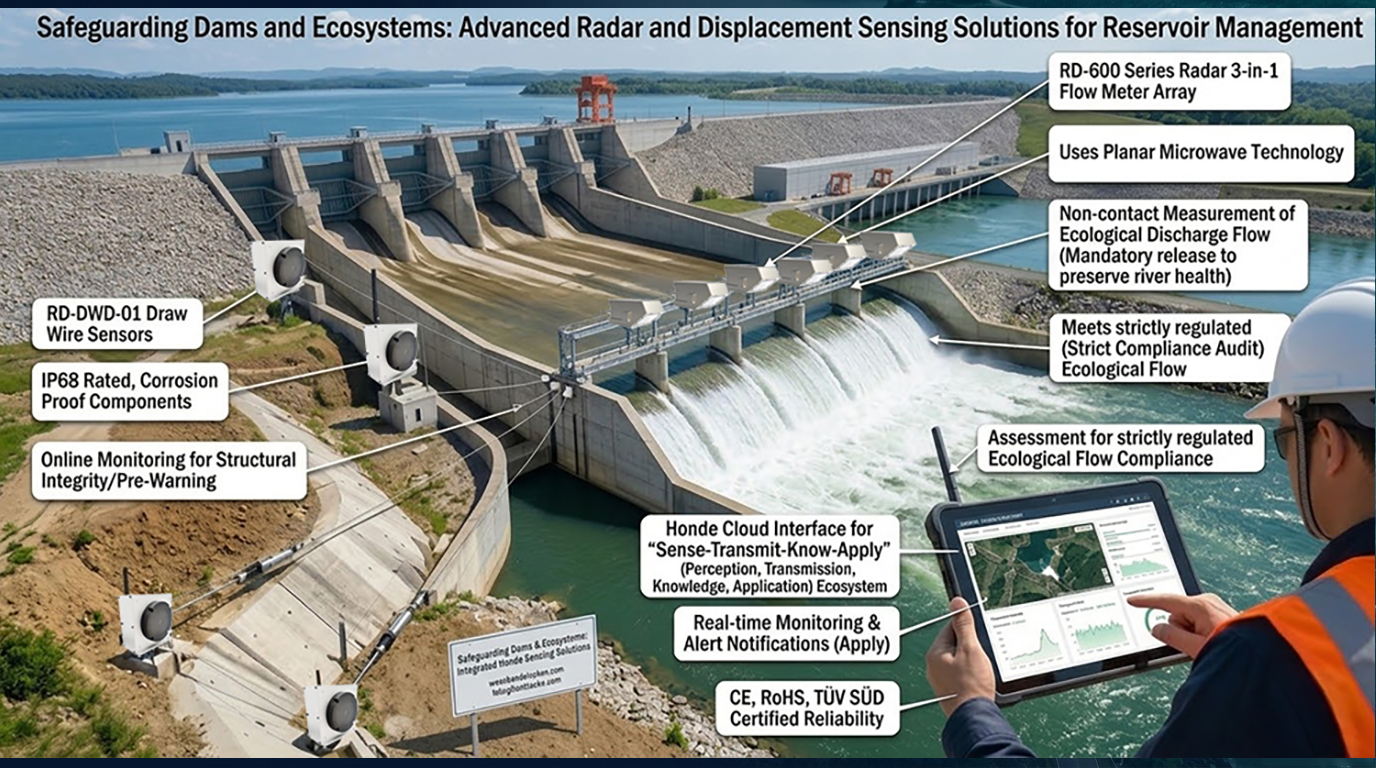
Honde Technology’s Reservoir & Ecological Flow Series was specified for recent Mekong Basin projects because it removes the sensor from the water entirely.
The Perception Layer: 80GHz Millimeter-Wave & 3-in-1 Integration
Honde’s hydrology architecture for 2026 utilizes two core non-contact instruments:
1. 80GHz High-Precision Reservoir Radar (HD-RWLP654-01)
Installed on the dam crest or intake tower, this 80GHz FMCW radar features a surgical 6° beam angle.
- The Advantage: It ignores the dam’s vertical concrete wall and overhanging catwalks, tracking the reservoir stage with ±1mm precision over an 80-meter range.
- Engineering Detail: The built-in Bluetooth 5.2 allows engineers to calibrate the sensor and view echo waveforms from a smartphone standing on the dam crest—no ladders required.
2. RD-600s 3-in-1 Radar Flowmeter (Ecological Standard)
For downstream V-notch weirs and discharge channels, the RD-600s integrates Surface Velocity, Water Level, and instantaneous Flow Rate (
m3/s) calculation into a single IP68 housing.
- The Compliance Tool: By inputting the weir or channel geometry, the internal microprocessor outputs the exact volumetric discharge required for MEF reporting.
3. Dam Slope Displacement (RD-DWD-01)
Safety is multi-dimensional. Our wire-draw displacement sensors are anchored to dam slopes and expansion joints, detecting micro-movements to warn of structural deformation before it becomes a failure.
The Honde Full-Stack Solutions Architecture
Managing a dam in a remote mountain valley requires a three-tiered digital nervous system:
Tier 1: Local Control & Environmental Safety
- Field Audit Tools: Technicians utilize the Honde Handmeter for rapid on-site cross-checks.
- Station Persistence: Every monitoring node is equipped with our Data Logger with screen, providing local dam operators with real-time discharge curves and 30-day graphical history on-site—critical for manual gate operation during a blackout.
- Reservoir Health: For water quality reporting, we deploy the Floating Buoy system integrated with our multi-parameter water quality sensor (DO + pH + Turbidity). The probe includes an Automatic cleaning brush to handle the high algae loads common in stagnant reservoirs.
Tier 2: The Wireless Nervous System (Transmission)
- Remote Connectivity: Data is transmitted from remote spillways using GPRS, 4G, WIFI, LoRa, or LoRaWAN wireless modules.
- The MQTT Logic: For national grid integration, all data is packetized in MQTT Json format. This ensures the flow and stability data feeds directly into the National Dam Safety Portal without custom middleware.
Tier 3: Cloud Management & Active Mitigation (The Safety Loop)
- All data is centralized on the Cloud server and software, providing a 24/7 “Digital Twin” of the dam’s status.
- The Alarm Relay System: This is the critical compliance loop. If the ecological flow drops below the legal threshold, the cloud platform triggers an Alarm Relay system to automatically open an automated gate or alert the station manager via SMS. Conversely, if the 80GHz radar detects a “Rapid Rise” during a flood, the system triggers downstream Acoustic-Optical sirens before the spillway gates open.
Real-World Case Study: MEF Compliance in Bolikhamsai, Laos
A major IPP (Independent Power Producer) in Laos required a SCADA-ready solution to monitor the ecological discharge of a 120MW hydropower plant.
The Honde Intervention:
- Hardware: Deployed RD-600s 3-in-1 Flowmeters over the downstream weir and 80GHz Radars on the reservoir tower.
- Transmission: Due to the narrow valley, LoRaWAN was used to transmit data over 6km to a central 4G gateway, utilizing the MQTT Json format.
- The Outcome: The non-contact system survived the 2026 pre-monsoon debris flush with zero maintenance. The Alarm Relay System ensured the MEF stayed within ±2% of the mandate, providing the operator with a “Digital Audit Trail” that satisfied the Mekong River Commission’s transparency requirements.
Contact Honde Technology for Hydrological Tenders
Honde Technology is a Germany TUV & Alibaba verified manufacturer. We provide the hardware, the software, and the “Air-Gap” reliability required for the world’s most critical infrastructure.
For more sensor information and customized IoT solutions, please contact Honde Technology Co., LTD.
- WhatsApp: +86-15210548582
- Email: info@hondetech.com
- Company Website: www.hondetechco.com
Post time: Jul-22-2026