

Date: June 10, 2026
Keywords: Ecological Flow Monitoring, Dam Safety Sensors, 80GHz Radar Level, 3-in-1 Radar Flowmeter, Reservoir Management IoT, RS485 Modbus Water Sensor.
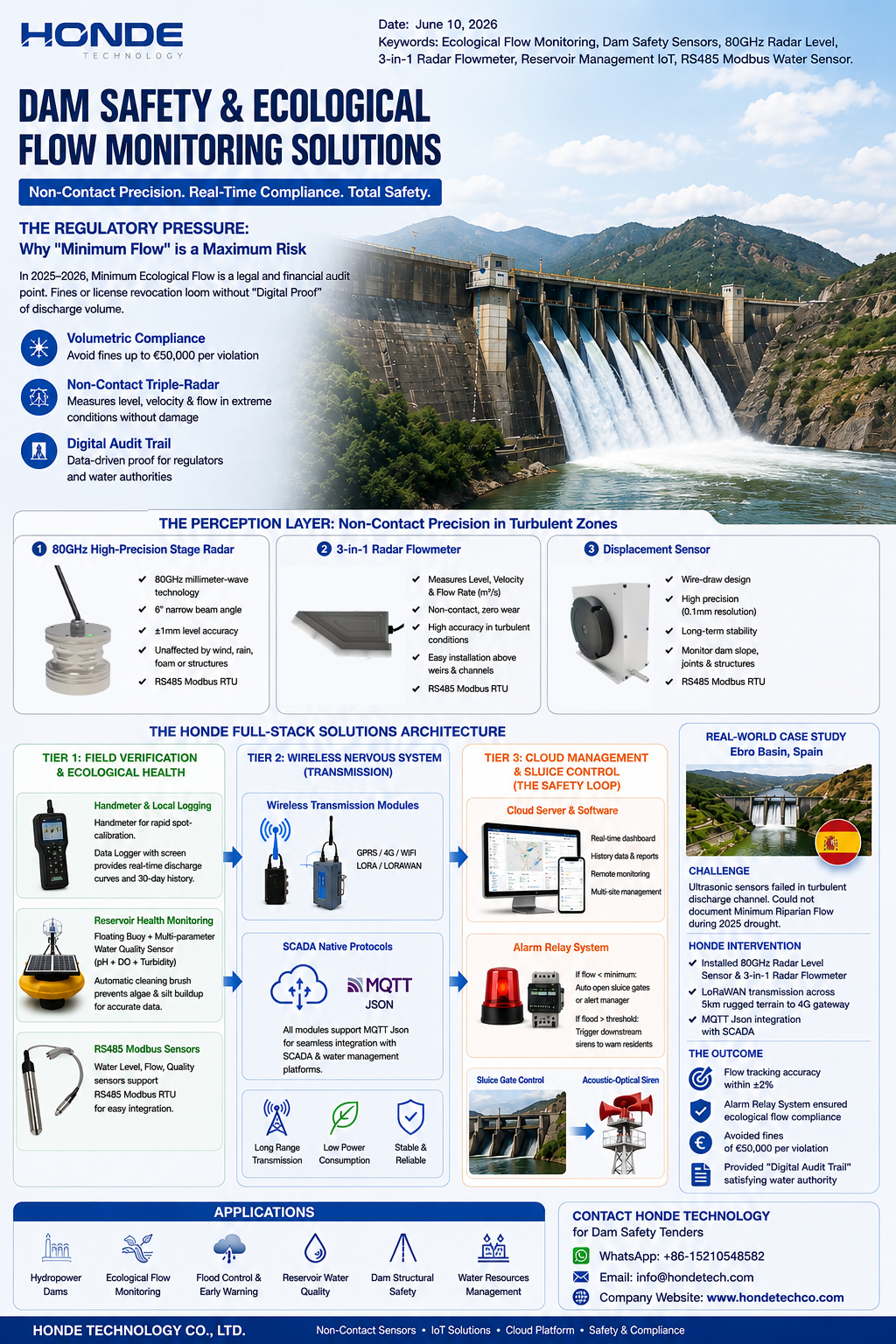
The Regulatory Pressure: Why “Minimum Flow” is a Maximum Risk
In 2025-2026, the global push for river restoration has turned “Minimum Ecological Flow” (the water released downstream of a dam to maintain aquatic life) into a legal and financial audit point. In regions like Spain (Andalusia), Brazil (Minas Gerais), and Laos (Mekong Basin), dam operators face massive fines or even license revocation if they cannot provide “Digital Proof” of their discharge volume.
The Engineering Paradox:
Monitoring water levels and flow rates at a dam is notoriously difficult. During spillway releases, the water is highly turbulent, filled with air bubbles, and extremely violent. Traditional contact-based sensors (like pressure transducers or bubblers) are either destroyed by the force of the water or provide “noise” instead of data.
To meet the high-stakes requirement for Volumetric Compliance, the industry has pivoted to a Non-Contact Triple-Radar architecture.
The Perception Layer: Non-Contact Precision in Turbulent Zones
Honde Technology’s Dam and Ecological Flow Solutions utilize high-frequency radar to monitor water from the safety of the bridge deck or spillway pier:
1. 80GHz High-Precision Stage Radar (HD-RWLP654-01)
Installed on the dam face or inside the reservoir intake tower, this 80GHz millimeter-wave radar features a focused 6° beam angle. It ignores the dam wall’s physical structure and overhanging catwalks, tracking reservoir levels with ±1mm precision even in heavy wind and rain.
2. The Integrated 3-in-1 Radar Flowmeter (RD-RWFMS-01)
For downstream discharge channels and V-notch weirs, the RD-RWFMS-01 provides a comprehensive data set. It simultaneously measures Water Level, Surface Velocity, and Flow Rate (
m3/s) without ever touching the water. This ensures zero damage during high-velocity releases and zero maintenance in silt-heavy environments.
3. Dam Structural Integrity: Displacement & Stability
Safety isn’t just about water; it’s about the structure. Our wire-draw displacement sensors (RD-DWD-01) are anchored to the dam slope and expansion joints. They detect micro-millimetric movements in real-time, providing an early warning system for structural deformation before it becomes a catastrophe.
The Honde Full-Stack Solutions Architecture
Managing a dam in a remote mountain valley requires a highly resilient, three-tiered monitoring architecture:
Tier 1: Field Verification & Ecological Health
- Handmeter & Local Logging: Field engineers utilize our Handmeter for rapid spot-calibration. Each monitoring node is equipped with our Data Logger with screen, providing local operators with real-time discharge curves and 30-day history without needing a network connection.
- Reservoir Health: In the main reservoir, we deploy the Floating Buoy system integrated with a multi-parameter water quality sensor (pH + DO + Turbidity). To handle the algae and silt typical of stagnant reservoir water, the probe includes an Automatic cleaning brush, ensuring the data used for “Ecological Flow” health reports is always accurate.
Tier 2: The Wireless Nervous System (Transmission)
- Remote-Ready Modules: Data is transmitted from remote spillways or downstream channels using GPRS/4G/WIFI/LORA/LORAWAN wireless modules.
- SCADA Native: All modules support the MQTT Json format, ensuring the discharge data feeds directly into the dam’s main SCADA system and the national water management agency’s portal without custom drivers.
Tier 3: Cloud Management & Sluice Control (The Safety Loop)
- All data is centralized on the Cloud server and software, offering a real-time management dashboard to see the real time data and history data.
- The Alarm Relay System: This is the critical compliance loop. If the ecological flow drops below the legal minimum, the cloud platform triggers an Alarm Relay system to automatically open automated sluice gates or alert the station manager. Conversely, during high-flood events, the system triggers downstream Acoustic-Optical sirens to warn residents before a major spillway opening.
Real-World Case Study: Managing Riparian Flow in the Ebro Basin, Spain
A major hydropower operator in Spain’s Ebro Basin was struggling to document their “Minimum Riparian Flow” during the drought of 2025. Their existing ultrasonic sensors were failing due to the high turbulence in the discharge channel.
The Honde Intervention:
- Installation: Installed the 80GHz Radar Level Sensor on the reservoir tower and the 3-in-1 Radar Flowmeter over the downstream discharge weir.
- Connectivity: Used LoRaWAN to transmit data across the rugged 5km terrain to a central 4G gateway, utilizing the MQTT Json format.
- The Outcome: The non-contact radar successfully tracked flow rates within ±2% accuracy during high-velocity release tests. The Alarm Relay System ensured that any dip in flow was instantly corrected by the automated gate controller, providing the operator with a “Digital Audit Trail” that satisfied the regional water authority and avoided potential fines of €50,000 per violation.
Contact Honde Technology for Dam Safety Tenders
For more sensor information and customized IoT solutions, please contact Honde Technology Co., LTD.
- WhatsApp: +86-15210548582
- Email: info@hondetech.com
- Company Website: www.hondetechco.com
Post time: Jun-15-2026