

The United Kingdom’s combined sewer system has a design feature that has become a national scandal: the storm overflow. When rainfall exceeds pipe capacity, the system is designed to discharge diluted sewage into rivers — an intentional relief valve that prevents sewage backing up into streets and homes. The design is sound. The accounting was not. Until recently, water companies had no obligation to measure when, how often, or how long these discharges occurred.
That ended with the Event Duration Monitoring (EDM) mandate. The Environment Agency now requires level sensors on storm overflows across England, and the data is published publicly — every spill, every duration, every location. The 2025 dataset recorded 290,000 discharge events lasting 1.87 million hours combined. The numbers are public. The monitoring that produces them is now the most consequential level-sensor deployment program in the UK water industry.
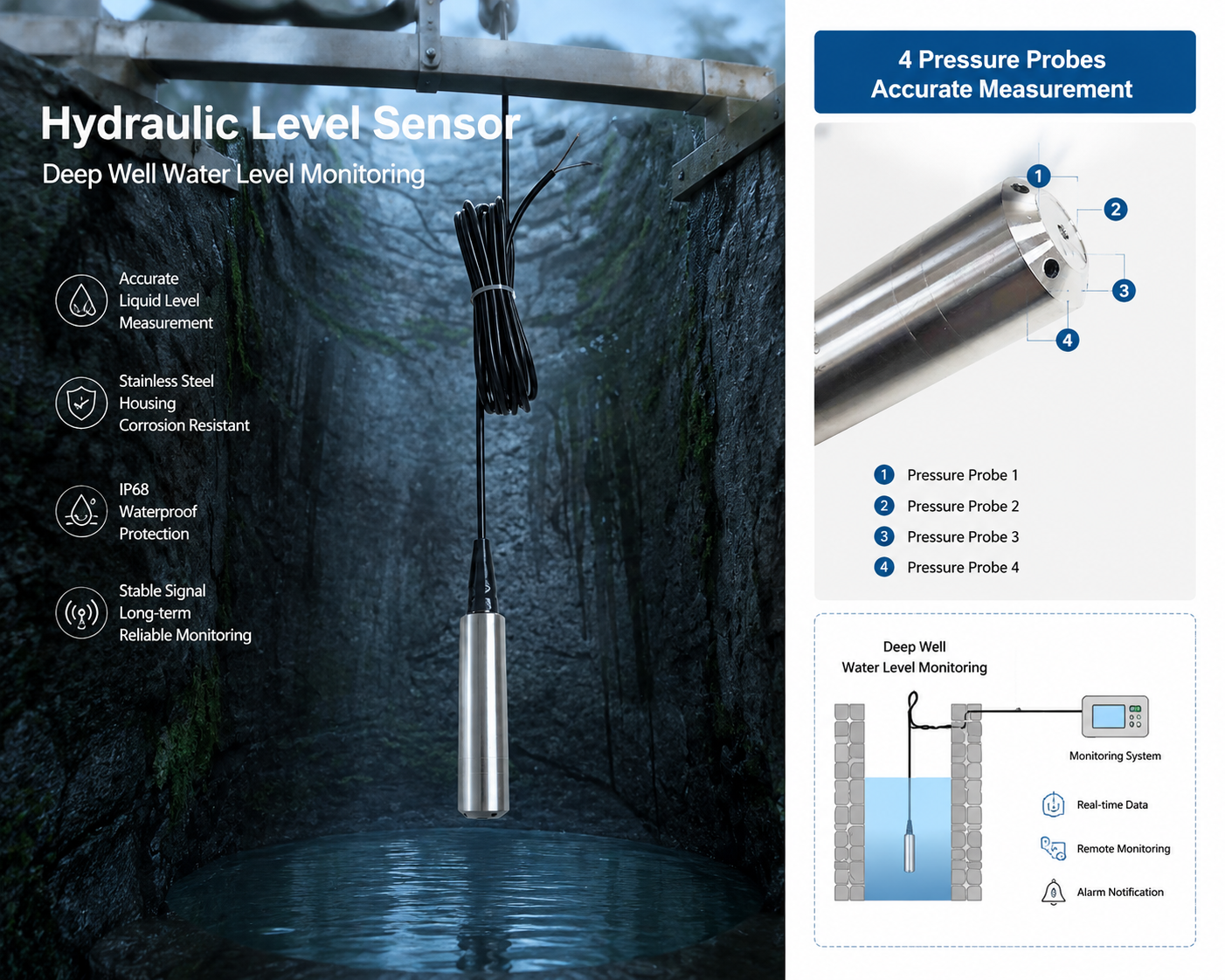
What the Sensor Actually Does at a Storm Overflow
A storm overflow operates on a simple principle: the sewer fills, the water level rises, and when it exceeds the weir crest, the overflow spills. The level sensor’s job is to detect exactly when that weir crest is crossed — the moment the spill starts — and when the level falls back below it, the moment the spill ends. The duration between the two is the EDM data point that gets reported, audited, and published.
The sensor is installed in the overflow chamber or wet well, measuring the sewage level continuously. Thames Water’s EDM description is explicit: the sensors “monitor the level of storm sewage in a tank or sewer” and “trigger an alert when a certain level” is reached. The threshold is the weir crest. Every time the level crosses it, an event is logged.
Why Pressure, Not Radar or Ultrasonic
The choice of sensor technology at a storm overflow is not academic. The measurement environment is the most hostile in water infrastructure: raw sewage, floating fat, foam, turbulence from the incoming flow, condensation, and humidity at 100%.
Ultrasonic sensors fail at storm overflows for a documented reason: foam. Sewage generates foam at the water surface — detergent residues, biological activity, turbulence. An ultrasonic sensor measures the distance to the first reflecting surface, which is the foam, not the water. A foam layer of 5 centimeters translates to a level error of 5 centimeters — enough to delay or falsify the weir-crossing detection by minutes.
Radar sensors handle foam better but have a different constraint at storm overflows: the chambers are often narrow, the mounting points limited, and the sensor must see the water surface from above through a shaft — which works, but at higher cost per site.
The pressure (hydrostatic) level sensor eliminates the surface problem entirely. It is submerged. It measures the hydrostatic head of the sewage column above its diaphragm — the actual force exerted by the liquid, regardless of what is floating or foaming on the surface. Fat, foam, turbulence, and floating debris have zero effect on the measurement. The sensor cannot be “blinded” by the surface because it does not look at the surface.
The Honde pressure level transmitter — 316L stainless body, ±0.1% FS accuracy, 1 mm resolution — is specified for EDM deployments for exactly this reason: it measures the sewage column it sits in, not the surface it could not see.
The Product Configuration
| Specification | Value |
|---|---|
| Measurement principle | Hydrostatic pressure (submersible) |
| Accuracy | ±0.1% FS |
| Resolution | 1 mm |
| Housing | 316L stainless steel, IP68 |
| Depth range | 10–200 m configurations |
| Output | RS485 Modbus-RTU / 4–20 mA |
| Wireless | GPRS / 4G / WiFi / LoRa / LoRaWAN |
| Application | Storm overflow chamber, wet well, sewer level |
The EDM Compliance Architecture
Field Results: Northern England Water Company EDM Program, 2025–2026
A water and sewerage company in northern England upgraded 400 storm overflow sites from no monitoring to full EDM instrumentation between January 2025 and March 2026, replacing an earlier generation of ultrasonic monitors that had proven unreliable in foam conditions.
EDM event detection comparison — ultrasonic baseline vs. pressure network:
| Metric | Ultrasonic baseline (2024) | Pressure network (2025–26) |
|---|---|---|
| Sites reporting event data | 268 | 400 |
| False spill events logged | 64 | 9 |
| Missed spill events (verified by manual review) | 41 | 3 |
| Foam-related measurement failures | 87 | 0 |
| Sites with data completeness > 95% | 61% | 94% |
Operational outcomes:
- The foam interference that had produced 87 measurement failures on the ultrasonic baseline was eliminated entirely — the submerged pressure sensors cannot be affected by surface conditions.
- False spill events dropped from 64 to 9 — the ultrasonic units had logged spurious weir-crossing events when foam or debris triggered surface reflections. Each false event previously required a site visit to verify and manually clear from the EDM record.
- The company’s 2025 EDM annual return to the Environment Agency was generated 93% from continuous sensor data — the highest instrumented proportion in the company’s reporting history — with the remaining 7% from sites awaiting sensor installation.
- The 50 mm pre-spill alarm provided an average of 24 minutes of advance notice across 61 spill events during the monitoring period — time used to pre-position tanker crews at known flood-risk locations.
- Zero sensor failures through the 14-month period. The 316L stainless bodies survived the raw sewage environment, including three fatberg-related high-flow events that overloaded the chambers.
Contact Honde Technology for Sewer and Storm Overflow Monitoring
Honde Technology is a Germany TUV & Alibaba verified manufacturer. We supply the pressure level measurement hardware, the foam-immune sensing technology, and the EDM telemetry logic required by water companies operating under regulatory discharge monitoring mandates.
For more sensor information and customized IoT solutions, please contact Honde Technology Co., LTD.
- WhatsApp: +86-15210548582
- Email: info@hondetech.com
- Company Website: www.hondetechco.com
The Demand Map Across Developed Sewer Networks
The same pressure level sensor specification is driving procurement across every developed country with a storm overflow or sewer flood monitoring mandate. Germany’s state environmental agencies require level monitoring at combined sewer overflows under the federal wastewater ordinance. France’s urban agglomerations are installing level monitors at CSO outfalls under EU Urban Wastewater Treatment Directive compliance. Japan’s MLIT sewer bureaus monitor wet-well levels in its metro drainage systems. Australia’s major urban water utilities deploy level transducers in their overflow structures under state environmental licences. The United States’ EPA consent decrees — imposed on cities like Atlanta, Baltimore, and St. Louis for CSO violations — mandate level-based event monitoring as a compliance condition. Each program converges on the same hardware requirement: a submerged pressure sensor that measures the sewage column directly, immune to foam and fat, reporting over GPRS/4G in MQTT Json format, with the level record forming the compliance ledger. The regulatory mandate — not the sensor — is what converts the specification into a procurement line item with a deadline.
Post time: Aug-20-2026