

The Brazil Reality: One Country, Two Rainfall Crises
By July 2026, Brazil confronts two opposite rainfall challenges simultaneously. In the southeastern coffee belt — Minas Gerais and Espírito Santo — farmers need precise rainfall data to time harvests, manage irrigation, and predict frost risk during the critical winter dry season. Missing a 10mm rainfall event that triggers a flowering cycle can shift an entire harvest by three weeks.
Meanwhile, in the mountainous regions of Rio de Janeiro state, the scars of the 2022 Petrópolis disaster remain fresh. There, 260mm of rain in six hours triggered mudslides that killed over 230 people. The state’s civil defense agency is now under a federal mandate to deploy dense, cost-effective rain monitoring grids across every high-risk municipality.
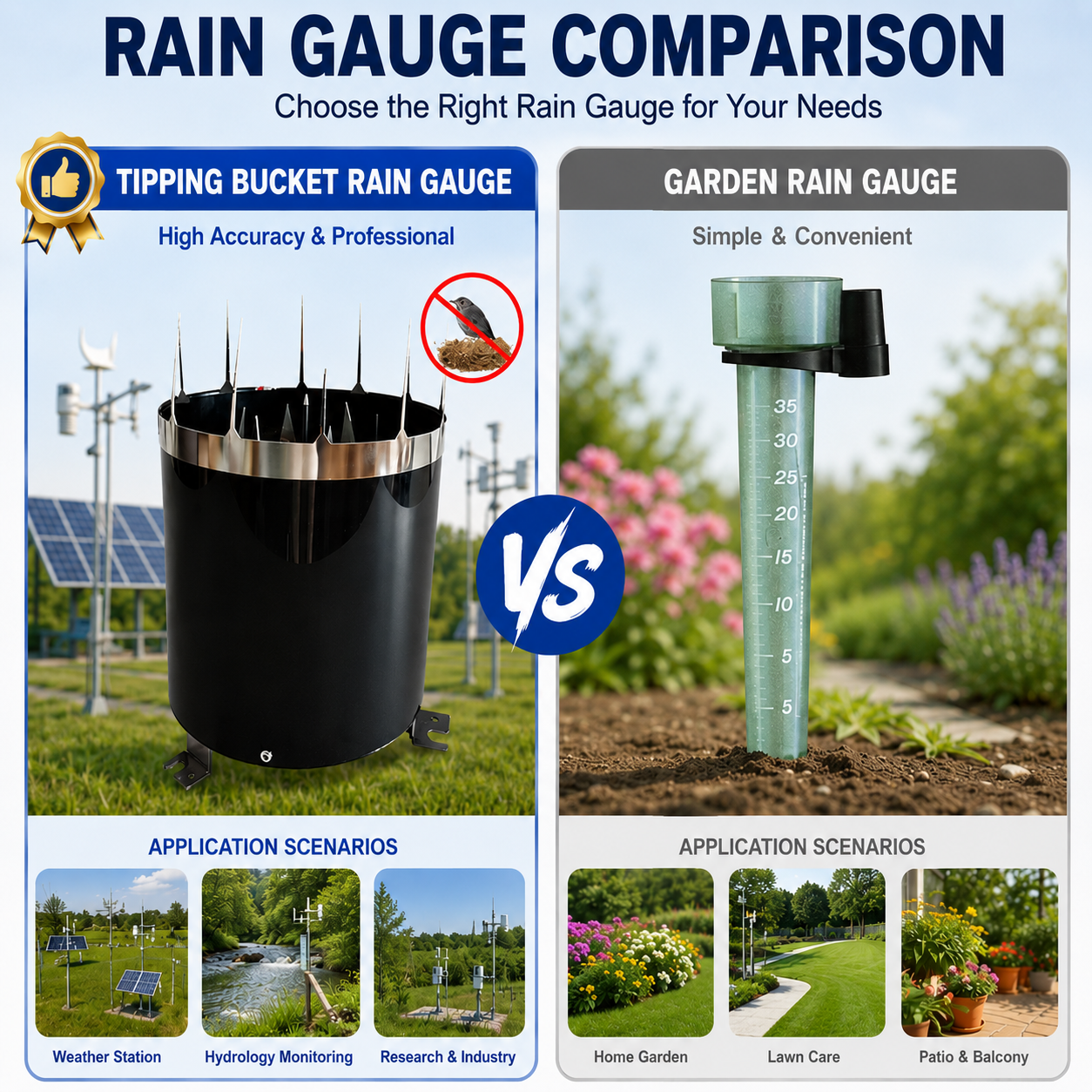
These two needs — agricultural precision and civil defense resilience — converge on a single piece of hardware: the 0.5mm tipping bucket rain gauge with RS485 Modbus-RTU output.
Honde Technology’s 0.5mm Pulse/RS485 Dual-Output Rain Gauge was specified for both Brazilian applications because it bridges the gap between legacy pulse-logging infrastructure and modern digital SCADA integration.
Why 0.5mm and RS485: The Engineering Logic
Brazil’s hydrology market is not a single customer. It is a patchwork of legacy dataloggers from the 1990s, modern IoT platforms, and everything in between. A sensor that only outputs pulse — or only outputs RS485 — fails in half the deployments. The Honde gauge solves this by offering both outputs simultaneously from a single unit.
Passive Pulse Output for Legacy Compatibility
The mechanical tipping bucket uses a passive reed switch. When the bucket tips at 0.5mm of accumulated rainfall, a dry contact closes. This pulse signal requires zero sensor-side power — it is simply counted by the datalogger.
- Why this matters in Brazil: Hundreds of existing INMET (National Institute of Meteorology) stations and agricultural weather networks run on legacy pulse-counting loggers. Replacing the logger is a
2,000–5,000 capital expense. Replacing the rain gauge alone is
85–120. The pulse output allows a direct one-to-one swap without touching the existing electronics.
RS485 Modbus-RTU for Modern SCADA
Simultaneously, the sensor outputs a digital RS485 signal with full diagnostic data — not just a count, but a complete data packet including:
- Instantaneous rainfall intensity (mm/h)
- Cumulative daily total
- Cumulative monthly total
- Sensor status and self-diagnostic flags
- Why this matters in Brazil: The civil defense networks being built in 2026 use centralized SCADA platforms that require digital data. RS485 Modbus-RTU enables cable runs up to 1,200 meters from the gauge to the communication module — critical when the gauge must be mounted on a rooftop or tower away from the control cabinet.
304 Stainless Steel with Anti-Insect Mesh
Brazil’s tropical climate accelerates sensor failure in ways that temperate-region specifications do not predict. Spider webs, ant nests, and fungal growth clog standard funnel inlets within weeks. The Honde gauge is built with:
- 304 stainless steel housing — immune to UV degradation and tropical humidity
- Anti-insect mesh at the funnel inlet — prevents the #1 cause of “zero data” failures during the rainy season
- Streamlined funnel geometry — self-clearing in heavy rainfall, shedding leaves and debris
The Honde Full-Stack Architecture for Brazilian Deployments
A rain gauge is a data point. A Honde Solution is a real-time decision-making system.
Tier 1: Local Field Operations
- During installation and quarterly audits, field technicians use the Handmeter to verify pulse counts and RS485 data integrity in under 60 seconds — no laptop required at a remote farm gate or mountain ridge.
- Every station connects to a Data Logger with screen, giving local operators — whether a coffee farm manager or a municipal civil defense coordinator — real-time rainfall intensity, daily accumulation, and 30-day graphical history on-site, even when cellular coverage is down.
Tier 2: Wireless Transmission Backbone
- Station communication modules support GPRS, 4G, WIFI, LoRa, or LoRaWAN, selected based on terrain and coverage. In the mountain valleys of Rio de Janeiro state, LoRaWAN provides 10km range with zero monthly data fees. In the flat agricultural plains of Minas Gerais, 4G modules connect directly to the cellular network.
- All data is packetized in MQTT Json format, feeding directly into the civil defense command center or the farm’s precision agriculture platform without proprietary middleware.
Tier 3: Cloud Management & Automated Warning
- The Cloud server and software consolidates data from every station into a unified dashboard showing real-time data and history data across the entire monitoring grid.
- The Alarm Relay System operates on two independent tracks:
- Civil defense track: When rainfall intensity exceeds 30mm in 30 minutes — the threshold identified in the Petrópolis disaster analysis — the cloud triggers a physical relay that activates Acoustic-Optical sirens in high-risk neighborhoods and sends an immediate alert to the municipal emergency operations center.
- Agricultural track: When cumulative rainfall reaches the threshold for a specific crop cycle trigger, the relay sends an automated notification to the farm manager’s mobile device, enabling precision harvest and irrigation scheduling.
Field Results: Dual Deployment in Southeastern Brazil, 2026
Two parallel deployments in July 2026 demonstrate the dual-purpose value of the Honde 0.5mm RS485 gauge.
Case 1: Coffee Belt Monitoring — Sul de Minas, Minas Gerais
A coffee cooperative representing 340 farms deployed 60 Honde rain gauges across a 400-square-kilometer growing region.
- Hardware: 60 0.5mm RS485 Rain Gauges on existing farm weather stations.
- Transmission: 4G modules transmitting MQTT Json to the cooperative’s central agronomic platform.
- Outcome: During a critical July flowering event, the network detected a 12mm isolated rainfall cell that covered only 40% of the monitored farms. The cooperative issued targeted irrigation recommendations to the 60% of farms that received no rain — a precision intervention that saved an estimated $180,000 in crop value by preventing asynchronous flowering across the harvest zone.
Case 2: Civil Defense Network — Região Serrana, Rio de Janeiro
The state civil defense agency deployed 45 Honde rain gauges across five high-risk municipalities in the mountainous Serrana region.
- Hardware: 45 gauges mounted on school rooftops and communication towers.
- Transmission: LoRaWAN gateways providing 8–12km coverage per gateway, transmitting MQTT Json to the state emergency operations center.
- Outcome: During a July 12 storm event, the network detected a rainfall intensity spike of 38mm in 25 minutes in a drainage basin above a residential neighborhood. The Alarm Relay System triggered sirens 18 minutes before mudflows reached the first houses. No fatalities occurred in the warned zone. The pulse output simultaneously logged data on the legacy INMET dataloggers at the same sites, ensuring zero data loss from the existing national network during the transition to digital SCADA.
Contact Honde Technology for Hydrology Tenders
For more sensor information and customized IoT solutions, please contact Honde Technology Co., LTD.
WhatsApp: +86-15210548582
- Email: info@hondetech.com
- Company Website: www.hondetechco.com
Post time: Jul-27-2026