

Soil CO₂ concentration is one of the most important indicators of soil biological activity, root respiration, and carbon cycling. A high-precision Soil CO₂ Sensor allows farmers, researchers, and environmental engineers to continuously monitor underground carbon dioxide concentration, optimize irrigation and fertilization strategies, evaluate soil health, and support carbon sequestration projects.
Modern Soil CO₂ Sensors equipped with NDIR technology, RS485 Modbus, 4-20mA output, LoRaWAN, 4G, and cloud platforms provide real-time underground monitoring with excellent stability for long-term deployment. This guide explains how Soil CO₂ Sensors work, where they are used, how to choose the right model, and why they are becoming essential equipment for smart agriculture and environmental monitoring.
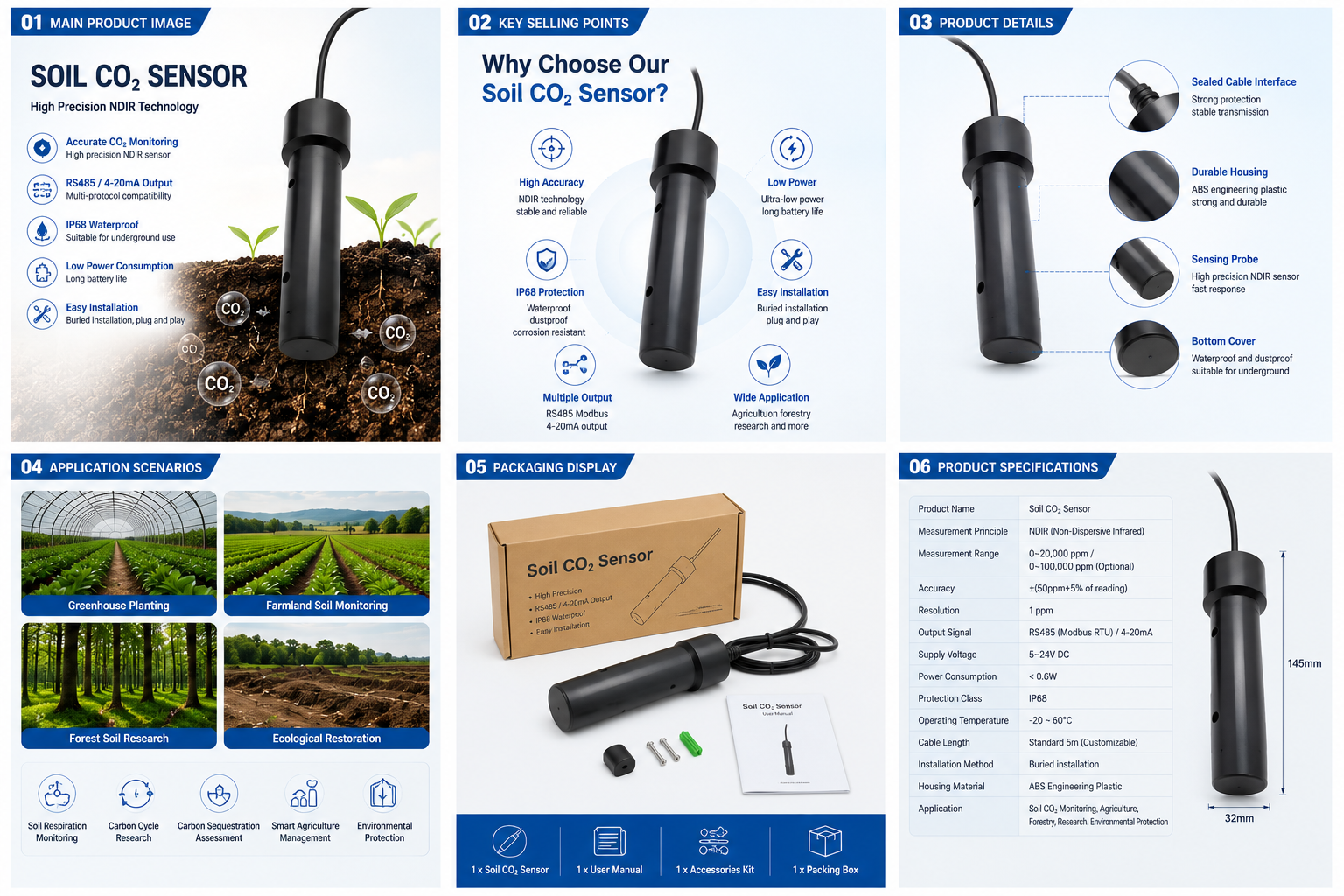
What Is A Soil CO2 Sensor
A Soil CO₂ Sensor is an underground gas monitoring device designed to measure carbon dioxide concentration within soil profiles. Unlike atmospheric CO₂ sensors, soil sensors operate in harsh underground environments where moisture, temperature, and pressure constantly change.
The sensor continuously detects CO₂ generated by:
- Plant root respiration
- Microbial activity
- Organic matter decomposition
- Soil biological metabolism
- Carbon cycling processes
Collected data helps users understand overall soil activity and ecosystem health.
Why Soil CO2 Monitoring Matters
Understanding underground CO₂ provides valuable information that cannot be obtained through soil moisture or temperature monitoring alone.
Major benefits include:
- Evaluate soil biological activity
- Optimize irrigation scheduling
- Improve fertilizer efficiency
- Monitor greenhouse cultivation
- Assess carbon sequestration projects
- Study forest ecosystems
- Support ecological restoration
- Reduce unnecessary agricultural inputs
As governments increasingly focus on carbon neutrality, soil carbon monitoring is becoming an important part of sustainable agriculture.
How NDIR Soil CO2 Sensors Work
Our Soil CO₂ Sensor adopts Non-Dispersive Infrared (NDIR) technology.
NDIR technology measures the infrared absorption characteristics of carbon dioxide molecules, providing:
- High accuracy
- Excellent long-term stability
- Low drift
- Fast response
- Strong anti-interference capability
- Long service life
Unlike electrochemical sensors, NDIR sensors require less maintenance and are better suited for continuous underground monitoring.
Main Features Of Our Soil CO2 Sensor
High Precision Measurement
Advanced NDIR sensing technology delivers stable and repeatable measurements suitable for scientific research and commercial agriculture.
IP68 Waterproof Design
The completely sealed housing allows permanent underground installation even in wet soil conditions.
Multiple Output Options
Available communication methods include:
- RS485 Modbus RTU
- 4-20mA
- LoRa
- LoRaWAN
- WiFi
- 4G
- Ethernet
- MQTT
- JSON API
These interfaces simplify integration into existing IoT monitoring systems.
Low Power Consumption
Optimized electronics support long-term outdoor deployment powered by solar energy or battery systems.
Cloud Platform Support
Data can be uploaded to:
- Honde Cloud Platform
- Customer Private Server
- MQTT Broker
- SCADA System
- PLC
- Mobile APP
- Web Dashboard
Real-time visualization, historical trend analysis, alarm notifications, and remote management are all supported.
Technical Specifications
| Item | Specification |
|---|---|
| Measurement Principle | NDIR Infrared |
| Measuring Range | 0–20,000 ppm Optional 0–100,000 ppm |
| Accuracy | ±50 ppm +5% Reading |
| Resolution | 1 ppm |
| Output | RS485 Modbus RTU 4–20mA |
| Supply Voltage | 5–24V DC |
| Protection Level | IP68 |
| Operating Temperature | -20°C to 60°C |
| Installation | Underground Burial |
| Housing Material | Engineering Plastic |
Typical Application Scenarios
Precision Agriculture
Monitor root-zone respiration and improve irrigation management.
Greenhouse Monitoring
Evaluate crop growth conditions while reducing energy and fertilizer consumption.
Carbon Sequestration Projects
Measure underground carbon dynamics for carbon neutrality assessments.
Forestry Research
Monitor forest soil respiration and ecological changes over time.
Ecological Restoration
Track microbial recovery in degraded land restoration projects.
Scientific Research
Ideal for universities, agricultural institutes, and environmental laboratories.
Soil CO2 Sensor VS Traditional Soil Monitoring
| Feature | Traditional Soil Sensors | Soil CO₂ Sensor |
|---|---|---|
| Soil Moisture | Yes | Optional Combination |
| Soil Temperature | Yes | Optional Combination |
| Root Respiration | No | Yes |
| Carbon Cycle Analysis | No | Yes |
| Microbial Activity | No | Yes |
| Carbon Sequestration Evaluation | No | Yes |
| Smart Agriculture | Limited | Excellent |
How To Select The Right Soil CO2 Sensor
Before purchasing, buyers should evaluate the following factors:
- Required measurement range
- Installation depth
- Communication protocol
- Power supply availability
- Waterproof protection level
- Data logging requirements
- Cloud platform compatibility
- Calibration method
- Environmental conditions
- Future expansion capability
Choosing the correct communication interface is especially important for large-scale agricultural IoT deployments.
Why Choose Honde Technology
Since 2011, Honde Technology Co., Ltd. has specialized in smart agriculture, environmental monitoring, and IoT sensing solutions.
Our advantages include:
- More than 15 years of manufacturing experience
- Products exported to over 70 countries
- Professional OEM and ODM services
- Strict quality control
- CE and RoHS compliance
- Fast delivery
- Technical support
- Complete IoT monitoring solutions
- Cloud software development
- Customized communication protocols
Our laboratory continuously tests sensor stability under different temperature, humidity, and soil conditions to ensure reliable long-term performance. Many customers initially focus only on CO₂ measurement range, but practical experience shows that IP68 waterproofing, NDIR stability, and communication compatibility are equally critical for successful long-term deployment.
Frequently Asked Questions
Can the sensor be buried permanently?
Yes. The IP68 waterproof design supports long-term underground installation.
Does it support LoRaWAN?
Yes. LoRaWAN, LoRa, RS485, WiFi, Ethernet, and 4G versions are available.
Is cloud monitoring supported?
Yes. Data can be uploaded to Honde Cloud Platform or third-party cloud systems using MQTT or JSON.
Can measurement range be customized?
Yes. Optional ranges up to 100,000 ppm are available.
Is OEM branding available?
Yes. We provide OEM and ODM manufacturing services for global distributors and system integrators.
Conclusion
Soil CO₂ monitoring is becoming an essential component of precision agriculture, environmental protection, forestry management, and carbon neutrality projects. By combining NDIR sensing technology, IP68 protection, multiple communication interfaces, and cloud-based data management, modern Soil CO₂ Sensors help users make more informed decisions while improving productivity and sustainability.
Whether you are building a smart farm, conducting ecological research, or implementing a carbon sequestration program, a professional Soil CO₂ Sensor provides the reliable underground data needed for long-term success.
Get A Custom Solution Today
Looking for a reliable Soil CO₂ monitoring solution? Contact our engineering team today for:
- Free technical consultation
- Product catalog
- OEM and ODM services
- Project design support
- Customized quotation
- Software demonstration
Post time: Jul-22-2026