

A wireless soil and air monitoring system with a LoRa collector and gateway provides a practical way to collect environmental data from distributed sensors and transmit it to a remote monitoring platform. By combining soil sensors, atmospheric sensors, a LoRa collector, and a wireless gateway, users can build a scalable monitoring network for precision agriculture, greenhouse monitoring, environmental research, and smart farming.
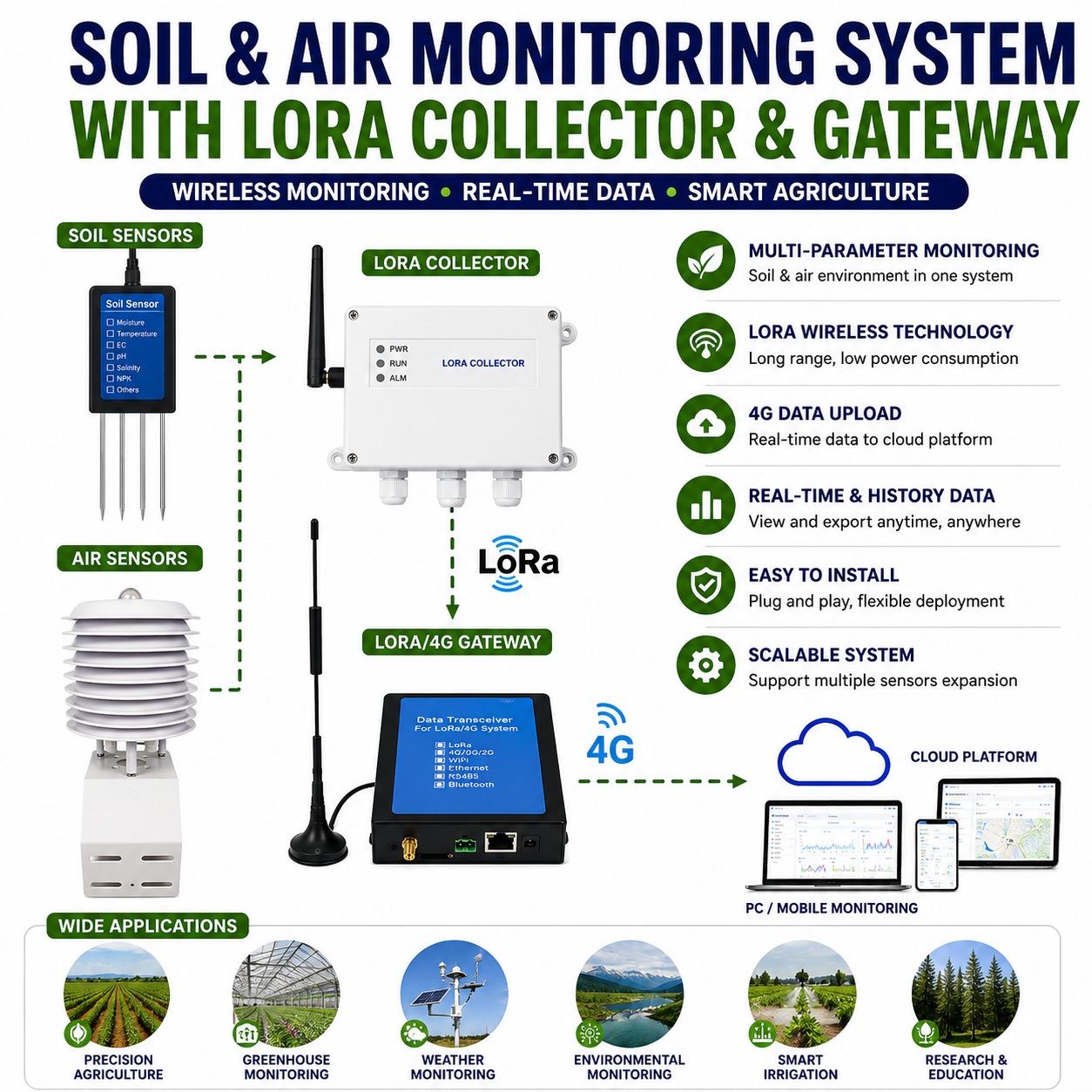
This article explains the system architecture, key components, wireless data transmission process, and important considerations when selecting a LoRa soil sensor monitoring system.
1. What Is a Wireless Soil And Air Monitoring System?
A wireless soil and air monitoring system connects multiple environmental sensors to a local LoRa data collector, which then communicates with a gateway for remote data transmission.
A typical architecture is:
This approach reduces the amount of field wiring required and makes it easier to deploy sensors across agricultural fields or other distributed monitoring locations.
Honde Technology provides soil monitoring solutions supporting LoRa/LoRaWAN wireless communication, as well as RS485-based sensor integration.
2. What Can the System Monitor?
The exact measurement parameters can be customized according to the project.
Soil Monitoring
Typical soil sensors can monitor:
- Soil Moisture
- Soil Temperature
- Soil EC
- Soil pH
- Soil Salinity
- NPK
- Other soil parameters
For example, Honde’s multi-parameter soil sensors can combine moisture, temperature, EC, pH, salinity and NPK measurements into one monitoring solution.
Air And Weather Monitoring
Atmospheric monitoring can include:
- Air Temperature
- Air Humidity
- Atmospheric Pressure
- Wind Speed
- Wind Direction
- Rainfall
- Solar Radiation
- Illuminance
- PM2.5 / PM10
- Other environmental parameters
This allows users to evaluate soil conditions together with atmospheric conditions, rather than relying on soil data alone.
3. How Does the LoRa Collector Work?
The LoRa collector acts as the local communication hub.
Instead of connecting every field sensor directly to the cloud, multiple sensors can first send their measurements to the collector.
The basic process is:
This architecture is particularly useful when sensors are distributed across a large agricultural area.
4. Why Use LoRa for Soil Monitoring?
LoRa is well suited to agricultural and environmental monitoring because it can connect distributed low-power sensors over relatively long wireless distances.
Compared with running individual communication cables from every sensor to a central monitoring room, a LoRa-based architecture can simplify field deployment.
| Feature | Wired Monitoring | LoRa Wireless Monitoring |
|---|---|---|
| Field Wiring | More | Less |
| Distributed Sensors | Suitable | Excellent |
| Remote Deployment | More difficult | Easier |
| Installation | More complex | Simplified |
| Network Expansion | Requires wiring | Easier to expand |
| Typical Application | Fixed installations | Fields and remote monitoring |
For agricultural projects, the combination of LoRa local communication + 4G remote transmission can provide a practical connection between field sensors and cloud-based monitoring.
Honde’s wireless monitoring solutions support LoRa, LoRaWAN, 4G, WiFi and other communication options depending on the configuration.
5. LoRa Collector And Gateway: What Is the Difference?
One of the most important points when designing a wireless monitoring system is understanding the different roles of the collector and gateway.
LoRa Collector
The collector is mainly responsible for:
- Receiving sensor data
- Aggregating local measurements
- Communicating with multiple sensors
- Sending collected data through LoRa
Gateway
The gateway acts as the bridge between the local LoRa network and the remote network.
It can provide:
- LoRa communication
- 4G communication
- WiFi communication
- Ethernet communication
- MQTT data transmission
- Cloud connection
- Data storage
- Alarm functions
Honde’s industrial gateway platform supports RS232/RS485, LoRa, optional WiFi, 4G, Ethernet and MQTT/JSON-related communication functions, depending on configuration.
6. Why MQTT Is Useful for Agricultural IoT
For remote agricultural monitoring, simply collecting data is not enough. The data must also reach the user’s monitoring platform reliably.
MQTT is commonly used in IoT applications because it is lightweight and suitable for machine-to-machine communication.
This architecture allows users to monitor environmental conditions remotely without visiting the field every day.
Honde’s LoRa/4G weather and soil monitoring architecture uses LoRa for local collection and 4G/MQTT for remote transmission.
7. Typical Applications
A wireless soil and air monitoring system can be used in many scenarios.
Precision Agriculture
Monitor soil moisture, temperature, EC, pH and nutrients to support irrigation and fertilization decisions.
Greenhouse Monitoring
Combine soil measurements with air temperature and humidity to understand the growing environment.
Agricultural Weather Stations
Combine soil sensors with weather stations to analyze relationships between weather and soil conditions.
Environmental Monitoring
Deploy distributed sensors for long-term environmental data collection.
Forestry And Ecological Research
Wireless sensors can be installed in remote areas where conventional cabling is inconvenient.
Smart Irrigation
Soil moisture data can be combined with weather information to support more accurate irrigation management.
8. Key Factors When Choosing a LoRa Soil Sensor System
Before purchasing a wireless monitoring system, buyers should evaluate several important factors.
1. Measurement Parameters
Determine whether the project requires:
- Moisture
- Temperature
- EC
- pH
- NPK
- Salinity
- Air temperature
- Humidity
- Weather parameters
Avoid purchasing unnecessary sensors if the project only requires a few parameters.
2. Communication Protocol
Check whether the sensor supports:
- RS485
- Modbus RTU
- SDI-12
- LoRa
- LoRaWAN
For example, Honde offers soil sensors with RS485 and LoRa/LoRaWAN configurations.
3. Wireless Transmission
The communication solution should match the installation environment.
| Deployment Condition | Recommended Communication |
|---|---|
| Short local connection | RS485 |
| Distributed field sensors | LoRa |
| LoRaWAN network | LoRaWAN |
| Remote cloud monitoring | LoRa + 4G |
| Local wireless network | WiFi |
| Existing industrial network | RS485 / Ethernet |
4. Power Supply
Remote agricultural systems often need low-power sensors and solar-powered equipment.
The complete system should therefore be evaluated as a combination of sensor power consumption + collector + gateway + communication module.
5. Cloud And Software
For commercial projects, check whether the supplier can provide:
- Real-time data
- Historical data
- Mobile monitoring
- PC monitoring
- Data export
- Alarm notifications
- MQTT integration
- Customized server/API
9. A Practical System Architecture From Honde Technology
Based on Honde’s existing wireless environmental monitoring solutions, a typical system can be configured as:
The system can also be expanded by adding atmospheric sensors or a compact weather station.
This makes it possible to build a unified monitoring system covering both soil conditions and atmospheric environmental data.
Honde’s published technical architecture specifically describes LoRa collectors for local sensor aggregation and LoRa/4G gateways for remote MQTT transmission.
10. Honde Technology Wireless Monitoring Solutions
Honde Technology Co., Ltd. develops environmental monitoring sensors and wireless IoT systems for agriculture, meteorology and environmental applications.
Our product portfolio includes:
- Soil Moisture Sensors
- Multi-Parameter Soil Sensors
- LoRa / LoRaWAN Soil Sensors
- Weather Stations
- Compact Weather Stations
- LoRa Collectors
- 4G Wireless Gateways
- Environmental Monitoring Systems
- Cloud Monitoring Solutions
Honde also provides OEM/ODM customization, allowing measurement parameters, communication interfaces and wireless modules to be configured according to project requirements.
11. Frequently Asked Questions
Can multiple soil sensors be connected to one LoRa collector?
Yes. The collector-based architecture is designed to aggregate data from distributed sensors before transmitting it through the wireless network. The exact number of supported sensors depends on the selected collector configuration.
Can the system transmit data to the cloud?
Yes. A LoRa/4G gateway can be used to transmit field data to a remote cloud platform, with MQTT available for IoT integration in suitable configurations.
Can soil and weather sensors be used together?
Yes. A major advantage of the architecture is that soil sensors and atmospheric sensors can be combined into one monitoring network. Honde’s published solutions include systems combining soil sensors and weather stations through LoRa wireless communication.
Can the system be customized?
Yes. Honde provides customized sensor combinations and communication solutions, including different environmental parameters and wireless transmission options.
Conclusion
A Soil And Air Monitoring System With LoRa Collector And Gateway is an effective architecture for building scalable wireless environmental monitoring networks.
The core concept is simple:
By combining soil sensors, air/weather sensors, LoRa communication, 4G connectivity and cloud monitoring, agricultural and environmental projects can move from isolated sensor measurements toward a complete remote monitoring system.
For projects requiring custom soil sensors, LoRa collectors, 4G gateways or complete wireless agriculture monitoring systems, contact Honde Technology Co., Ltd.
Get a Custom Wireless Soil And Air Monitoring Solution
Post time: Aug-28-2026