

Outdoor environmental monitoring is becoming increasingly important for smart agriculture, renewable energy, highways, airports, construction sites, and environmental protection projects. A modern 3-in-1 Smart Weather Sensor integrates wind speed, wind direction, and infrared rainfall detection into a compact device, reducing installation costs while improving monitoring efficiency.
This guide explains how to choose the right weather sensor, compares key technical features, and highlights why industrial users worldwide are adopting integrated weather monitoring solutions.
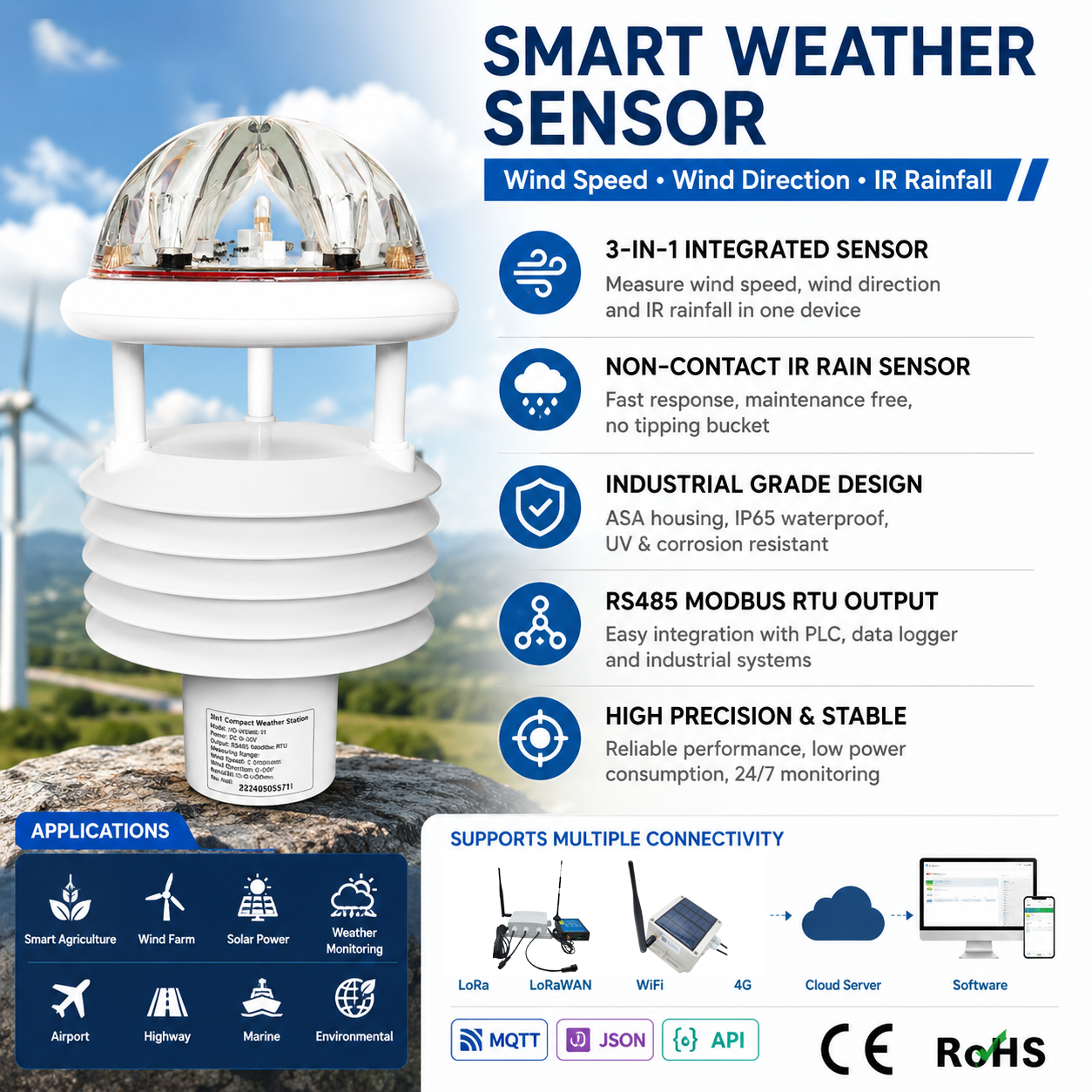
Why Choose a 3-in-1 Weather Sensor Instead of Multiple Individual Sensors?
Traditional weather monitoring systems require several independent sensors, resulting in higher installation costs, more wiring, and additional maintenance.
A compact integrated weather sensor offers:
- ● Simultaneous monitoring of multiple weather parameters
- ● Reduced installation and maintenance costs
- ● Higher system reliability
- ● Simplified wiring
- ● Better compatibility with IoT platforms
- ● Lower power consumption
- ● Faster deployment
For most industrial and agricultural applications, a single integrated weather sensor provides excellent performance while minimizing long-term operating expenses.
What Does a 3-in-1 Weather Sensor Measure?
A typical industrial weather sensor measures the following environmental parameters:
| Parameter | Purpose | Typical Applications |
|---|---|---|
| Wind Speed | Monitor air movement | Wind farms, construction, ports |
| Wind Direction | Determine wind orientation | Aviation, agriculture, meteorology |
| IR Rainfall Detection | Detect rainfall instantly | Smart irrigation, road weather systems |
Unlike traditional tipping bucket rain gauges, infrared rainfall sensors detect rainfall immediately without moving mechanical parts, significantly reducing maintenance requirements.
Why Infrared Rainfall Detection Is Becoming More Popular
Infrared (IR) rainfall sensors offer several advantages over conventional rain gauges.
Advantages include:
- → Fast rain detection
- → No mechanical tipping bucket
- → Maintenance-free operation
- → High reliability
- → Long service life
- → Better response during light rainfall
- → Suitable for unattended monitoring stations
Industrial Features That Matter
When selecting an outdoor weather sensor, environmental durability is just as important as measurement accuracy.
Look for features such as:
- UV-resistant ASA housing
- IP65 waterproof protection
- Corrosion-resistant materials
- Industrial-grade electronic components
- Wide operating temperature range
- Stable long-term outdoor performance
- Compact integrated design
RS485 Modbus RTU Makes Integration Easy
Industrial users typically require sensors that can communicate with PLCs, RTUs, SCADA systems, and cloud gateways. The RS485 Modbus RTU protocol remains one of the world’s most widely used industrial communication standards.
Wireless IoT Connectivity for Smart Monitoring
Modern weather monitoring projects increasingly require remote access to environmental data. A complete monitoring solution can support:
Comparison: Integrated Weather Sensor vs Traditional Weather Monitoring
| Feature | Integrated 3-in-1 Sensor | Traditional Separate Sensors |
|---|---|---|
| Installation | Easy | Complex |
| Wiring | Minimal | Multiple cables |
| Maintenance | Low | High |
| Cost | Lower overall | Higher |
| Space Required | Compact | Large |
Typical Applications
The compact weather sensor is widely used in:
- Smart Agriculture
- Precision Farming
- Greenhouses
- Weather Monitoring Stations
- Solar Power Plants
- Wind Farms
- Airports
- Highways
- Bridges
- Ports
- Environmental Monitoring
- Hydrology Projects
- Smart Cities
- Construction Sites
- Marine Weather Monitoring
Our Manufacturing Experience
At Honde Technology Co., Ltd., we have specialized in environmental monitoring and IoT sensing solutions since 2011.
Our engineering team continuously improves sensor durability, communication stability, and system integration to meet the demands of industrial customers in more than 70 countries.
Based on years of customer feedback, one common issue is that many buyers focus only on measurement range while overlooking communication compatibility and enclosure protection. Selecting the correct IP rating, communication protocol, and wireless transmission solution can significantly reduce future maintenance costs.
Why Customers Choose Honde Technology
Frequently Asked Questions
Is infrared rainfall detection better than a tipping bucket?
Infrared rainfall sensors provide faster rain detection, require less maintenance, and contain no moving mechanical parts, making them ideal for unattended outdoor monitoring.
Can the sensor connect to PLC systems?
Yes. The sensor supports RS485 Modbus RTU, making it compatible with most PLC, SCADA, and industrial automation systems.
Does it support wireless communication?
Yes. Optional communication modules include LoRa, LoRaWAN, WiFi, 4G, and cloud-based MQTT/JSON data transmission.
Conclusion
An integrated 3-in-1 Smart Weather Sensor offers an efficient, reliable, and cost-effective solution for outdoor environmental monitoring. By combining wind speed, wind direction, and infrared rainfall detection into one industrial-grade device, users can reduce installation complexity while improving data quality and system reliability.
Whether you’re building a smart agriculture project, renewable energy installation, or industrial weather monitoring network, selecting a sensor with durable construction, RS485 communication, and flexible IoT connectivity will ensure long-term performance.
Get a Custom Quote
Looking for a reliable weather monitoring solution for your project?
Company Name: Honde Technology Co., Ltd.
Website: www.hondetechco.com
Email: info@hondetech.com
Whether you need OEM customization, bulk purchasing, or a complete weather monitoring system, our technical team is ready to help you choose the right solution. Contact us today to receive datasheets, pricing, and customized recommendations.
Post time: Jul-15-2026