

A compact automatic weather station is the ideal solution for users who need accurate, real-time environmental monitoring while minimizing installation space, maintenance, and power consumption. The best models combine ultrasonic sensing technology, RS485 Modbus communication, 5V low-power operation, and multiple wireless transmission options to support applications ranging from smart agriculture to industrial IoT and environmental monitoring.
This guide explains how to select the right compact weather station, compares key specifications, and highlights the features that professional buyers should consider before purchasing.
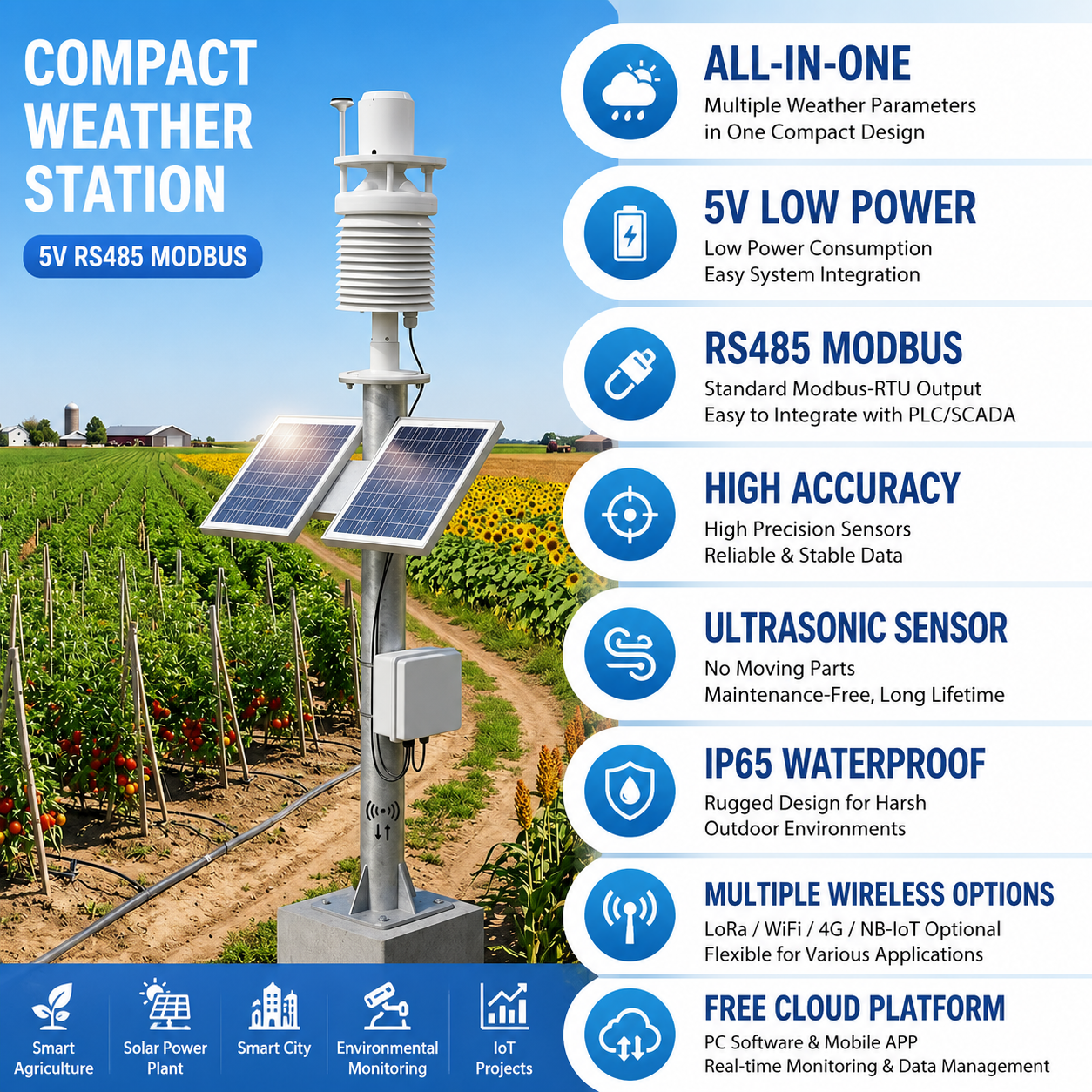
Why Compact Weather Stations Are Becoming the Industry Standard
As precision agriculture and Industrial IoT continue to expand worldwide, traditional mechanical weather stations are gradually being replaced by compact integrated weather sensors.
Compared with conventional systems, compact weather stations offer:
- Smaller installation footprint
- Lower maintenance costs
- Faster deployment
- Better long-term stability
- Easier cloud integration
For agricultural projects, solar farms, smart cities, and environmental monitoring networks, these advantages significantly reduce total operating costs.
What Is a Compact Automatic Weather Station?
A compact automatic weather station integrates multiple meteorological sensors into a single device.
- Wind Speed
- Wind Direction
- Air Temperature
- Relative Humidity
- Atmospheric Pressure
- Solar Radiation
- Rainfall
- PM2.5 / PM10
- Noise
- UV Index
- Illumination
The integrated design eliminates multiple individual sensors, reducing installation complexity while improving measurement consistency.
Why Ultrasonic Technology Is Better Than Mechanical Sensors
One of the biggest improvements in modern weather stations is the adoption of ultrasonic wind measurement technology.
- Bearing wear
- Mechanical friction
- Frequent maintenance
- Lower accuracy after years of operation
- No moving parts
- Maintenance-free
- Fast response
- Long service life
- Better reliability in harsh environments
For remote installations, ultrasonic technology greatly reduces maintenance costs over the product lifecycle.
Why RS485 Modbus Is the Preferred Communication Protocol
Industrial users rarely purchase weather stations as standalone devices.
Instead, they integrate them into:
- PLC systems
- SCADA platforms
- Data loggers
- Industrial controllers
- Smart irrigation systems
- Environmental monitoring networks
Because of this, RS485 Modbus RTU has become the global standard.
Advantages include:
- Long transmission distance
- Excellent anti-interference capability
- High compatibility
- Easy integration
- Low communication cost
Why 5V Low Power Design Matters
Many monitoring projects operate from solar energy.
A 5V power design offers several benefits:
- Lower power consumption
- Smaller solar panels required
- Longer battery life
- Lower installation costs
- Easier integration into embedded IoT systems
This makes compact weather stations particularly suitable for remote agricultural fields and off-grid monitoring sites.
Comparison Table: Compact Weather Station vs Traditional Weather Station
| Feature | Compact Weather Station | Traditional Weather Station |
|---|---|---|
| Installation | Very Easy | Complex |
| Sensor Design | Integrated | Multiple Separate Sensors |
| Maintenance | Almost None | Regular Maintenance |
| Wind Measurement | Ultrasonic | Mechanical Cups |
| Communication | RS485 Modbus | Various |
| Power Consumption | Very Low | Higher |
| Installation Cost | Low | High |
| Reliability | Excellent | Medium |
| Suitable for IoT | Yes | Limited |
Key Features to Look For Before Buying
Professional buyers should evaluate the following factors before purchasing.
Choose a weather station capable of monitoring several weather parameters simultaneously.
Benefits include:
- Lower installation costs
- Better appearance
- Simplified maintenance
Look for industrial-grade digital sensors that provide:
- Stable output
- Excellent repeatability
- Long-term calibration stability
Accurate environmental data improves irrigation scheduling, crop protection, and environmental analysis.
Outdoor monitoring equipment should provide excellent environmental protection.
Recommended features:
- IP65 Waterproof
- UV-resistant housing
- Corrosion resistance
- Wide operating temperature range
Modern projects increasingly require remote monitoring.
Choose models supporting:
- LoRa
- LoRaWAN
- WiFi
- 4G LTE
- Ethernet
- MQTT
- JSON API
A professional monitoring system should include:
- Web dashboard
- Mobile App
- Historical data storage
- Alarm notifications
- Data export
- Remote configuration
Cloud connectivity significantly improves operational efficiency.
Typical Applications
Compact automatic weather stations are widely used in:
Our Manufacturing Experience
At Honde Technology Co., Ltd., we have been manufacturing environmental monitoring equipment since 2011.
Our weather monitoring solutions have been installed in more than 70 countries, serving customers across agriculture, renewable energy, industrial automation, environmental protection, and smart city projects.
Based on years of project experience, we have found that many customers initially focus only on price. However, long-term reliability, communication compatibility, and maintenance costs ultimately determine the total cost of ownership.
For remote projects, choosing an ultrasonic compact weather station with industrial RS485 communication can significantly reduce maintenance expenses over many years of operation.
Why Choose Honde Technology?
Our Advantages
- Professional Manufacturer Since 2011
- OEM & ODM Service
- Industrial Grade Quality
- CE & RoHS Certified Products
- RS485 Modbus Standard
- Multiple Wireless Communication Options
- Free Cloud Platform
- Technical Support
- Global Shipping
- Exported to 70+ Countries
Frequently Asked Questions
It supports RS485 Modbus RTU, making it compatible with PLCs, SCADA systems, industrial controllers, and IoT gateways.
Yes. The 5V low-power design is ideal for solar-powered monitoring systems.
Yes. Optional communication modules include:
- LoRa
- LoRaWAN
- WiFi
- 4G LTE
- MQTT
- JSON
Absolutely. The compact weather station features an IP65-rated enclosure and is designed for continuous outdoor operation in demanding environments.
Conclusion
Selecting the right compact automatic weather station involves more than comparing prices. Buyers should consider measurement accuracy, communication protocols, power consumption, environmental protection, wireless connectivity, and long-term maintenance requirements.
A modern ultrasonic weather station with RS485 Modbus communication and cloud connectivity provides a reliable, scalable solution for agriculture, environmental monitoring, and Industrial IoT applications.
By choosing the right system, organizations can improve operational efficiency, reduce maintenance costs, and gain accurate weather data for better decision-making.
If you’re looking for a reliable Compact Automatic Weather Station manufacturer, our engineering team is ready to help.
We provide:
- OEM & ODM Manufacturing
- Technical Consultation
- Custom Project Solutions
- Worldwide Shipping
- Fast Quotation Within 24 Hours
Contact us today to receive product specifications, pricing, and customized weather monitoring solutions for your project.
Post time: Jul-21-2026