

Introduction
A high-accuracy pyranometer is essential for reliable solar irradiance measurement in photovoltaic (PV) plants, weather stations, smart agriculture, and environmental monitoring projects. The best pyranometers should provide stable long-term performance, accurate solar radiation data, industrial communication interfaces, and weather-resistant protection for outdoor deployment.
This guide explains how to select the right solar radiation sensor, compares key technical specifications, and highlights the factors that most buyers overlook when sourcing pyranometers for professional applications.
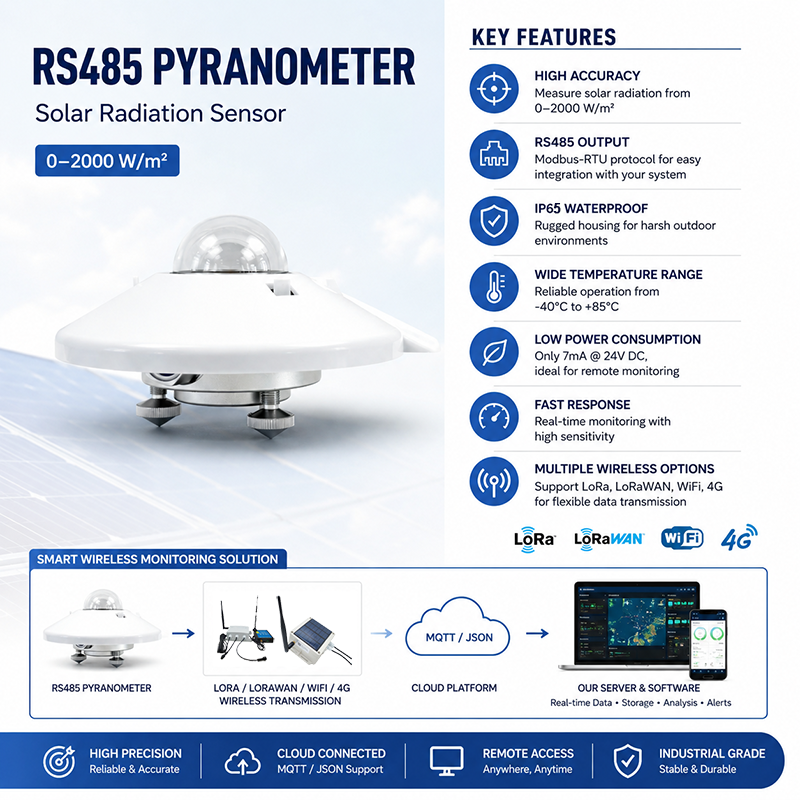
What Is a Pyranometer?
A pyranometer is a solar radiation sensor used to measure global solar irradiance (W/m²) on a horizontal surface. It is widely used in:
- ►Photovoltaic power plants
- ►Solar resource assessment
- ►Meteorological stations
- ►Smart agriculture systems
- ►Environmental monitoring networks
- ►Research institutions
Accurate irradiance data helps optimize energy production, improve system efficiency, and support scientific analysis.
Why Solar Irradiance Accuracy Matters
Solar irradiance is one of the most critical parameters affecting photovoltaic system performance.
Even a small measurement deviation can result in:
- ⚠Incorrect PV efficiency calculations
- ⚠Poor energy yield forecasts
- ⚠Inaccurate performance ratio (PR) analysis
- ⚠Reduced ROI for solar projects
Most professional solar monitoring systems require sensors with high stability and factory calibration to ensure reliable long-term data collection.
Typical Measurement Requirements
| Application | Recommended Accuracy |
|---|---|
| Basic Weather Monitoring | ±5% |
| Smart Agriculture | ±3% |
| Solar Power Plants | ±2% |
| Research & Calibration | ≤±1% |
Key Features to Consider When Buying a Pyranometer
1Measurement Accuracy
The first specification buyers should evaluate is measurement accuracy.
The Honde RS485 Pyranometer measures solar radiation from:
Key advantages include:
- ✓High sensitivity
- ✓Fast response time
- ✓Excellent linearity
- ✓Low annual drift
These characteristics ensure consistent solar irradiance monitoring throughout the sensor’s service life.
2Long-Term Stability
Many low-cost solar radiation sensors lose accuracy after prolonged exposure to:
- ●UV radiation
- ●High humidity
- ●Temperature fluctuations
- ●Dust accumulation
Long-term stability directly affects data reliability.
In our experience of manufacturing environmental monitoring equipment, many project failures originate from sensor drift rather than communication issues.
When evaluating a pyranometer, always request:
- ✓Annual stability specifications
- ✓Calibration certificates
- ✓Long-term field testing data
3Factory Calibration
Calibration is often overlooked by buyers.
A properly calibrated pyranometer provides:
- ✓Consistent measurement results
- ✓Reduced maintenance costs
- ✓Faster deployment
- ✓Better data comparability
The Honde RS485 Pyranometer is factory calibrated before shipment to ensure dependable field performance.
4Communication Interfaces and IoT Integration
Modern monitoring projects require more than just sensor measurements.
Industrial users increasingly demand:
- ✓RS485 Modbus RTU
- ✓LoRa
- ✓LoRaWAN
- ✓WiFi
- ✓4G LTE
- ✓MQTT JSON Protocol
These communication options allow real-time data transmission to cloud platforms, SCADA systems, and remote monitoring software.
Wireless Monitoring Architecture
| Component | Function |
|---|---|
| Pyranometer | Solar Radiation Measurement |
| LoRa / 4G Gateway | Wireless Transmission |
| MQTT JSON Platform | Cloud Data Transfer |
| Monitoring Software | Visualization & Analysis |
| Mobile App | Remote Access |
This architecture significantly reduces installation costs for large-scale solar farms and distributed monitoring projects.
5IP65 Outdoor Protection
Outdoor environmental monitoring equipment must withstand harsh weather conditions.
Recommended protection level:
Benefits include:
- ✓Dust resistance
- ✓Rain protection
- ✓UV resistance
- ✓Reliable outdoor operation
The Honde Pyranometer is designed for long-term deployment in:
- ►Solar farms
- ►Agricultural fields
- ►Meteorological stations
- ►Industrial environments
Applications of Pyranometers
Solar Power Plants
Solar irradiance measurement supports:
- ✓Performance Ratio (PR) analysis
- ✓Energy yield calculation
- ✓Panel efficiency monitoring
- ✓Preventive maintenance
Smart Agriculture
Solar radiation directly influences:
- ✓Photosynthesis
- ✓Crop growth
- ✓Irrigation scheduling
- ✓Greenhouse management
Farm operators can use irradiance data to optimize crop production and resource utilization.
Weather Stations
Meteorological stations use pyranometers to monitor:
- ✓Solar radiation
- ✓Climate trends
- ✓Environmental conditions
- ✓Scientific research data
Common Mistakes Buyers Make
Many buyers focus only on price and ignore critical specifications.
The most common sourcing mistakes include:
- 1 Ignoring calibration certification
- 2 Choosing non-industrial communication protocols
- 3 Overlooking IP protection ratings
- 4 Not considering long-term stability
- 5 Selecting sensors without technical support
These issues often result in higher total ownership costs over time.
Why Choose Honde Technology?
About Honde Technology Co., Ltd.
Honde Technology specializes in environmental monitoring sensors and IoT solutions for agriculture, meteorology, and renewable energy industries.
Our solutions are deployed worldwide in:
- ►PV Power Plants
- ►Smart Agriculture Projects
- ►Environmental Monitoring Networks
- ►Weather Stations
- ►Research Institutions
Product Advantages
Frequently Asked Questions
Conclusion
Choosing the right pyranometer requires more than comparing prices. Accuracy, stability, calibration quality, communication protocols, and environmental protection all play crucial roles in long-term project success.
For solar farms, weather stations, and smart agriculture systems, a high-quality RS485 pyranometer can significantly improve data reliability and operational efficiency.
Request a Quote
Looking for a professional solar radiation monitoring solution?
Company Name: Honde Technology Co., Ltd.
Website: www.hondetechco.com
Email: info@hondetech.com
Contact our engineering team today to receive product specifications, application recommendations, and a customized quotation for your project.
Post time: Jun-18-2026