

An Ultraviolet Radiation Sensor (UV Sensor) is an essential component of modern weather stations, environmental monitoring systems, smart agriculture, and solar energy monitoring projects. Selecting the right sensor requires more than simply comparing prices—it involves evaluating measurement accuracy, spectral response, environmental durability, communication protocols, and long-term stability.
In this guide, we’ll explain how UV radiation sensors work, compare different technologies, discuss important purchasing considerations, and help you select the ideal solution for your application.
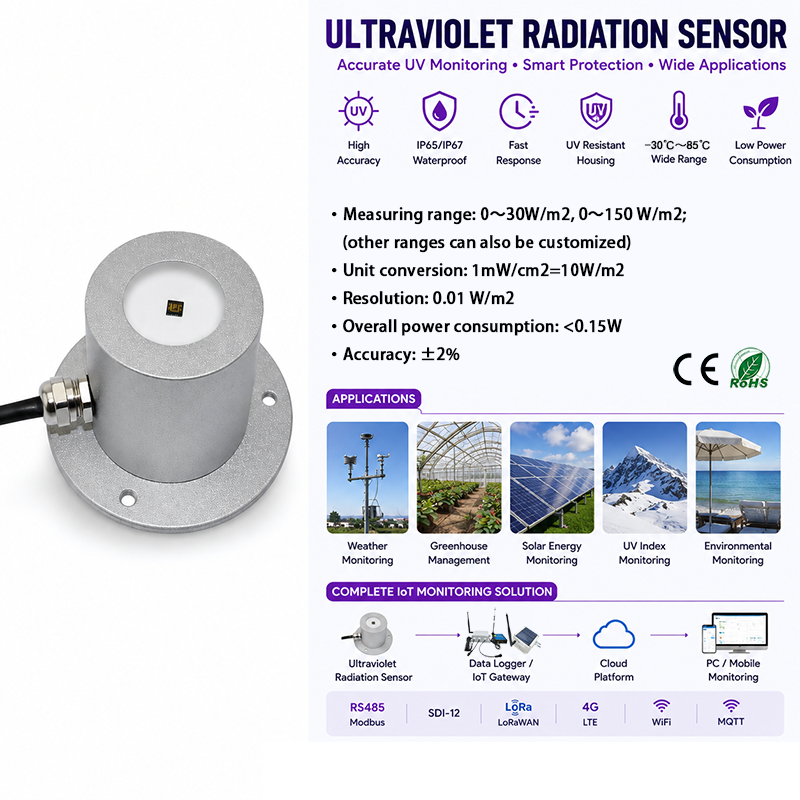
What Is an Ultraviolet Radiation Sensor?
An Ultraviolet Radiation Sensor measures the intensity of ultraviolet light reaching the Earth’s surface. Depending on the application, it can monitor:
- UVA Radiation
- UVB Radiation
- UVC Radiation (special applications)
- UV Index
- Total UV Irradiance
The sensor converts ultraviolet light into electrical signals that can be transmitted to weather stations, PLC systems, IoT gateways, or cloud monitoring platforms.
Common industries include:
Why UV Radiation Monitoring Is Becoming More Important
As climate conditions continue to change, ultraviolet radiation has become a critical environmental parameter for many industries.
Smart Agriculture
Proper UV monitoring helps growers:
- • Optimize crop growth
- • Improve greenhouse shading control
- • Protect sensitive plants
- • Increase agricultural productivity
Weather Monitoring
Meteorological stations use UV sensors together with:
to build comprehensive weather monitoring systems.
Solar Energy Industry
UV radiation influences:
- • Solar panel aging
- • Module degradation
- • PV efficiency evaluation
- • Environmental performance analysis
Accurate UV measurements help optimize photovoltaic system maintenance.
How Does a UV Radiation Sensor Work?
The sensing element uses a highly sensitive photodetector combined with optical filters to accurately measure ultraviolet energy while minimizing interference from visible and infrared light.
The sensor then converts optical energy into standard industrial outputs such as:
These outputs can be integrated directly into SCADA systems, PLCs, weather stations, and cloud platforms.
Key Specifications to Consider
| Parameter | Why It Matters |
|---|---|
| Measurement Accuracy | Determines monitoring reliability |
| Spectral Response | Covers UVA, UVB or total UV |
| Response Time | Faster response captures rapid UV changes |
| Temperature Stability | Ensures consistent readings |
| Waterproof Rating | IP65/IP67 recommended |
| Operating Temperature | Suitable for harsh environments |
| Output Signal | RS485, SDI-12, Analog |
| Long-term Stability | Reduces maintenance costs |
| Power Consumption | Important for solar-powered stations |
RS485 Modbus vs Analog Output
| Feature | RS485 Modbus | Analog Output |
|---|---|---|
| Communication Distance | Excellent | Limited |
| Noise Immunity | High | Medium |
| Multi-device Networking | Yes | No |
| Data Accuracy | Digital | Analog Drift Possible |
| Smart Monitoring | Excellent | Limited |
For most industrial applications, RS485 Modbus is the preferred communication protocol due to its stability and ease of integration.
Typical Applications
A high-quality UV radiation sensor can be used in:
Smart Agriculture
Monitor UV intensity to optimize irrigation, shading, and crop growth.
Greenhouse Automation
Improve environmental control and protect high-value crops.
Automatic Weather Stations
Measure UV radiation alongside complete meteorological parameters.
Environmental Monitoring
Track long-term ultraviolet radiation trends for ecological research.
Solar Power Plants
Evaluate UV exposure and support photovoltaic performance analysis.
Scientific Research
Universities and laboratories use UV sensors for climate and atmospheric studies.
Complete IoT Environmental Monitoring Solution
Modern UV sensors are no longer standalone devices.
They can easily integrate with:
This enables real-time remote monitoring from anywhere in the world.
Our Manufacturing Experience
At Honde Technology Co., Ltd., we have specialized in manufacturing environmental monitoring equipment for many years.
Our engineering team has supplied thousands of monitoring projects across agriculture, meteorology, environmental protection, smart cities, and renewable energy industries.
Common Buyer Mistake:
From our experience, one of the most common mistakes buyers make is selecting sensors based solely on price. Low-cost UV sensors often suffer from:
- • Poor spectral consistency
- • Significant measurement drift
- • Weak waterproof performance
- • Limited outdoor lifespan
For long-term outdoor installations, selecting industrial-grade sensors with stable calibration and reliable communication interfaces significantly reduces maintenance costs over the product lifecycle.
Why Choose Honde Technology UV Radiation Sensors?
Our UV Radiation Sensors provide:
Frequently Asked Questions
Conclusion
Choosing the right Ultraviolet Radiation Sensor requires evaluating measurement accuracy, communication protocol, environmental durability, and long-term reliability rather than focusing solely on price.
Whether you’re building an automatic weather station, greenhouse monitoring system, smart agriculture solution, or solar energy project, investing in a high-quality UV sensor ensures accurate data, reduced maintenance, and dependable long-term performance.
Get Expert Support for Your Project
If you’re looking for a reliable Ultraviolet Radiation Sensor manufacturer or need a customized environmental monitoring solution, our engineering team is ready to help.
We provide OEM/ODM services, technical support, complete IoT monitoring solutions, and fast global delivery.
Post time: Jul-02-2026