

1. Introduction: The Direct Answer for Solar Precision
A thermoelectricity total radiation sensor (pyranometer) is a precision instrument that measures the total hemispherical solar radiation, providing the flat spectral response necessary for accurate solar efficiency monitoring. To ensure maximum durability and data integrity in utility-scale projects, these sensors must feature rugged aluminum housing and support standard industrial protocols like RS485 Modbus or MQTT. Selecting a sensor with an integrated leveling pallet is essential for precise horizontal alignment and minimizing measurement errors in the field.
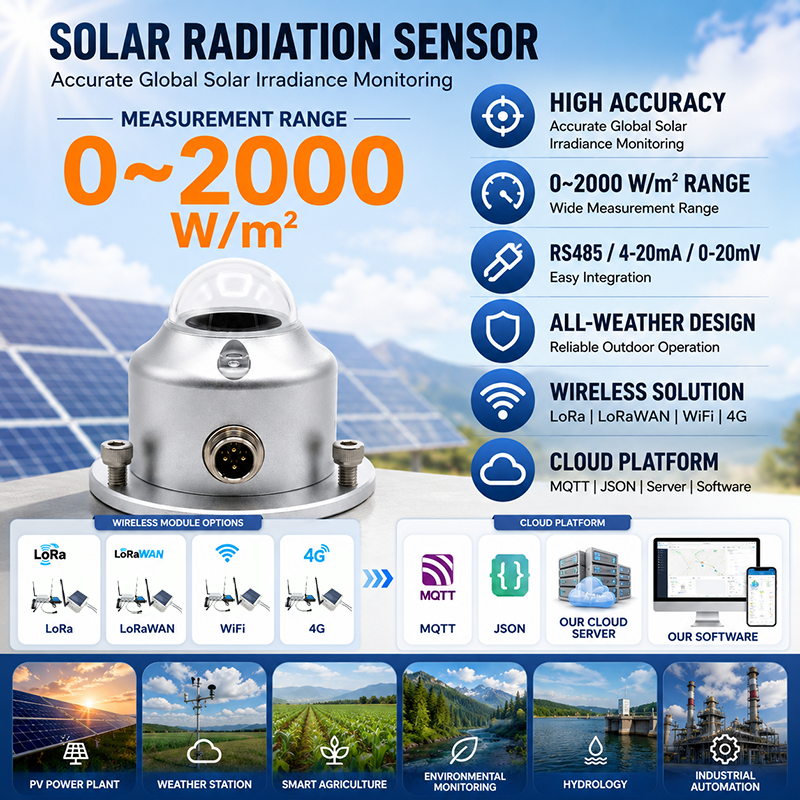
2. Engineering Durability: Industrial Sensor Housing for Weatherproof Monitoring
In the pursuit of solar precision, the underlying technology matters. While photodiode-based sensors are common, professional-grade thermoelectric sensors are preferred for their superior spectral flatness across the solar spectrum. However, this precision is only as reliable as the sensor’s protection.
At Honde Technology, our sensors utilize an industrial sensor housing crafted from high-grade aluminum. Unlike polycarbonate alternatives that degrade under intense UV exposure, a metal chassis provides the structural integrity required for decades of weatherproof monitoring. The internal thermoelectric elements are further protected by a high-transparency glass shield, ensuring the sensor remains resilient against environmental degradation while maintaining the optical clarity necessary for accurate radiation capture.
3. Installation Precision: The Importance of Horizontal Alignment
Even a high-performance sensor will yield compromised data if the installation is flawed. To mitigate cosine error and ensure measurement integrity, the following leveling protocol is mandatory during deployment. Solar radiation data is calculated based on a hemispherical field of view; any tilt in the sensor relative to the horizon will result in significant data bias.
To simplify this process for field engineers, our hardware features an integrated horizontal pallet and a precision adjustment mechanism at the base. To secure accurate data, follow this professional leveling procedure:
- Structural Mounting: Secure the sensor base to a stable, vibration-resistant crossarm or mounting plate.
- Primary Leveling: Utilize the integrated horizontal pallet at the bottom of the device to check the current orientation.
- Fine Adjustment: Manipulate the adjustment screws to align the internal bubble level perfectly within the center of the pallet.
- Integrity Verification: Once leveled, tighten all mounting hardware to ensure the sensor remains horizontal despite wind loads or thermal expansion.
4. Connectivity & Data Protocols: Feeding the Modern IoT Ecosystem
Modern solar assets require more than just raw data; they require network-ready information that can be ingested by SCADA systems and cloud platforms. The Honde Technology sensor bridges the gap between hardware and software by offering a robust physical RJ45 interface supporting “Modbus Pro” communication.
Beyond standard wired connections, our ecosystem supports various wireless solar monitoring configurations for remote or distributed assets:
| Connection Type | Protocol / Format | Primary Use Case |
|---|---|---|
| Physical RJ45 Port | Standard Modbus Pro | Wired industrial PLC, SCADA, and Data Logger integration. |
| Wireless Modules | LoRa, 4G, Wi-Fi, GPS | Remote field deployment where trenching or cabling is non-viable. |
| IoT Data Formats | MQTT, JSON | Direct-to-cloud transmission for modern web-based monitoring software. |
This multi-protocol support allows for real-time visualization through our proprietary server and software, giving operators immediate insight into solar irradiance levels.
5. Technical Specifications Overview
For procurement officers and technical leads, the following specifications summarize the high-density capabilities of the Honde Technology radiation sensor:
- Housing Material: CNC-machined Aluminum for maximum durability.
- Optical Shield: Transmissive Protective Glass (Weatherproof).
- Physical Interface: Standard RJ45 Port.
- Digital Protocols: Modbus Pro (RS485-based), MQTT, and JSON.
- Wireless Flexibility: Optional LoRa, 4G, Wi-Fi, and GPS integration.
- Alignment Hardware: Integrated horizontal leveling pallet with adjustment screws.
6. Industry Experience: Why Honde Technology?
As a specialized manufacturer, Honde Technology Co., Ltd. operates with an engineering-first approach to environmental monitoring. In our manufacturing process, we recognize that the value of an industrial sensor lies in its long-term stability and ease of integration. We focus on providing turnkey, durable solutions that simplify the transition from physical environmental phenomena to actionable digital data.
Our commitment to quality ensures that our sensors meet the rigorous demands of the global energy sector. For detailed technical inquiries or project-specific configurations, please contact our engineering team:
- Website: www.hondetechco.com
- Email: info@hondetech.com
7. Conclusion & Call to Action (CTA)
Selecting a thermoelectricity total radiation sensor is a strategic decision that affects the bankability of solar project data. By prioritizing aluminum construction, a standardized RJ45 interface, and rigorous horizontal alignment, you eliminate the variables that lead to costly data errors.
- Download the Detailed Thermoelectricity Sensor Spec Sheet
- Request a Custom Quote for Your Solar Monitoring Project
Post time: Jun-24-2026