

Introduction: What Is A Type C Port RS485 Soil Sensor And Why Is It Important?
A Type C Port RS485 Soil Sensor is an advanced digital soil monitoring device designed for precision agriculture, greenhouse management, and smart irrigation systems. Unlike traditional soil probes, this sensor combines multi-parameter soil measurement, RS485 Modbus communication, Type-C connection, and long-term outdoor durability to provide accurate soil data for modern farming.
For farmers, agricultural solution providers, and IoT system integrators, the right soil sensor can help monitor soil moisture, soil temperature, electrical conductivity (EC), soil pH, and NPK nutrients, enabling scientific irrigation, fertilizer optimization, and improved crop productivity.
With more than 15 years of experience in environmental monitoring equipment manufacturing, Honde Technology Co., Ltd. develops reliable soil sensors designed for global smart agriculture projects, supporting distributors, system integrators, and OEM partners worldwide.
1. Why Smart Agriculture Needs Advanced Soil Monitoring Sensors
Traditional farming mainly depends on manual soil inspection. However, manual measurement has several limitations:
- Data collection is time-consuming
- Soil conditions change continuously
- Human judgment may cause irrigation errors
- Large farms require automatic monitoring solutions
Modern precision agriculture requires real-time soil information to make better decisions.
A digital soil sensor provides continuous monitoring of:
| Soil Parameter | Function | Agricultural Value |
|---|---|---|
| Soil Moisture | Measures water content in soil | Prevents over-irrigation and drought stress |
| Soil Temperature | Monitors root zone temperature | Improves crop growth management |
| Soil EC | Detects soil conductivity | Helps analyze fertilizer concentration |
| Soil pH | Measures acidity and alkalinity | Optimizes nutrient absorption |
| Soil NPK | Detects nitrogen phosphorus potassium | Supports precise fertilization |
By integrating soil sensors with wireless gateways, cloud platforms, and irrigation controllers, farmers can achieve automatic irrigation and intelligent crop management.
2. Key Features Of Type C Port RS485 Soil Sensor
2.1 Type-C Port Design For Easy Connection
Traditional sensors often require complicated wiring and connectors. The Type-C interface provides:
- Plug-and-play connection
- Faster installation
- Better cable compatibility
- Convenient maintenance
For agricultural distributors and engineering companies, Type-C design reduces installation time and improves user experience.
2.2 RS485 Modbus RTU Communication For Industrial Integration
RS485 is widely used in industrial monitoring systems because of its stability and long-distance transmission capability.
The sensor supports:
- RS485 communication
- Modbus RTU protocol
- Stable data transmission
- Easy connection with PLC, RTU, gateway, and IoT controllers
| Communication Method | Advantage | Application |
|---|---|---|
| RS485 Modbus RTU | Stable wired communication | Greenhouse and farm automation |
| 4G | Remote data transmission | Large agricultural areas |
| LoRa LoRaWAN | Low-power wireless monitoring | Smart farms |
| WiFi | Local network connection | Small farms and laboratories |
3. How To Choose The Best Soil Sensor For Precision Agriculture
When selecting a soil sensor, buyers should evaluate five important factors.
3.1 Measurement Parameters
Different agricultural projects require different monitoring functions.
Basic Soil Monitoring
Suitable for:
- Garden irrigation
- Greenhouse planting
- Small farms
Recommended parameters:
- Soil moisture
- Soil temperature
Advanced Precision Agriculture
Suitable for:
- Commercial farms
- Agricultural research
- Fertigation systems
Recommended parameters:
- Soil moisture
- Temperature
- EC
- pH
- NPK
3.2 Accuracy And Stability
A professional soil sensor should provide:
- Stable measurement output
- Low signal interference
- Long-term operation
- Reliable calibration
Poor-quality sensors may produce unstable readings, causing incorrect irrigation or fertilizer decisions.
3.3 Waterproof And Outdoor Durability
Agricultural sensors are installed underground or outdoors, so protection performance is critical.
Important features include:
| Feature | Benefit |
|---|---|
| Waterproof Housing | Protects electronic components |
| Corrosion Resistance | Suitable for long-term soil installation |
| Durable Probe Design | Maintains stable measurement |
| Low Power Consumption | Supports continuous monitoring |
4. Type C RS485 Soil Sensor Applications
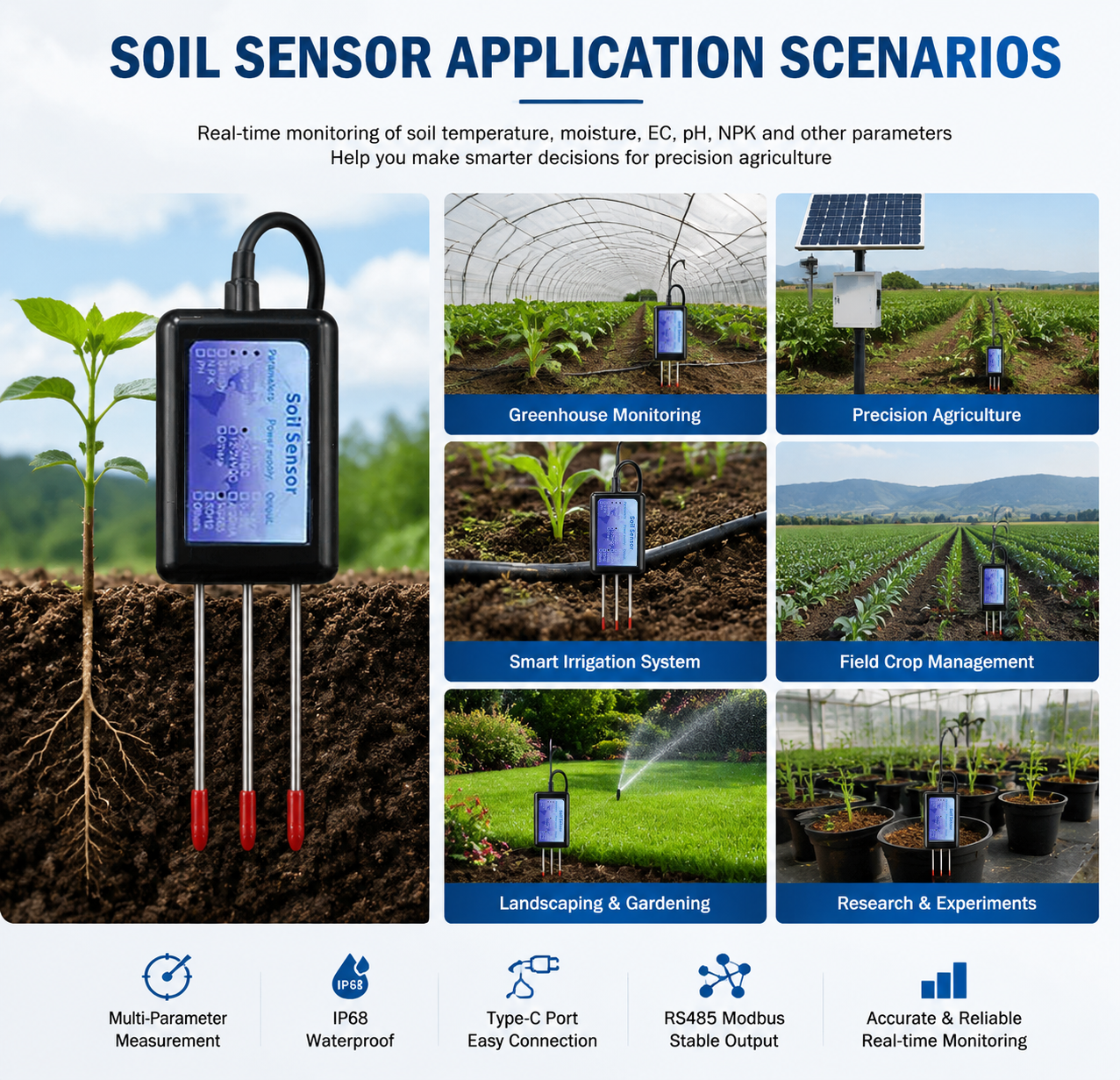
This multi-parameter soil sensor is widely used in:
Smart Agriculture
Applications:
- Precision irrigation
- Crop growth monitoring
- Fertilizer management
Greenhouse Monitoring
Benefits:
- Automatic watering control
- Environmental optimization
- Improved crop quality
Agricultural Research
Used for:
- Soil analysis
- Field experiments
- Climate adaptation studies
Smart Irrigation Systems
Integrated with:
- Water pumps
- Irrigation controllers
- Cloud platforms
5. Type C Port RS485 Soil Sensor Specification Overview
| Item | Description |
|---|---|
| Product Name | Type C Port RS485 Soil Sensor |
| Measurement | Soil Moisture Temperature EC pH NPK Optional |
| Output | RS485 Modbus RTU |
| Connection | Type-C Port |
| Application | Smart Agriculture Greenhouse Garden |
| Installation | Soil Insertion Measurement |
| Communication | Wired Industrial Communication |
| Customization | OEM ODM Available |
6. Why Choose Honde Technology Soil Sensors?
Professional IoT Monitoring Manufacturer
Company Name: Honde Technology Co., Ltd.
Website: www.hondetechco.com
Email: info@hondetech.com
Honde Technology Co., Ltd. focuses on the research, development, manufacturing, and global supply of smart environmental monitoring equipment.
Our product solutions include:
- Soil sensors
- Weather stations
- Water quality monitoring equipment
- Smart agriculture IoT systems
- Environmental monitoring devices
With professional manufacturing experience, Honde supports:
7. Common Mistakes When Buying Soil Sensors
Many buyers focus only on price but ignore system compatibility.
Before purchasing, check:
1. Communication Compatibility
Confirm whether the sensor supports:
- RS485
- Modbus RTU
- IoT gateway connection
2. Required Parameters
Avoid purchasing sensors with unnecessary functions or missing critical parameters.
3. Installation Environment
Consider:
- Soil type
- Installation depth
- Outdoor conditions
- Long-term maintenance
Choosing the correct sensor prevents replacement costs and improves monitoring reliability.
FAQ About Type C Port RS485 Soil Sensor
Q1: What parameters can an RS485 soil sensor measure?
A: Depending on the model, it can measure soil moisture, temperature, EC, pH, and NPK nutrients.
Q2: Can the soil sensor connect to a PLC or IoT gateway?
A: Yes. The RS485 Modbus RTU output allows integration with PLC systems, data loggers, gateways, and smart agriculture platforms.
Q3: Is this soil sensor suitable for outdoor farming?
A: Yes. The waterproof design and durable structure make it suitable for farms, greenhouses, gardens, and outdoor agricultural monitoring.
Q4: Can Honde provide OEM customization?
A: Yes. Honde Technology supports OEM/ODM customization according to project requirements, including communication methods, parameters, and appearance design.
Conclusion: Build Smarter Agriculture With Reliable Soil Monitoring
A Type C Port RS485 Soil Sensor is an essential tool for modern precision agriculture. By combining accurate soil measurement, stable Modbus communication, easy Type-C connection, and durable outdoor design, it helps farmers and agricultural companies achieve smarter irrigation and better crop management.
For agricultural distributors, IoT solution providers, and engineering companies looking for reliable soil monitoring solutions, Honde Technology provides professional products and customized support.
Contact Honde Technology today for product specifications and project solutions.
Company Name: Honde Technology Co., Ltd.
Website: www.hondetechco.com
Email: info@hondetech.com
Post time: Jul-29-2026