

What Is a WiFi Agriculture Weather Station?
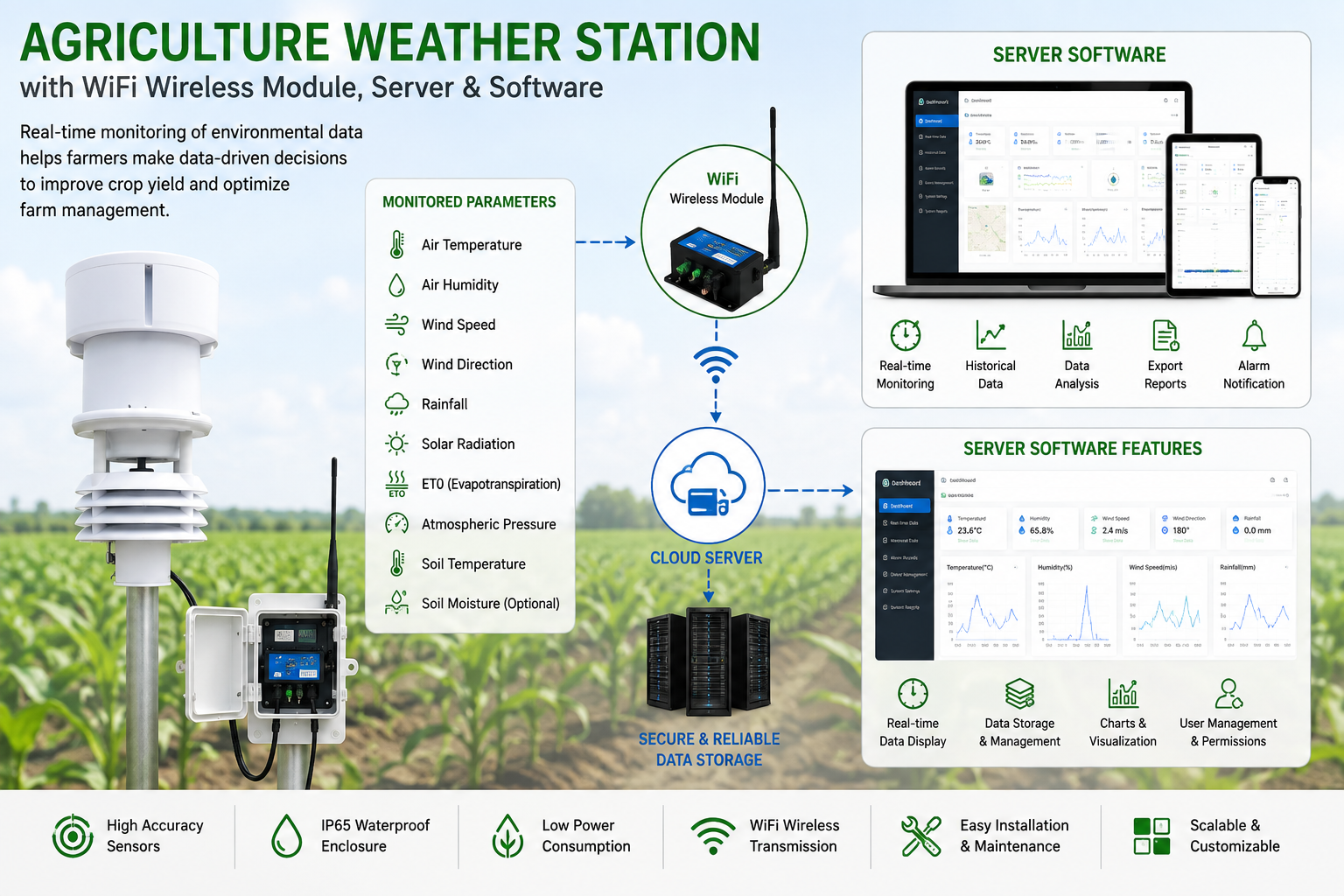
A WiFi agriculture weather station is a field monitoring system that collects real-time weather and environmental data and transmits it wirelessly to a server or cloud platform for visualization, analysis, and agricultural decision-making. Compared with a traditional standalone weather station, a connected system can help farmers and agricultural managers monitor temperature, humidity, wind, rainfall, solar radiation, atmospheric pressure, ET0, and optional soil parameters remotely.
For modern farms, the real value is not simply measuring weather conditions. It is turning environmental data into actionable information for irrigation, crop management, greenhouse control, disease-risk assessment, and precision agriculture.
Why Weather Monitoring Matters in Modern Agriculture
Weather directly affects crop growth, water consumption, disease development, spraying conditions, and harvesting operations.
A localized weather station can provide farm-level information that may be more useful for agricultural decisions than relying only on regional weather forecasts.
For example:
- Air temperature helps evaluate crop growth conditions and heat stress.
- Air humidity supports microclimate and disease-risk analysis.
- Wind speed and direction help determine whether conditions are suitable for spraying.
- Rainfall helps farmers understand natural water input.
- Solar radiation provides information about crop energy and environmental conditions.
- Atmospheric pressure adds another important environmental parameter.
- ET0 (Evapotranspiration) can support irrigation planning.
- Soil temperature and soil moisture can be added for more complete crop and root-zone monitoring.
The combination creates a more complete farm environmental monitoring system.
How a WiFi Agriculture Weather Station Works
A typical system follows a simple data flow:
The field weather station continuously collects environmental data. The WiFi wireless module transmits the measurements to a server or cloud platform, where the data can be stored, visualized, analyzed, and accessed remotely.
This architecture allows agricultural teams to move from periodic manual measurement to continuous digital monitoring.
1. Field Data Collection
The weather station is installed directly in the agricultural environment.
Depending on the configuration, the system can monitor:
| Parameter | Agricultural Application |
|---|---|
| Air Temperature | Crop growth and heat-stress monitoring |
| Air Humidity | Microclimate and disease-risk assessment |
| Wind Speed | Spraying and weather-condition assessment |
| Wind Direction | Spray management and environmental analysis |
| Rainfall | Irrigation and water management |
| Solar Radiation | Crop environment and energy monitoring |
| ET0 | Irrigation planning and water-demand estimation |
| Atmospheric Pressure | Environmental and weather analysis |
| Soil Temperature | Root-zone and crop-growth monitoring |
| Soil Moisture | Irrigation and soil-water management |
The exact sensor combination can be customized according to the project requirements.
2. WiFi Wireless Data Transmission
The WiFi wireless module connects the field monitoring equipment with the digital monitoring system.
Instead of requiring farmers to visit the station and manually download measurements, environmental information can be transmitted wirelessly for remote monitoring.
This is particularly useful for:
- Large agricultural farms
- Greenhouse projects
- Orchards
- Agricultural research stations
- Smart irrigation projects
- Precision farming projects
- Agricultural demonstration areas
For projects requiring different communication distances or network conditions, the communication architecture can also be designed according to the actual deployment environment.
3. Cloud Server and Agriculture Monitoring Software
Collecting data is only the first step.
The server and software layer transforms sensor measurements into information that agricultural users can understand.
A typical agriculture monitoring platform can provide:
- Real-time data display
- Historical data storage
- Data trend charts
- Environmental analysis
- Report generation
- Alarm notifications
- User management
- Remote monitoring
- Multi-device access
Farm managers can therefore monitor field conditions from a computer, tablet, or mobile device instead of checking every station manually.
Key Benefits of a WiFi Agriculture Weather Station
1. Real-Time Agricultural Weather Monitoring
Weather conditions can change rapidly.
Real-time monitoring provides continuously updated information about the local agricultural environment, allowing farmers to respond faster to changing conditions.
For example, rainfall data can help determine whether irrigation should be reduced, while temperature and humidity trends can provide useful information for crop management.
2. Data-Driven Irrigation Management
Water management is one of the most important applications.
By combining rainfall, temperature, humidity, solar radiation, ET0, and optional soil moisture measurements, farmers can build a more complete picture of crop water requirements.
Instead of relying entirely on fixed irrigation schedules, agricultural managers can use actual field data to make more informed decisions.
Weather monitoring + ET0 + soil moisture = a stronger foundation for precision irrigation.
3. Greenhouse Microclimate Monitoring
Greenhouses require a controlled growing environment.
A weather monitoring system can help track temperature, humidity, solar radiation, and other environmental conditions around the growing area.
Historical data can also help growers understand how the greenhouse environment changes throughout the day and across different seasons.
This information can support decisions related to ventilation, irrigation, shading, and crop management.
4. Orchard and Vineyard Monitoring
Orchards and vineyards often contain large areas with different microclimates.
Installing weather stations in representative locations allows growers to monitor localized environmental conditions.
Applications include:
- Microclimate monitoring
- Irrigation management
- Crop growth analysis
- Weather-condition assessment
- Disease-risk management
- Agricultural data collection
For high-value crops, localized environmental data can become an important part of precision farming.
5. Precision Agriculture
Precision agriculture is fundamentally about making decisions based on accurate field information.
A WiFi agriculture weather station can become one of the environmental data sources within a broader smart farming system.
Weather data can potentially be combined with:
- Soil sensors
- Irrigation systems
- Agricultural machinery
- Greenhouse controllers
- Farm management software
- Cloud platforms
- Other IoT devices
This creates a more connected agricultural ecosystem.
What Should Buyers Look for When Choosing an Agriculture Weather Station?
Not every weather station is designed for agricultural deployment.
When comparing suppliers, buyers should evaluate the complete system rather than focusing only on the sensor itself.
| Selection Factor | What Buyers Should Check |
|---|---|
| Sensor Parameters | Does the system measure the parameters required by the crop or project? |
| Communication | Is WiFi suitable for the installation environment? |
| Server | Can data be securely stored and managed? |
| Software | Does the platform provide charts, historical data and reports? |
| ET0 | Is evapotranspiration required for irrigation management? |
| Soil Monitoring | Can soil temperature or moisture sensors be integrated? |
| Outdoor Protection | Is the enclosure suitable for long-term outdoor deployment? |
| Power Supply | Can the system operate reliably at remote field locations? |
| Customization | Can sensor combinations and communication methods be adapted? |
| Scalability | Can additional stations or sensors be added later? |
The best solution is not necessarily the weather station with the largest number of sensors. It is the system that provides the right data, communication, software, and scalability for the actual agricultural application.
Agriculture Weather Station vs. Traditional Weather Monitoring
| Feature | Traditional Manual Monitoring | WiFi Agriculture Weather Station |
|---|---|---|
| Data Collection | Periodic/manual | Continuous/automatic |
| Remote Access | Limited | Available through connected software |
| Historical Data | Often fragmented | Centralized storage |
| Real-Time Monitoring | Limited | Supported |
| Data Visualization | Manual processing | Digital charts and dashboards |
| Irrigation Analysis | Experience-based | Data-supported |
| Multi-Site Management | Difficult | More scalable |
| Alerts | Manual observation | Software-based notifications |
| Integration | Limited | Suitable for IoT and smart farming systems |
The major advantage is not simply automation. It is the ability to create a continuous agricultural data record that can be used for analysis and decision-making.
Practical Applications Across Agriculture
A WiFi agriculture weather station can be deployed in many agricultural scenarios.
Open-Field Crops
Monitor local weather conditions across corn, wheat, vegetables, and other field crops to support irrigation and crop management.
Greenhouse Farming
Track environmental conditions inside or around greenhouse production areas and support climate-management decisions.
Orchards
Monitor orchard microclimates and combine weather information with irrigation and crop-management practices.
Vineyards
Collect localized weather information to understand vineyard microclimate variations and support precision management.
Smart Irrigation
Combine rainfall, ET0, weather data, and optional soil moisture information to improve irrigation scheduling.
Agricultural Research
Build long-term environmental datasets for crop experiments, variety evaluation, and agricultural research.
From Weather Data to Smart Farming Decisions
The most valuable part of an agriculture weather station is the complete data chain:
For example:
This is why integrating the weather station, WiFi communication, server, and software is more powerful than using an isolated sensor.
Why Choose Honde Technology for Agriculture Weather Monitoring?
Honde Technology Co., Ltd. focuses on IoT-based solutions for smart agriculture, environmental monitoring, and water-related applications.
For agricultural weather monitoring projects, Honde can provide a solution combining:
- Agriculture weather station hardware
- Multiple environmental sensors
- WiFi wireless communication
- Cloud/server connectivity
- Monitoring software
- Remote data visualization
- Agricultural application customization
The system can be configured according to project requirements, including different monitoring parameters, communication methods, power configurations, and software needs.
For distributors, system integrators, agricultural technology companies, and project contractors, this approach makes it easier to build a complete agricultural weather monitoring solution rather than sourcing individual components from multiple suppliers.
FAQ: WiFi Agriculture Weather Station
What does an agriculture weather station measure?
Depending on the configuration, it can measure air temperature, air humidity, wind speed, wind direction, rainfall, solar radiation, atmospheric pressure, ET0, soil temperature, and soil moisture.
Can the weather station connect to WiFi?
Yes. A WiFi wireless module can transmit field data to a server or cloud platform for remote monitoring and management.
Can farmers monitor data remotely?
Yes. With the appropriate server and software configuration, users can view real-time data, historical records, charts, and other information remotely.
Can ET0 be used for irrigation management?
Yes. ET0 is particularly useful as an indicator of atmospheric water demand and can be combined with rainfall and soil-moisture information to support irrigation planning.
Can the system be customized?
Yes. Agricultural projects often have different monitoring requirements, so sensor combinations, communication methods, power supply, server configuration, and software functions can be adapted to project requirements.
Conclusion: Build a More Connected Agriculture Monitoring System
A WiFi agriculture weather station is more than an outdoor weather sensor. When combined with wireless communication, cloud/server infrastructure, and monitoring software, it becomes an important data source for precision agriculture, smart irrigation, greenhouse management, orchard monitoring, and agricultural research.
The right system should provide reliable environmental data while making that information easy to access, analyze, and apply.
For agricultural distributors, system integrators, and farm technology projects looking for a complete agriculture weather monitoring system with WiFi, server, and software, contact Honde Technology for product specifications and project consultation.
Post time: Aug-14-2026