

What Is a Wind Speed Sensor With Alarm?
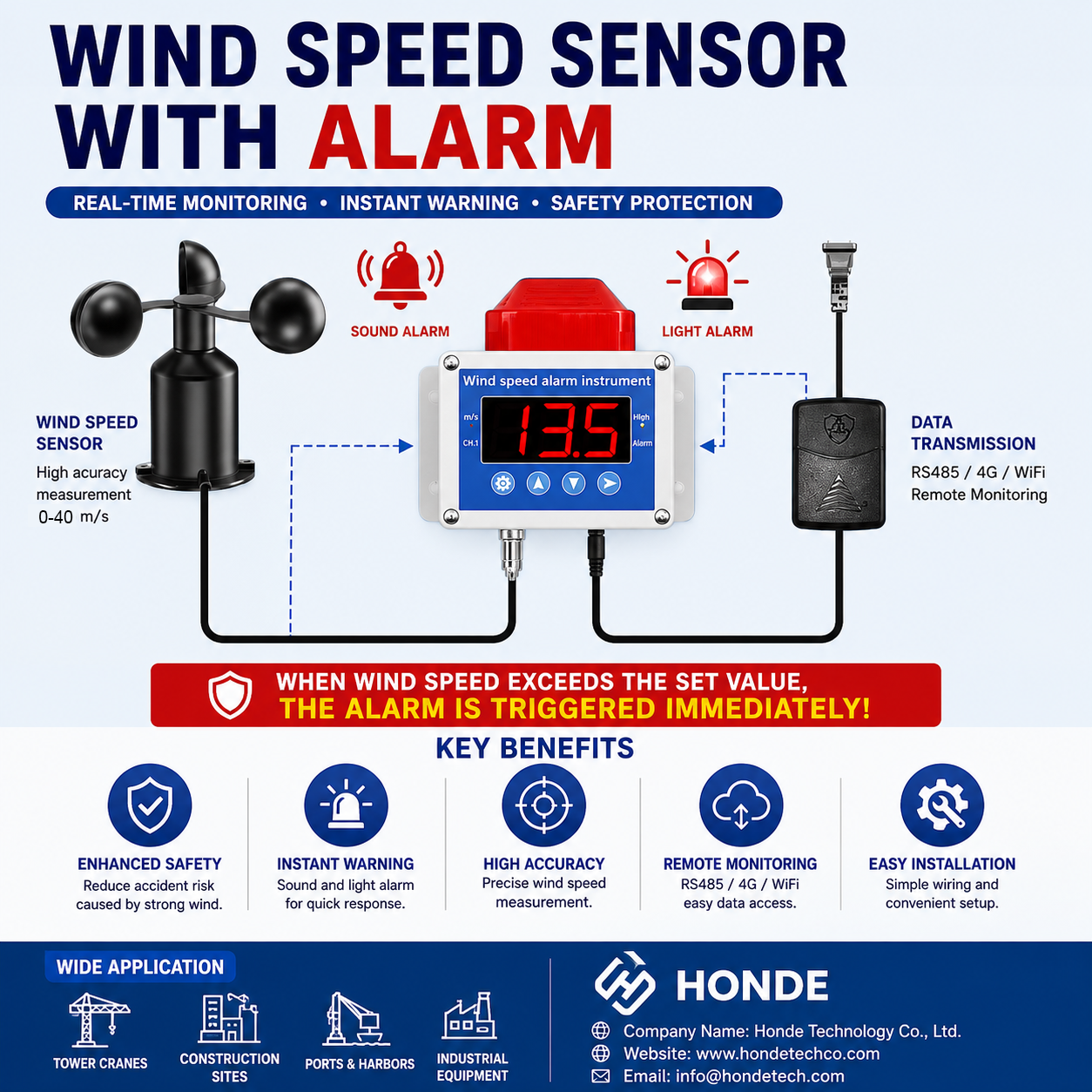
A wind speed sensor with alarm combines real-time wind speed measurement with a warning function that alerts operators when wind speed exceeds a preset safety threshold.
For tower cranes, lifting equipment, ports and other high-altitude or wind-sensitive operations, the key value is not simply measuring wind speed. The system must detect changing wind conditions, trigger an immediate warning and, when required, connect with equipment control or remote monitoring systems.
A typical system can be structured as:
Wind Speed Sensor → Controller → Sound & Light Alarm → RS485 / Wireless Communication → Monitoring Platform
Honde Technology offers mechanical wind speed and direction sensors with optional alarm monitoring, RS485 and analog outputs. Its alarm configuration can issue a control command when the preset wind-speed threshold is exceeded, including applications where equipment needs to stop operating.
Why Is Wind Speed Monitoring Important for Crane Safety?
Wind is one of the environmental factors that can directly affect lifting operations.
When wind speed increases, operators may face:
- •Increased load swing
- •Reduced lifting stability
- •Greater lateral forces
- •Difficulty controlling suspended loads
- •Increased risk during high-altitude operations
- •Unsafe conditions for certain lifting procedures
This is why a crane wind speed monitoring system should provide information that operators can understand immediately.
A digital value alone may not be enough when personnel are working around heavy machinery.
An integrated sound and light alarm provides an additional layer of visual and audible warning.
Honde’s tower-crane-oriented wind monitoring solution combines wind-speed measurement with real-time warning and remote management functions. The published configuration supports 0–60 m/s wind-speed measurement, sound/light alarms, RS485 communication and optional 4G/WiFi transmission.
Wind Speed Sensor vs Wind Speed Sensor With Alarm
These two products are often confused, but their purposes are different.
| Feature | Standard Wind Speed Sensor | Wind Speed Sensor With Alarm |
|---|---|---|
| Wind speed measurement | ✓ | ✓ |
| Real-time monitoring | ✓ | ✓ |
| Digital output | Optional | ✓ |
| RS485 integration | Model dependent | Available |
| Sound alarm | — | ✓ |
| Light alarm | — | ✓ |
| Preset threshold | Usually external | ✓ |
| Operator warning | Limited | Immediate |
| Equipment control | External system required | Can be integrated |
| Remote monitoring | Optional | Optional |
| Best application | Weather monitoring | Safety-critical operations |
For general meteorological monitoring, a standard anemometer may be sufficient.
For tower cranes, construction equipment and industrial safety, an integrated alarm system can be much more practical because the operator does not have to continuously watch a display.
How Does a Wind Speed Alarm System Work?
The basic operating principle is straightforward.
Step 1: Measure Wind Speed
The anemometer continuously measures the current wind speed.
Honde’s mechanical wind sensor uses a three-cup configuration, while other Honde models use ultrasonic technology depending on the application.
Step 2: Compare With the Preset Threshold
The controller compares the measured wind speed with the configured alarm value.
For example:
Current Wind Speed < Warning Threshold → Normal Operation
Current Wind Speed ≥ Warning Threshold → Alarm
The actual threshold should always be determined according to the equipment manufacturer’s operating limits, project safety procedures and applicable regulations rather than using a universal value.
Step 3: Activate the Alarm
When the threshold is reached, the system can activate:
- •Red warning light
- •Audible alarm
- •Display warning
- •Relay/control output
Honde’s mechanical alarm sensor documentation describes a sound alarm function that can respond when the preset wind-speed value is exceeded and can be configured to issue a control command to stop equipment.
Step 4: Transmit the Data
For larger projects, wind data can also be transmitted through:
- •RS485
- •4G
- •WiFi
- •LoRa
- •LoRaWAN
This enables centralized monitoring and historical data analysis.
What Wind Speed Range Should You Choose?
One of the most important specifications when purchasing a wind sensor is the measurement range.
Honde configurations include different ranges depending on the sensor model and application. The crane-oriented system described by Honde supports customizable 0–30 m/s or 0–60 m/s measurement ranges.
A general selection principle is:
| Application | Typical Selection Consideration |
|---|---|
| Indoor ventilation | Low wind-speed range |
| Agriculture | Moderate wind-speed range |
| Weather monitoring | Wide environmental range |
| Construction site | Wide range |
| Tower crane | Wide range + alarm |
| Port equipment | Wide range + corrosion resistance |
| Wind-sensitive industrial equipment | Range based on equipment limits |
Do not select a sensor solely because it has the highest measurement range.
The sensor should be matched to:
- Required wind-speed range
- Accuracy
- Starting wind speed
- Alarm threshold
- Installation height
- Environmental conditions
- Communication interface
- Equipment control requirements
Mechanical Anemometer or Ultrasonic Wind Sensor?
This is another important decision for B2B buyers.
Mechanical Wind Speed Sensor
Mechanical anemometers commonly use rotating cups to measure wind speed.
Advantages
- •Mature measurement principle
- •Easy to understand
- •Cost-effective
- •Suitable for many industrial applications
- •Available with RS485 and analog outputs
Honde’s mechanical wind sensor portfolio includes aluminum-alloy versions with RS485, 4–20 mA and 0–5 V options, together with sound/light warning configurations.
Ultrasonic Wind Sensor
Ultrasonic anemometers measure wind using the propagation time of ultrasonic signals rather than rotating mechanical cups.
Honde’s ultrasonic weather station documentation describes this as a maintenance-free approach without rotating mechanical parts and supports wind-speed measurements up to 70 m/s on the referenced model.
Comparison
| Feature | Mechanical Anemometer | Ultrasonic Wind Sensor |
|---|---|---|
| Rotating parts | Yes | No |
| Maintenance | Periodic inspection may be needed | Generally lower mechanical maintenance |
| Cost | Usually economical | Usually higher |
| Industrial applications | Excellent | Excellent |
| Wind speed | ✓ | ✓ |
| Wind direction | Available | Available |
| RS485 | ✓ | ✓ |
| 4G/WiFi | System dependent | Available in selected systems |
| Best choice | Cost-sensitive industrial monitoring | Maintenance-free advanced monitoring |
For a cost-sensitive crane project, a mechanical wind speed alarm sensor can be an attractive option.
For applications where minimizing moving parts is important, an ultrasonic solution deserves consideration.
Why RS485 Matters in Industrial Wind Monitoring
A professional RS485 wind speed sensor can be much easier to integrate into an industrial monitoring system than a simple analog sensor.
With RS485/Modbus communication, the wind sensor can communicate with:
- •PLC
- •Industrial controller
- •Data logger
- •Weather station
- •IoT gateway
- •Computer
- •Remote monitoring system
Honde’s wind monitoring products support RS485 communication, while some configurations also provide analog outputs such as 4–20 mA and 0–5 V.
This gives system integrators flexibility when connecting the sensor to existing infrastructure.
Wind Speed Sensor With 4G and WiFi Remote Monitoring
For a single crane, local sound and light alarms may be enough.
For a large construction project with multiple cranes, remote monitoring becomes much more valuable.
A typical architecture is:
Honde’s broader weather-monitoring systems support 4G, WiFi, LoRa and LoRaWAN, together with cloud software for real-time data viewing and historical data downloading. The software can also support alarm settings for monitored parameters.
This creates two levels of protection:
Local Safety: Sound + Light Alarm
Remote Management: Cloud Data + Historical Records + Remote Monitoring
What Are the Best Applications for a Wind Speed Alarm Sensor?
1. Tower Cranes
This is one of the most important applications.
A crane-mounted wind sensor can provide real-time wind information to operators and safety managers.
The system can be configured with:
- •Wind speed sensor
- •LED display
- •Sound alarm
- •Light alarm
- •RS485
- •4G/WiFi
- •Relay/control output
Honde specifically describes its wind-speed alarm system for tower cranes and high-altitude work.
2. Construction Sites
Construction sites can experience rapidly changing wind conditions, especially when working with:
- •Tower cranes
- •Mobile cranes
- •Hoists
- •Elevated platforms
- •Large temporary structures
A visible alarm can help operators respond quickly when configured limits are exceeded.
3. Ports and Harbor Equipment
Ports can be exposed to strong and rapidly changing winds.
Wind monitoring can be used around:
- •Container cranes
- •Gantry cranes
- •Loading equipment
- •Open storage areas
For coastal environments, material selection becomes particularly important.
Honde offers aluminum-alloy wind sensor versions designed for stronger environmental durability and corrosion resistance.
4. Wind-Sensitive Industrial Equipment
Wind monitoring can also be applied to:
- •Industrial plants
- •Large outdoor machinery
- •Elevated structures
- •Temporary installations
- •Energy facilities
The actual alarm logic should be configured according to the equipment’s engineering requirements.
What Should You Check Before Buying a Wind Speed Alarm Sensor?
Here is the practical B2B checklist we recommend.
1. Measurement Range
Confirm the required maximum wind speed.
2. Accuracy
Do not compare sensors only by range. Accuracy at the operating range is equally important.
3. Starting Wind Speed
A lower starting wind speed can be important for applications requiring detection of light winds.
4. Alarm Function
Confirm:
- •Alarm threshold setting
- •Sound alarm
- •Light alarm
- •Relay output
- •Automatic reset
- •External control capability
5. Communication
Ask whether the sensor supports:
RS485 / Modbus-RTU / 4–20 mA / 0–5 V / 4G / WiFi
depending on your system.
6. Environmental Protection
For outdoor installation, check:
- •Waterproof rating
- •Operating temperature
- •UV resistance
- •Corrosion resistance
- •Mechanical strength
7. Installation
Confirm:
- •Mounting method
- •Cable length
- •Sensor dimensions
- •Installation height
- •Connector type
8. Remote Monitoring
For multi-site projects, ask whether the supplier can provide:
- •Cloud server
- •PC software
- •Mobile access
- •Historical data
- •Data export
- •Email alarms
Honde Wind Speed Alarm Solution: From Sensor to Complete System
Honde Technology Co., Ltd. provides different wind-monitoring architectures rather than limiting customers to a single sensor type.
For example, a project can use:
Mechanical Wind Sensor → LED Display → Sound & Light Alarm → RS485
or:
Wind Sensor → 4G/WiFi Module → Cloud Server → PC / Mobile Monitoring
For projects requiring broader environmental monitoring, wind speed can also be combined with wind direction, temperature, humidity, atmospheric pressure, rainfall, illumination and other parameters in an integrated weather station.
This modular approach is particularly useful for OEM buyers, distributors and system integrators who need different configurations for different projects.
Mechanical vs Ultrasonic vs Integrated Weather Station
| Solution | Main Function | Alarm | Remote Monitoring | Recommended Application |
|---|---|---|---|---|
| Mechanical Wind Sensor | Wind speed/direction | Optional | Optional | Industrial & crane monitoring |
| Mechanical Alarm Anemometer | Wind + immediate warning | ✓ | Optional | Crane & construction safety |
| Ultrasonic Anemometer | Wind speed/direction | System dependent | ✓ | Advanced weather monitoring |
| Mini Weather Station | Multiple weather parameters | ✓ | ✓ | Agriculture, industry, smart sites |
| Full Weather Monitoring System | Multi-parameter + cloud | ✓ | ✓ | Large monitoring projects |
Common Mistakes When Buying a Wind Speed Sensor With Alarm
Mistake 1: Choosing Only by Measurement Range
A 0–60 m/s sensor is not automatically better than a 0–30 m/s sensor.
The measurement range should correspond to the actual application.
Mistake 2: Ignoring the Alarm Output
Some buyers purchase a sensor and only later discover that they need a separate controller and alarm device.
If immediate local warning is required, specify sound + light alarm from the beginning.
Mistake 3: Forgetting Equipment Integration
If the sensor must communicate with a PLC or control system, confirm the communication protocol before ordering.
Mistake 4: Using the Same Alarm Threshold Everywhere
Wind safety limits are application-specific.
The threshold should be based on the crane/equipment manufacturer’s specifications, lifting plan and site safety procedures.
Mistake 5: Ignoring the Installation Environment
A sensor installed at a coastal port has different material requirements from one installed inside a protected industrial facility.
FAQ: Wind Speed Sensor With Alarm
What is a wind speed sensor with alarm?
It is a wind-speed monitoring device that combines wind measurement with an audible and/or visual warning when the measured wind speed reaches a configured threshold.
Can a wind speed alarm sensor be used for tower cranes?
Yes. Crane wind monitoring is a major application. Honde offers configurations specifically described for tower-crane and high-altitude safety monitoring.
Does the wind sensor support RS485?
Selected Honde wind-speed alarm models support RS485, while other configurations also offer analog outputs such as 4–20 mA and 0–5 V.
Can the alarm stop equipment automatically?
Selected configurations can issue control commands when the preset wind-speed value is exceeded. The actual interlock design should be engineered according to the equipment control system and safety requirements.
Can wind data be monitored remotely?
Yes. Depending on the configuration, Honde systems can use 4G, WiFi, LoRa or LoRaWAN communication and matched cloud/software systems.
Is an ultrasonic wind sensor better than a mechanical sensor?
Not universally. Mechanical sensors can provide a cost-effective industrial solution, while ultrasonic sensors eliminate rotating mechanical parts and can be attractive where low mechanical maintenance is a priority.
Conclusion: Choose a Wind Monitoring System, Not Just an Anemometer
The most important lesson when purchasing a wind speed sensor with alarm is that the sensor itself is only one part of the safety system.
For a professional B2B project, evaluate the complete chain:
Accurate Measurement → Threshold Detection → Sound & Light Alarm → Equipment Control → Data Communication → Remote Monitoring
For tower cranes and construction sites, the priority should be immediate local warning and reliable measurement.
For ports and large industrial sites, add corrosion-resistant construction and centralized monitoring.
For multi-site projects, RS485 + 4G/WiFi/LoRaWAN + cloud software can transform a basic wind sensor into a complete remote wind monitoring system. Honde’s product range supports these different architectures and can combine wind monitoring with broader weather parameters when required.
Get a Customized Wind Speed Monitoring Solution From Honde
Company Name: Honde Technology Co., Ltd.
Website: www.hondetechco.com
Email: info@hondetech.com
For an RFQ, it is recommended to provide:
- Application — Tower Crane / Construction / Port / Industrial
- Required wind-speed range
- Required alarm threshold
- Sound and light alarm requirement
- RS485 / 4–20 mA / 0–5 V requirement
- 4G / WiFi / LoRaWAN requirement
- Power supply
- Cable length
- Installation environment
- Required quantity
Honde Technology can configure the wind sensor, display, alarm, communication module and monitoring software according to the actual project requirements.
Post time: Aug-26-2026