

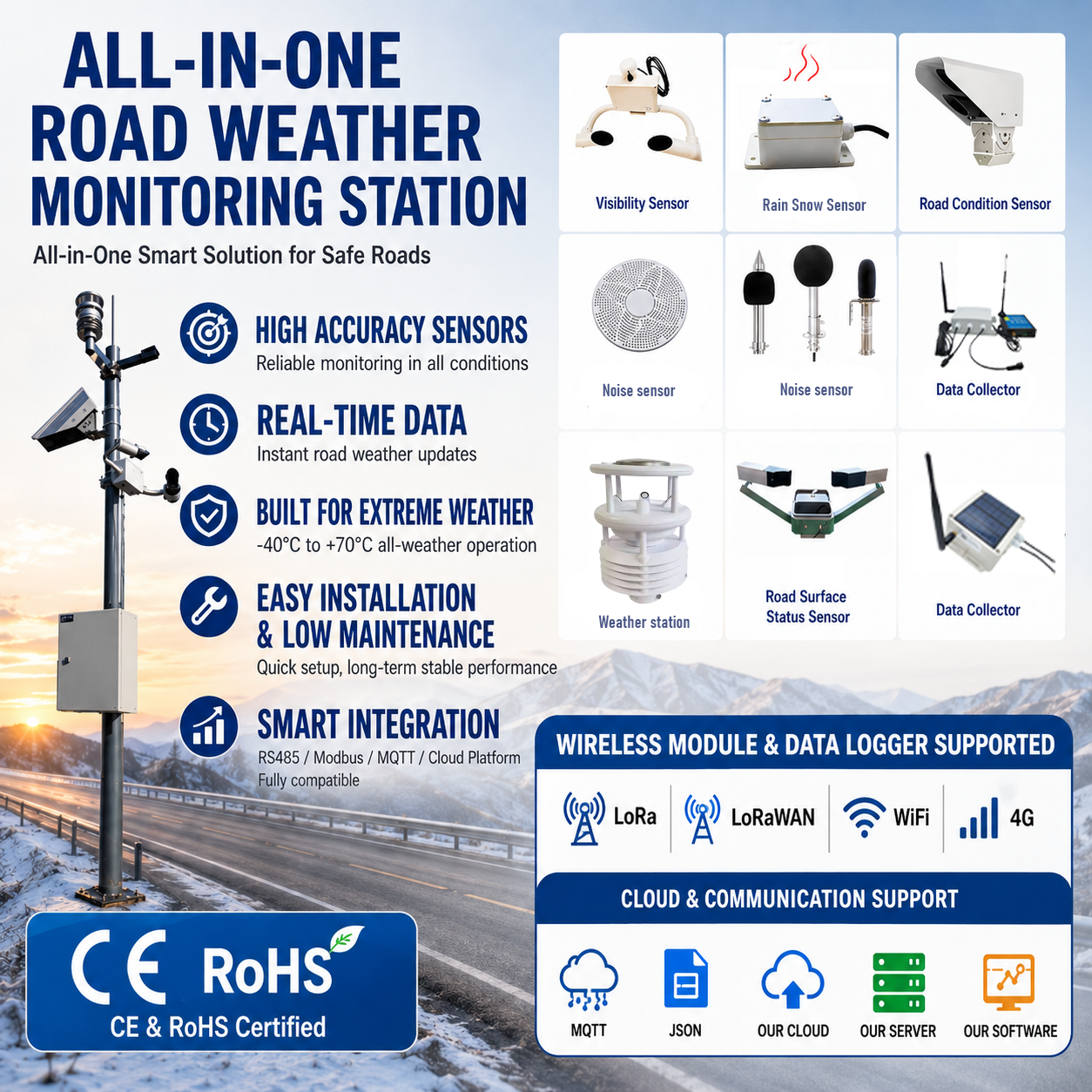
An All-in-One Road Weather Monitoring Station combines road surface condition monitoring, visibility detection, weather sensing, and intelligent communication into a single integrated system. It provides transportation authorities with real-time environmental data, enabling early warnings for black ice, fog, heavy rainfall, snowfall, and other hazardous conditions.
Compared with traditional roadside weather stations, modern integrated systems reduce installation costs, simplify maintenance, and improve traffic safety through continuous monitoring and cloud-based data management.
This guide explains the system architecture, key sensors, selection criteria, applications, and why integrated road weather stations have become an essential component of Intelligent Transportation Systems (ITS) and Road Weather Information Systems (RWIS).
Extreme weather remains one of the leading causes of traffic accidents worldwide. Dense fog, freezing rain, black ice, snow accumulation, and strong crosswinds significantly increase driving risks.
Transportation agencies increasingly deploy Road Weather Information Systems (RWIS) to:
- Reduce traffic accidents
- Improve winter road maintenance
- Optimize snow removal operations
- Support intelligent traffic management
- Reduce operational costs
- Improve driver safety
An integrated monitoring station provides continuous, real-time environmental awareness that enables faster decision-making.
An All-in-One Road Weather Monitoring Station integrates multiple environmental sensors on a single roadside pole.
Typical configuration includes:
| Sensor | Function |
|---|---|
| Road Condition Sensor | Detect water, snow, ice, black ice, road status |
| Visibility Sensor | Measure fog and atmospheric visibility |
| Present Weather Sensor | Detect rain, snow, drizzle, hail |
| Wind Speed & Direction Sensor | Monitor crosswind conditions |
| Air Temperature & Humidity Sensor | Measure ambient weather |
| Road Surface Temperature Sensor | Monitor pavement temperature |
| Snow Depth Sensor | Measure accumulated snowfall |
| Rain Gauge | Record precipitation |
| Solar Radiation Sensor (Optional) | Weather forecasting |
| Data Logger | Collect all sensor data |
The result is one intelligent platform capable of monitoring nearly every road weather parameter.
An integrated road weather monitoring station typically consists of:
- Environmental Sensors
- Road Surface Sensors
- Weather Sensors
- Data Logger
- Industrial Controller
- Solar Power System
- Battery Backup
- Wireless Communication Module
- Cloud Monitoring Platform
All collected data is transmitted to a central management platform where operators can monitor road conditions in real time.
Modern road condition sensors use infrared spectroscopy to detect:
- • Dry pavement
- • Wet pavement
- • Water film thickness
- • Snow thickness
- • Ice thickness
- • Black ice
- • Friction (Grip Index)
Because the sensor never touches the pavement, installation is faster and maintenance costs are significantly reduced.
Visibility sensors use Forward Scatter Optical Technology to measure atmospheric visibility.
Ideal for:
- • Dense fog
- • Coastal highways
- • Mountain roads
- • Airport runways
- • Bridges
Continuous visibility monitoring enables automatic traffic warning systems.
Weather sensors continuously measure:
- • Air Temperature
- • Relative Humidity
- • Wind Speed
- • Wind Direction
- • Rainfall
- • Atmospheric Pressure
Together these parameters provide complete weather information for highway management centers.
Industrial-grade sensors ensure long-term stable measurement with high repeatability.
Designed for harsh outdoor environments including: Heavy Rain, Snow, Ice, Fog, Dust, High Humidity, Strong Wind.
Supports multiple communication methods: RS485 Modbus, Ethernet, LoRa, LoRaWAN, WiFi, 4G LTE, MQTT, JSON API.
The system easily integrates with PLCs, SCADA platforms, ITS, and RWIS infrastructure.
Road weather data can be uploaded to: Private Servers, MQTT Broker, JSON API, Cloud Dashboard, Mobile APP, PC Monitoring Software.
Engineers can access real-time road information from anywhere.
Monitor road conditions continuously and issue early warnings for dangerous weather.
Bridge decks freeze earlier than ordinary roads. Real-time monitoring improves safety.
Monitor visibility and environmental conditions at tunnel entrances and exits.
Detect fog, snowfall, and runway surface conditions to support safe aircraft operations.
Early warning of snow accumulation, freezing temperatures, and black ice.
Provide environmental data for intelligent transportation management systems.
| Feature | Traditional Station | All-in-One Station |
|---|---|---|
| Multiple Sensors | Partial | ✔ Fully Integrated |
| Road Condition Detection | Optional | ✔ Included |
| Visibility Monitoring | Rare | ✔ Standard |
| Cloud Platform | Limited | ✔ Supported |
| Wireless Communication | Limited | ✔ Multiple Options |
| Installation Cost | High | Lower |
| Maintenance | Complex | Simple |
| Expansion | Difficult | Easy |
Many buyers focus only on weather parameters while overlooking road surface monitoring.
Based on our experience in road weather monitoring projects, the most common issues include:
- • Choosing contact-type pavement sensors that require road cutting.
- • Ignoring black ice detection capabilities.
- • Selecting systems without remote cloud management.
- • Purchasing equipment that cannot integrate with existing traffic platforms.
- • Underestimating the importance of visibility monitoring in mountainous and coastal regions.
Choosing an expandable platform from the outset helps reduce future upgrade costs and simplifies maintenance.
With more than 10 years of manufacturing experience, Honde Technology Co., Ltd. specializes in professional environmental monitoring equipment for smart transportation, meteorology, agriculture, hydrology, and industrial applications.
- Professional R&D Team
- OEM & ODM Service
- CE & RoHS Certified
- Factory Direct Supply
- Strict Quality Control
- Global Technical Support
- Cloud Monitoring Platform
- Private Server Deployment
- Multiple Wireless Communication Options
- Customized Road Weather Solutions
| Parameter | Description |
|---|---|
| Communication | RS485, Modbus RTU |
| Wireless | LoRa, LoRaWAN, WiFi, 4G |
| Cloud | MQTT, JSON API |
| Installation | Pole Mounted |
| Power Supply | Solar / AC |
| Operating Temperature | -40°C ~ +70°C |
| Protection | IP65/IP66 |
| Applications | Highway, Bridge, Tunnel, Airport, Smart City |
An All-in-One Road Weather Monitoring Station is more than a weather station—it is a complete intelligent monitoring solution for modern transportation infrastructure. By integrating road condition sensing, visibility monitoring, weather observation, and cloud connectivity, it helps agencies improve safety, reduce maintenance costs, and optimize traffic operations.
For organizations planning highway, bridge, tunnel, airport, or smart city projects, selecting a scalable and industrial-grade monitoring platform provides long-term value and operational reliability.
Whether you are building a new RWIS, upgrading an Intelligent Transportation System (ITS), or looking for a customized roadside monitoring solution, our engineering team is ready to help.
- ✔ Request a free consultation
- ✔ Download the product catalog
- ✔ Receive technical specifications
- ✔ Get a customized quotation
- ✔ Discuss OEM & ODM cooperation
Post time: Jun-30-2026