

1. What Is an Industrial Light Intensity Sensor?
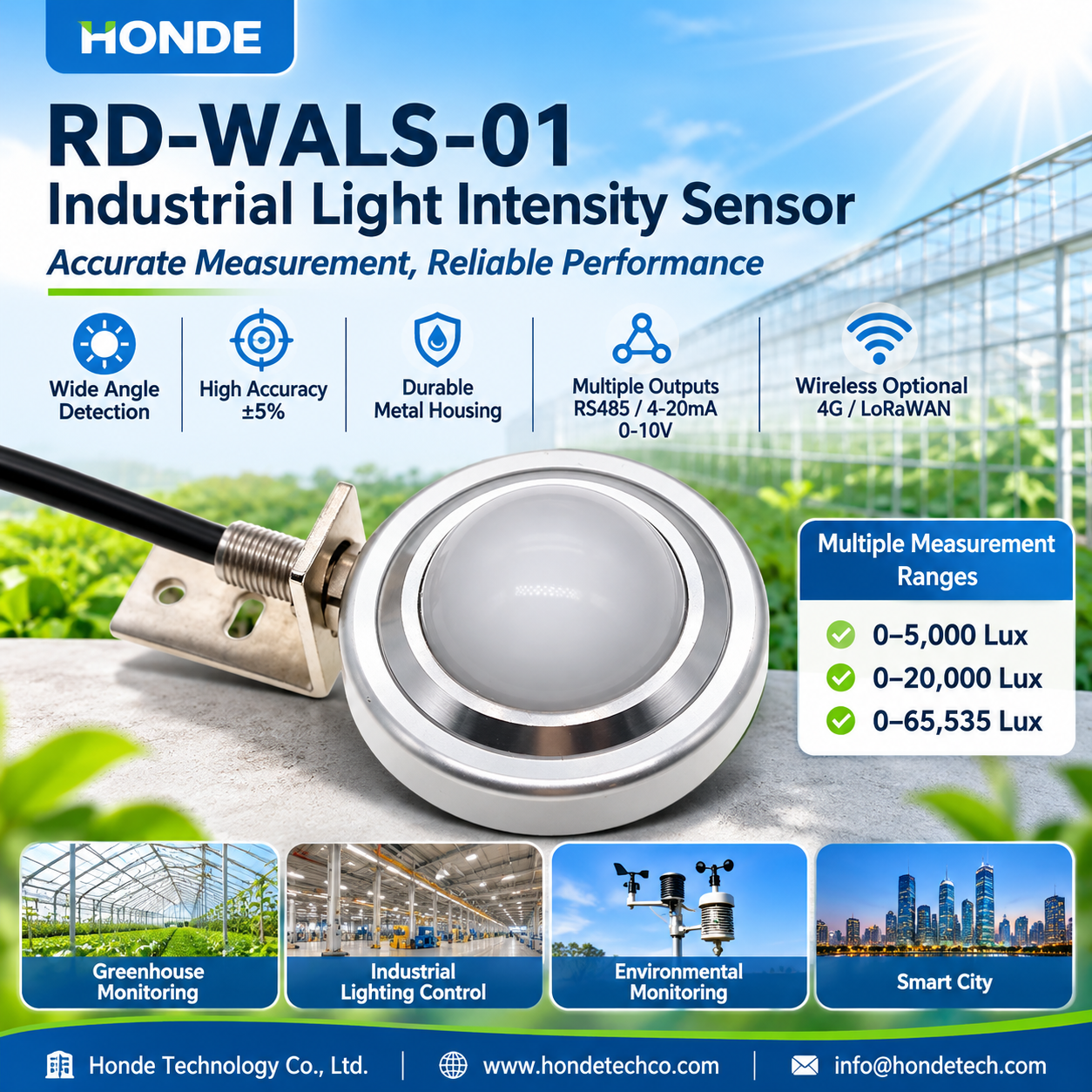
An industrial light intensity sensor measures the brightness of natural or artificial light and converts it into readable electrical signals for environmental monitoring and automated control. The HONDE RD-WALS-01 Wide-Angle Light Sensor is designed for measuring ambient light intensity, with selectable measurement ranges of 0–5,000 Lux, 0–20,000 Lux, and 0–65,535 Lux.
Featuring a photosensitive probe, metal housing, and multiple signal output options, this sensor can be integrated into greenhouse monitoring systems, industrial lighting management, environmental monitoring stations, and smart building projects.
For system integrators and equipment manufacturers, choosing the right illuminance sensor is important for obtaining reliable light data and building an efficient monitoring system.
2. Why Is Light Intensity Monitoring Important?
Light intensity directly affects many environmental and industrial processes. Continuous monitoring allows users to understand changing lighting conditions and make more informed operational decisions.
2.1 Smart Agriculture and Greenhouse Lighting
In greenhouse agriculture, insufficient or excessive light can influence crop development and growing conditions.
An industrial light intensity sensor helps greenhouse operators:
- Monitor natural sunlight entering the greenhouse.
- Identify differences in light intensity between growing areas.
- Evaluate the effectiveness of shading systems.
- Monitor changes in natural and artificial lighting.
- Provide data for automatic supplementary lighting control.
By connecting the sensor to an automated control system, users can establish lighting thresholds to control supplementary lights or shading equipment.
Agriculture Greenhouse Sensor System
2.2 Industrial Lighting Management
In factories, warehouses, and production workshops, illumination monitoring helps maintain suitable working conditions.
Typical applications include:
- Monitoring workshop lighting levels.
- Evaluating warehouse illumination conditions.
- Supporting automatic lighting control.
- Monitoring lighting changes in production areas.
- Improving energy management strategies.
2.3 Outdoor Environmental Monitoring
Outdoor light intensity changes throughout the day and across different weather conditions.
Continuous monitoring provides useful information for:
- Weather observation stations.
- Urban lighting management.
- Agricultural environmental monitoring.
- Outdoor research projects.
- Solar and environmental data collection.
3. HONDE RD-WALS-01 Wide-Angle Light Sensor: Key Features
The RD-WALS-01 is an industrial illumination sensor designed for environmental light intensity monitoring.
Its photosensitive probe detects ambient light and converts the measurement into electrical output signals for data acquisition and monitoring systems.
Main Product Advantages
1. Wide Measurement Range
Three measurement ranges are available:
- 0–5,000 Lux
- 0–20,000 Lux
- 0–65,535 Lux
Customers can select the appropriate range according to their project requirements.
2. Photosensitive Probe Design
The photosensitive probe provides light detection with a wide sensing angle, making it suitable for different environmental monitoring installations.
3. Durable Metal Housing
The metal shell provides mechanical protection and supports installation in industrial and environmental monitoring applications.
4. Multiple Signal Output Options
Available output interfaces include:
- RS485
- 4–20mA
- 0–10V
RS485 communication supports Modbus integration, making it convenient to connect the sensor to PLCs, data loggers, industrial controllers, and monitoring systems.
5. Flexible Wireless Communication
For remote monitoring applications, the sensor can be integrated with optional wireless transmission modules:
- GPRS
- 4G
- WiFi
- LoRa
- LoRaWAN
A matched cloud server and software solution is also available with the corresponding wireless module.
Users can monitor real-time data, download historical records, and analyze measurement curves through a computer.
4. RD-WALS-01 Technical Specifications
The following table summarizes the main technical specifications.
| Parameter | Specification |
|---|---|
| Model | RD-WALS-01 |
| Sensor Type | Wide-Angle Light Sensor |
| Measurement Parameter | Light Intensity |
| Measurement Range | 0–5,000 / 20,000 / 65,535 Lux |
| Measurement Accuracy | ±7% |
| Light Test Accuracy | ±5% |
| Wavelength Range | 380–730 nm |
| Temperature Characteristics | ±0.5/°C |
| Measurement Unit | Lux |
| Output Signal | RS485, 4–20mA, 0–10V |
| Communication Protocol | Modbus for RS485 |
| Power Supply | DC 5–24V / DC 12–24V |
| Baud Rate | 9600 bps |
| Housing Material | Aluminum Alloy |
| Power Consumption | Less than 2W |
| Operating Temperature | -30 to 65°C |
| Operating Humidity | 0–100% RH |
| Wireless Options | GPRS, 4G, WiFi, LoRa, LoRaWAN |
Note: Measurement range, output type, and power supply should be confirmed according to the selected configuration. Wireless communication requires the corresponding optional module.
5. How to Choose the Right Light Sensor for Your Project?
Selecting an industrial light sensor involves more than comparing measurement accuracy. Buyers should consider the measurement range, output interface, installation environment, and data transmission requirements.
5.1 Select the Appropriate Lux Measurement Range
Different applications require different measurement ranges.
| Application | Recommended Consideration |
|---|---|
| Indoor lighting | Lower measurement range |
| Warehouse monitoring | 0–20,000 Lux or project-specific selection |
| Greenhouse monitoring | Select according to actual sunlight conditions |
| Outdoor environmental monitoring | Higher measurement range, such as 0–65,535 Lux |
The actual range should be selected according to expected maximum illumination and the required measurement resolution.
5.2 Choose the Correct Output Signal
The output interface determines how easily the sensor can communicate with your existing equipment.
| Output | Typical Application |
|---|---|
| RS485 | PLC, Modbus data logger, industrial monitoring |
| 4–20mA | Industrial control and long-distance analog transmission |
| 0–10V | Building automation and control systems |
For projects requiring multiple sensors and centralized data acquisition, RS485 Modbus is a practical integration option.
5.3 Consider Wireless Data Transmission
For remote agricultural fields, distributed greenhouses, and outdoor environmental monitoring stations, wireless communication can reduce the complexity of field wiring.
HONDE provides optional wireless modules:
- 4G/GPRS for remote cellular communication.
- WiFi for compatible local network environments.
- LoRa for long-range, low-power communication.
- LoRaWAN for distributed IoT monitoring networks.
The communication method should be selected according to coverage, power availability, transmission distance, and network infrastructure.
6. Lux vs. PAR vs. PPFD: What Is the Difference?
This is an important consideration when purchasing a light sensor for agriculture.
Although Lux, PAR, and PPFD are related to light measurement, they describe different aspects of light.
| Measurement | Meaning | Typical Application |
|---|---|---|
| Lux | Illuminance based on human visual sensitivity | General lighting and environmental monitoring |
| PAR | Photosynthetically Active Radiation, generally 400–700 nm | Plant lighting research |
| PPFD | Photosynthetic Photon Flux Density | Greenhouse crop lighting management |
The RD-WALS-01 measures light intensity in Lux. It is suitable for general ambient illumination monitoring.
If your project requires measuring the light available for plant photosynthesis, a dedicated PAR or PPFD sensor is more appropriate.
Choosing the correct measurement principle helps avoid inaccurate conclusions when evaluating crop lighting conditions.
For more information, explore our guide to [PAR Sensor with LoRaWAN Collector for Smart Agriculture Light Monitoring].
7. Typical Applications of RD-WALS-01
Greenhouse Environmental Monitoring
Install light sensors in different greenhouse areas to monitor sunlight variations and support shading and supplementary lighting decisions.
Smart Agriculture
Combine light monitoring with air temperature, humidity, soil moisture, and other agricultural sensors to build a comprehensive environmental monitoring system.
Industrial Workshops and Warehouses
Monitor indoor illumination levels and provide data for lighting management and energy optimization.
Weather and Environmental Monitoring Stations
Integrate illumination sensors with meteorological equipment to collect environmental light data alongside other weather parameters.
Smart Building and Urban Lighting
Use real-time illumination measurements as an input for automatic lighting control and smart city management.
8. Build a Complete IoT Light Monitoring System
A light sensor becomes more valuable when integrated into a complete data acquisition and monitoring system.
HONDE can provide different communication configurations according to project requirements.
Typical System Architecture:
RD-WALS-01 Light Sensor
↓
RS485 / 4–20mA / 0–10V
↓
Data Logger or Wireless Data Collector
↓
4G / WiFi / LoRa / LoRaWAN
↓
Cloud Server and Monitoring Software
↓
Computer or Mobile Device
The matched cloud server and software can provide:
- Real-time measurement data visualization.
- Historical data storage and downloading.
- Data curve analysis.
- Parameter alarm threshold settings.
- Remote environmental monitoring.
For greenhouse projects requiring multiple environmental parameters, explore our [Agriculture Greenhouse Sensor System: Complete Guide to Smart Greenhouse Monitoring].
HONDE can also provide customized monitoring solutions integrating light sensors, soil sensors, weather stations, and wireless data collectors.
9. Why Choose HONDE RD-WALS-01?
HONDE specializes in environmental monitoring equipment and IoT sensing solutions.
When selecting an illumination sensor manufacturer, buyers should consider not only the sensor itself but also customization, communication compatibility, and long-term technical support.
HONDE offers:
- Multiple measurement ranges for different project requirements.
- RS485, 4–20mA, and 0–10V output options.
- Optional GPRS, 4G, WiFi, LoRa, and LoRaWAN communication.
- Matched cloud server and monitoring software.
- Customized solutions for different environmental monitoring projects.
- Technical support for system integration and project applications.
Whether you are developing a greenhouse monitoring system, industrial lighting management platform, or outdoor environmental monitoring network, HONDE can help you select a suitable light sensing solution.
10. Frequently Asked Questions (FAQ)
Q1: What does the RD-WALS-01 light sensor measure?
It measures ambient light intensity, with Lux as the measurement unit.
Q2: What is the measurement range of RD-WALS-01?
Three ranges are available: 0–5,000 Lux, 0–20,000 Lux, and 0–65,535 Lux.
Q3: Does the RD-WALS-01 support RS485 Modbus?
Yes. The RS485 version supports Modbus communication and can connect to compatible PLCs, data loggers, and monitoring systems.
Q4: Can the light sensor transmit data wirelessly?
Yes. Optional GPRS, 4G, WiFi, LoRa, and LoRaWAN modules are available according to project requirements.
Q5: Can I view the measurement data remotely?
Yes. With the corresponding wireless module and matched cloud server software, users can view real-time data, download historical records, and analyze data curves on a computer.
Q6: Is the RD-WALS-01 suitable for greenhouse applications?
Yes. It can monitor ambient illumination in greenhouses and provide data for lighting management, shading decisions, and environmental analysis.
Q7: Can this sensor directly measure PAR or PPFD?
No. RD-WALS-01 measures illuminance in Lux. Projects requiring photosynthetic photon measurements should use a dedicated PAR or PPFD sensor.
Q8: Can the sensor be customized for OEM projects?
Please contact HONDE with your required measurement range, output signal, power supply, cable length, and communication requirements. Our team can help evaluate a suitable configuration.
11. Conclusion: Choose the Right Industrial Light Intensity Sensor
The HONDE RD-WALS-01 Wide-Angle Light Sensor provides a practical solution for industrial illumination monitoring, greenhouse environmental measurement, warehouse lighting management, and outdoor monitoring projects.
With selectable measurement ranges, multiple output interfaces, metal housing, and optional wireless communication, it can be integrated into different environmental monitoring and IoT systems.
Looking for a reliable RS485 light intensity sensor manufacturer in China?
Contact HONDE Technology Co., Ltd. today to discuss your project requirements and request a customized quotation.
Watch the RD-WALS-01 Product Introduction
Video: https://youtu.be/vfdA_jfrn5I
Product Details and Inquiry
Product Model: RD-WALS-01
Alibaba Product Link: https://www.alibaba.com/product-detail/Photosensitive-Probe-Metal-Shell-Illumination-Sensor_1601467146559.html
About HONDE
Company Name: Honde Technology Co., Ltd.
Website: https://www.hondetechco.com
Email: info@hondetech.com
HONDE Technology Co., Ltd. is an IoT technology company specializing in the R&D, production, and sales of smart water equipment, smart agriculture equipment, smart environmental monitoring equipment, and integrated IoT solutions.
We are committed to making technology improve everyday life and providing reliable sensing and monitoring solutions for customers worldwide.
Contact us today for product specifications, technical consultation, OEM customization, and project quotations.
Post time: Nov-23-2026