

Summary
Selecting the right industrial outdoor temperature and humidity sensor is essential for accurate environmental monitoring in agriculture, photovoltaic power plants, marine environments, smart cities, and industrial automation. A high-quality sensor should provide high measurement accuracy, radiation shielding, waterproof protection, RS485 Modbus communication, and long-term stability.
This guide explains how outdoor temperature and humidity sensors work, compares important specifications, discusses installation best practices, and helps buyers choose the right solution for their projects.
Why Temperature and Humidity Monitoring Matters
Environmental temperature and humidity directly affect:
- Crop growth
- Solar power generation efficiency
- Greenhouse climate control
- Weather forecasting
- Marine environmental monitoring
- HVAC automation
- Smart city environmental management
Accurate data enables better decision-making while reducing maintenance costs and improving operational efficiency.
What Is an Outdoor Temperature and Humidity Sensor?
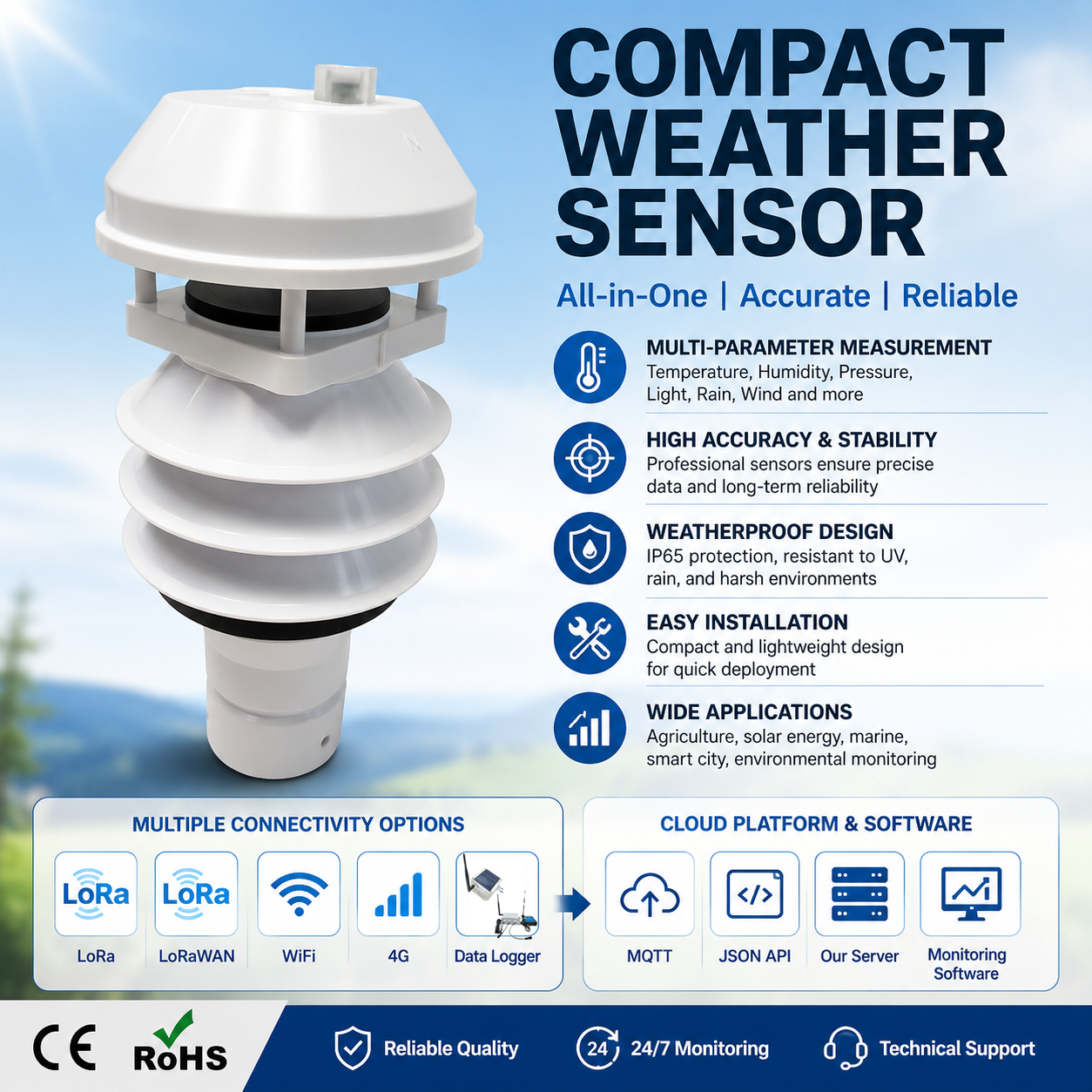
An outdoor temperature and humidity sensor is designed to continuously monitor ambient air conditions in harsh outdoor environments.
Unlike indoor sensors, industrial outdoor models feature:
- Radiation shield design
- UV-resistant housing
- Waterproof construction
- Anti-corrosion materials
- Industrial communication interfaces
- Continuous 24/7 operation
These features ensure reliable measurements under direct sunlight, rain, wind, and changing weather conditions.
How Radiation Shields Improve Measurement Accuracy
One of the most important components is the multi-layer radiation shield.
Without proper shielding:
- Direct sunlight heats the sensor
- Temperature readings become inaccurate
- Relative humidity values drift
- Weather data loses reliability
Our multi-plate radiation shield minimizes solar radiation while allowing natural airflow, ensuring highly accurate environmental measurements.
Key Features to Look For
1. High Accuracy Measurement
Choose sensors with stable digital sensing elements that offer:
- Fast response
- Excellent repeatability
- Low drift
- Long-term stability
2. Industrial RS485 Modbus Communication
RS485 Modbus RTU remains the preferred communication protocol because it offers:
- Long transmission distance
- Excellent anti-interference capability
- Easy PLC integration
- SCADA compatibility
- IoT gateway support
3. Waterproof Outdoor Design
Industrial applications require protection against:
4. Easy System Integration
Modern monitoring projects require seamless integration with:
- Weather stations | Data loggers | PLC systems
- Smart agriculture platforms | Environmental monitoring systems
5. Multiple Wireless Transmission Options
For remote monitoring, wireless communication greatly reduces installation costs. Options include:
These solutions enable real-time cloud monitoring from virtually anywhere.
Technical Specification Comparison
| Feature | Standard Industrial Sensor | Honde Outdoor Sensor |
|---|---|---|
| Temperature Measurement | Yes | Yes High Accuracy |
| Humidity Measurement | Yes | Yes High Stability |
| Radiation Shield | Basic | Multi-layer Shield |
| Waterproof Design | IP54 | Industrial Outdoor Design |
| RS485 Modbus | Optional | Standard |
| Wireless Upgrade | Limited | LoRa LoRaWAN WiFi 4G |
| Cloud Platform | Optional | MQTT JSON Supported |
| OEM & ODM | Limited | Available |
Typical Applications
Smart Agriculture
- Precision farming
- Irrigation control
- Crop monitoring
- Orchard management
Weather Stations
- Air temperature
- Relative humidity
- Environmental conditions
Solar Power Plants
- PV efficiency analysis
- Equipment protection
- Performance evaluation
Marine & Coastal
- Ports / Offshore platforms
- Coastal weather stations
- Marine observation systems
Smart Cities
- Air quality stations
- Urban weather monitoring
- Environmental data collection
Installation Tips
- Install 1.5–2 meters above ground.
- Avoid direct heat sources.
- Keep away from reflective surfaces.
- Ensure adequate airflow around the radiation shield.
- Regularly inspect for dust or insect blockage.
Proper installation significantly improves measurement accuracy.
Common Mistakes Buyers Make
Many buyers focus only on sensor price while overlooking critical factors. Common mistakes include:
- Choosing indoor sensors for outdoor use
- Ignoring radiation shielding
- Selecting non-industrial communication interfaces
- Not considering future IoT expansion
- Purchasing sensors without waterproof protection
These issues often result in inaccurate measurements and higher maintenance costs.
Why Choose Honde Technology?
With over 15 years of experience in industrial environmental monitoring solutions, Honde Technology Co., Ltd. provides complete IoT monitoring systems for customers in more than 70 countries.
Our advantages include:
- Professional R&D team
- Strict quality control
- OEM & ODM services
- Complete weather station solutions
- One-stop IoT integration
- Fast technical support
- Global project experience
In addition to sensors, we also provide:
- Wireless gateways
- Data loggers
- Cloud platform
- MQTT & JSON API
- Remote monitoring software
This allows customers to deploy a complete environmental monitoring solution from a single supplier.
Frequently Asked Questions
What communication protocol is supported?
The sensor supports RS485 Modbus RTU, making it compatible with PLCs, SCADA systems, industrial controllers, and IoT gateways.
Can it connect to cloud platforms?
Yes. Our complete solution supports MQTT, JSON, Cloud server deployment, Web monitoring software, and Mobile monitoring.
Is OEM customization available?
Yes. We provide Logo, Firmware, Communication, and Housing customization, along with complete OEM & ODM services.
Can the sensor work in harsh outdoor environments?
Yes. The industrial outdoor design is suitable for high humidity, rain, UV exposure, coastal environments, agricultural fields, and industrial sites.
Conclusion
An industrial outdoor temperature and humidity sensor is much more than a basic measuring device—it is the foundation of reliable environmental monitoring. Choosing a sensor with a radiation shield, industrial-grade waterproof design, RS485 Modbus communication, and IoT connectivity ensures long-term accuracy, dependable performance, and easy integration into modern monitoring systems.
Get a Professional Environmental Monitoring Solution
Looking for a reliable outdoor temperature and humidity monitoring system? Honde Technology Co., Ltd. offers complete environmental monitoring solutions.
Contact us today to receive:
- Free technical consultation
- Product catalog
- Datasheets
- OEM/ODM solutions
- Custom quotation
Post time: Jul-16-2026