

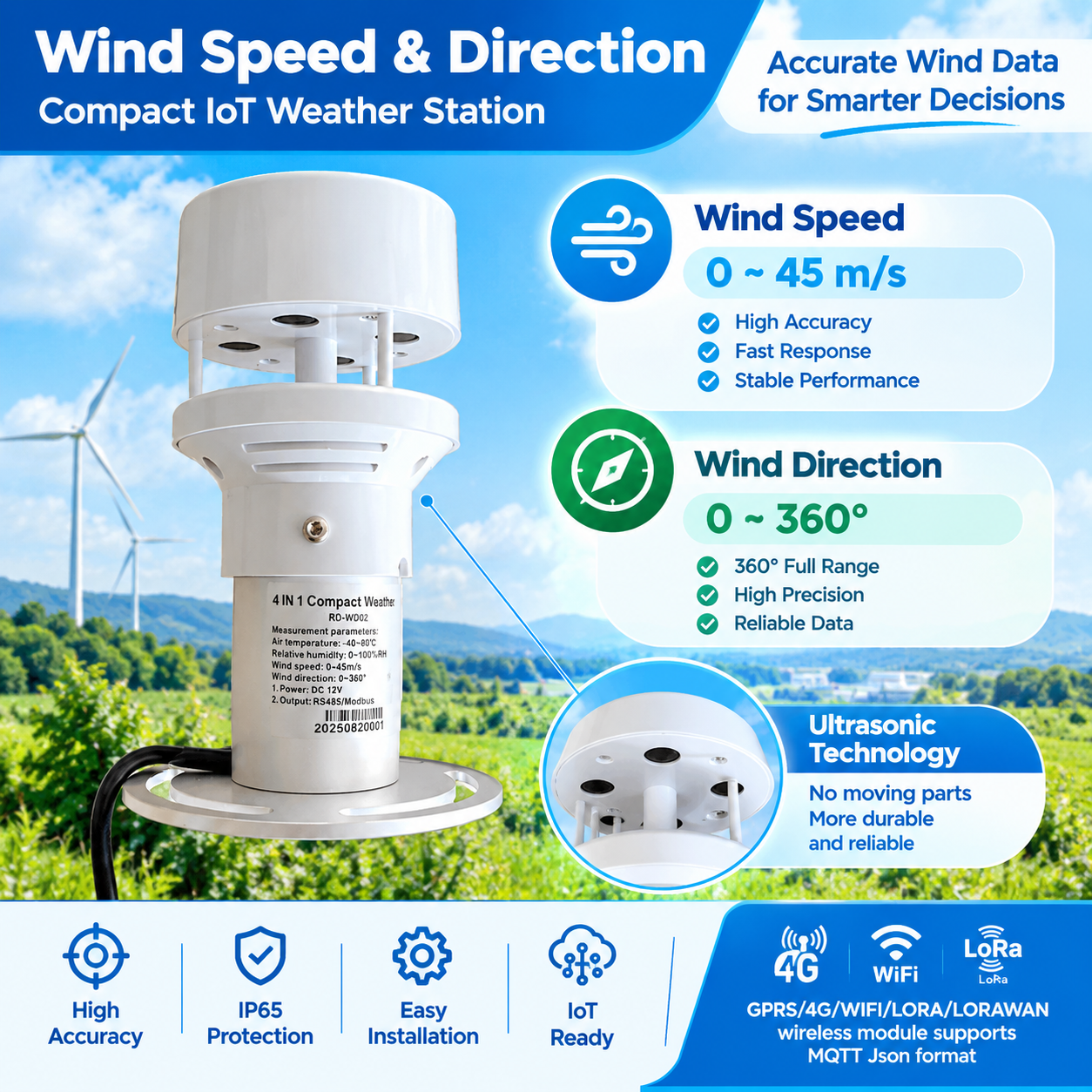
1. What Is an Ultrasonic Wind Sensor?
An ultrasonic wind sensor measures wind speed and wind direction by transmitting ultrasonic signals between transducers and analyzing how wind affects the signals’ travel time or phase. Compared with traditional mechanical anemometers, ultrasonic wind sensors can operate without rotating cups or moving direction vanes, making them an attractive choice for modern weather stations and automated environmental monitoring systems.
For B2B buyers, the best ultrasonic wind sensor is not simply the one with the lowest purchase price. It should match the required measurement range, accuracy, communication protocol, environmental conditions, installation method, and data acquisition system.
Honde Technology Co., Ltd. provides wind measurement products and integrated weather monitoring solutions for applications such as smart agriculture, weather monitoring, and environmental data collection. Buyers can explore our ultrasonic wind sensor product on Alibaba.com and contact our team to confirm the exact configuration for their projects.
2. How Does Ultrasonic Wind Measurement Work?
An ultrasonic wind sensor typically uses two or more ultrasonic transducers arranged in a defined geometry. The transducers send and receive sound signals along known paths.
When wind travels along the measurement path, it changes the time required for sound to travel in different directions. The sensor’s electronics process these differences to calculate wind speed and determine wind direction.
The main advantages of this measurement principle include:
- No rotating parts: Reduces mechanical wear associated with bearings and moving components.
- Low routine maintenance: Eliminates the need to maintain rotating cups or a mechanical direction vane.
- Continuous monitoring: Supports automatic wind data collection for unattended monitoring stations.
- Digital integration: Compatible interfaces can simplify connection to data loggers, controllers, and weather station systems.
Actual measurement performance depends on sensor geometry, calibration, signal processing, environmental conditions, and installation quality. Buyers should always check the technical specification of the exact model rather than assuming that all ultrasonic sensors offer the same performance.
3. Ultrasonic Wind Sensor vs. Traditional Mechanical Anemometer
Which technology is more suitable for your weather monitoring project? The answer depends on your operating environment, maintenance plan, budget, and data requirements.
| Comparison Factor | Ultrasonic Wind Sensor | Mechanical Anemometer |
|---|---|---|
| Measurement principle | Ultrasonic signal analysis | Rotating cups and/or direction vane |
| Moving components | No rotating measurement components | Mechanical components rotate |
| Routine maintenance | Generally lower mechanical maintenance | May require inspection of moving parts |
| Wind direction measurement | Available in combined speed-and-direction models | Often uses a separate direction vane |
| Integration | Depends on available digital interfaces | Depends on the selected output and data acquisition system |
| Typical applications | Automated weather stations, smart agriculture, environmental monitoring | Weather stations, agricultural monitoring, and other wind measurement applications |
| Purchase decision | Consider accuracy, environmental suitability, and integration | Consider mechanical durability, maintenance, and measurement requirements |
Important: This is a general technology comparison, not a guarantee that every ultrasonic model outperforms every mechanical instrument. For high-accuracy projects, compare the manufacturer’s specifications and calibration documentation.
4. Five Key Factors to Check Before Purchasing an Ultrasonic Wind Sensor
4.1 Measurement Range and Accuracy
Start with the maximum wind speed expected at the installation site. Agricultural weather stations, road monitoring systems, coastal installations, and wind energy projects may have different measurement requirements.
Ask your supplier for:
- Wind speed measurement range
- Wind speed accuracy and resolution
- Wind direction range and accuracy
- Response time
- Operating temperature range
- Calibration or verification documentation, where required
Do not confuse resolution with accuracy. A sensor displaying more decimal places is not necessarily more accurate.
4.2 Communication Interface: RS485, Modbus, RS232, or SDI-12
Communication compatibility is essential when integrating a wind sensor into an existing monitoring system.
| Interface or Protocol | What Buyers Should Confirm |
|---|---|
| RS485 | Electrical interface, wiring, baud rate, and device addressing |
| Modbus RTU | Register map, data types, byte order, and supported commands |
| RS232 | Voltage levels, connector pinout, and host compatibility |
| SDI-12 | Version compatibility, addressing, and data command support |
| Wireless communication | Module type, frequency band, regional regulations, and network coverage |
RS485 and Modbus RTU are commonly used in industrial monitoring systems. However, RS485 is an electrical interface, while Modbus RTU is a communication protocol. Confirm both the hardware interface and the actual protocol supported by your selected model.
4.3 Housing Material and Outdoor Protection
An outdoor wind sensor may be exposed to ultraviolet radiation, rain, dust, temperature changes, and strong wind loads.
If you are considering an ABS ultrasonic wind sensor with a customized logo, ask the manufacturer to confirm the exact housing material, outdoor weather resistance, UV resistance, and available ingress protection rating.
Also evaluate the mounting bracket, cable gland, connector, cable length, and installation orientation.
Procurement tip: Do not assume that ABS housing automatically means IP65 or another specific protection level. Request the rating and supporting documentation for the exact model.
4.4 Power Consumption and Remote Deployment
For remote weather stations, power consumption directly affects the design of the power supply and backup system.
Before ordering, confirm:
- Supply voltage and maximum current.
- Average power consumption under normal operating conditions.
- Startup behavior and measurement interval.
- Compatibility with solar power and battery systems.
- Whether the sensor can work with the planned data logger or wireless gateway.
For solar-powered agricultural stations, calculate the complete system’s power requirements instead of considering the sensor alone.
4.5 OEM Logo, Customization, and Integration
For equipment manufacturers, distributors, and project integrators, OEM customization can help create a consistent product line.
Depending on the model and order requirements, discuss the following options with the supplier:
- Customized logo and product labeling
- Housing or enclosure requirements
- Cable length and connector configuration
- Communication interface and protocol
- Integration with a data logger or weather station
- Product documentation and packaging
- Sample evaluation before bulk purchasing
Confirm the available customization options, minimum order quantity, lead time, and any additional engineering costs before placing an order.
5. Where Are Ultrasonic Wind Sensors Used?
Smart Agriculture and Precision Farming
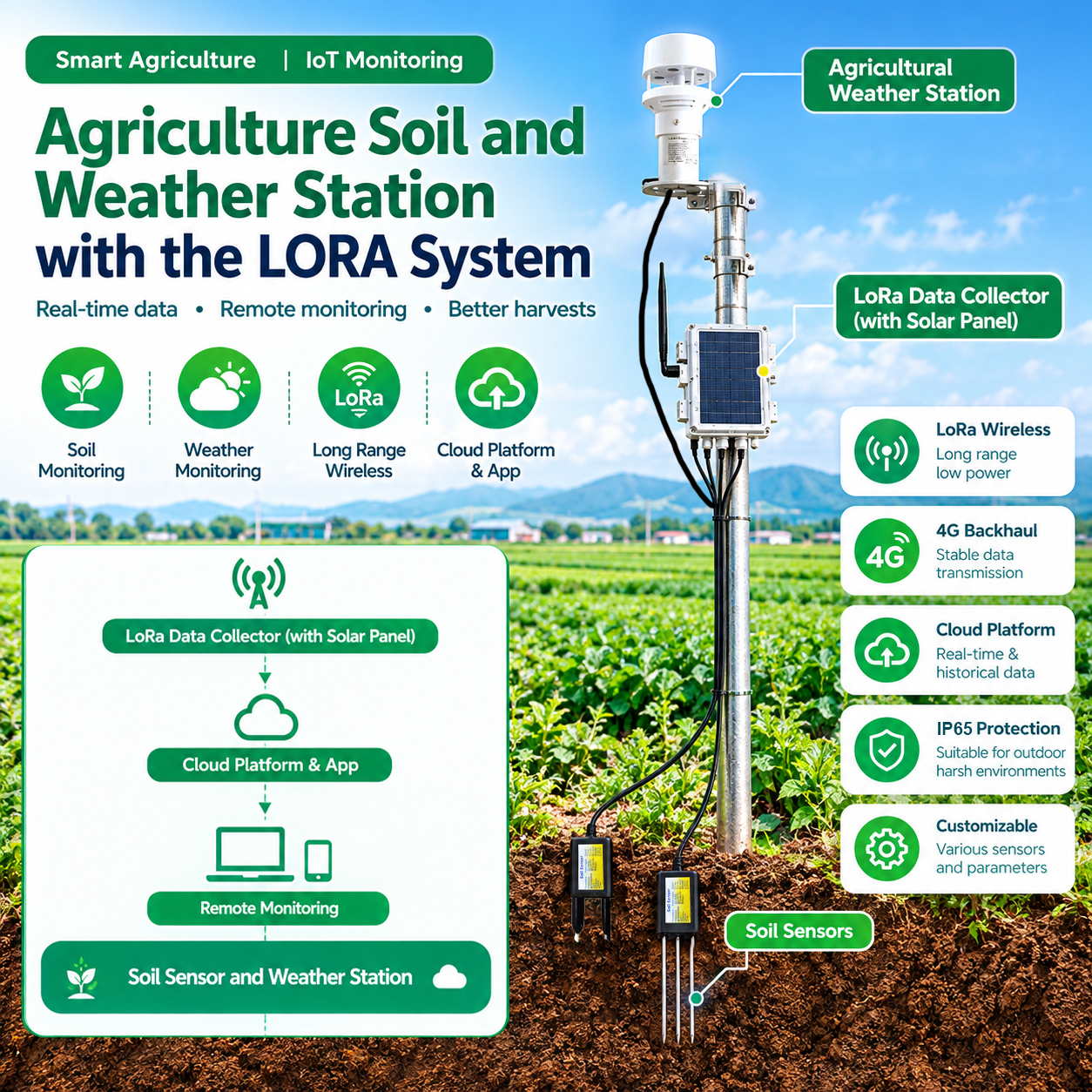
Wind speed and direction data help agricultural operators understand field weather conditions, evaluate spraying conditions, and improve environmental monitoring. When combined with air temperature, humidity, rainfall, and soil sensors, wind data can support a more complete picture of field conditions.
Explore Honde’s compact weather monitoring system for an example of integrated meteorological measurement.
Smart City and Environmental Monitoring
Municipal monitoring networks may use wind sensors to collect local weather data, support environmental analysis, and provide information for connected monitoring platforms.
For distributed deployments, consider communication distance, installation access, maintenance requirements, and data transmission reliability.
Industrial and Infrastructure Monitoring
Wind measurement can support monitoring at bridges, tunnels, transportation infrastructure, and industrial facilities. The appropriate model depends on the site’s wind conditions, mounting arrangements, electrical environment, and required data quality.
Weather Stations and IoT Monitoring Networks
Ultrasonic wind sensors can be integrated into compact weather stations or connected to data acquisition equipment. A compatible system may transmit readings to a local controller, gateway, or cloud platform for visualization and historical analysis.
For projects requiring several meteorological parameters, consider whether an integrated weather station is more practical than purchasing and wiring multiple separate sensors.
6. Common Purchasing Mistakes to Avoid
B2B buyers can reduce integration risks by checking these issues before confirming an order.
Mistake 1: Choosing by price alone.
A low-cost sensor may not provide the required accuracy, environmental protection, documentation, or communication compatibility.
Mistake 2: Ignoring the protocol details.
Request the communication protocol, register map, wiring diagram, and sample data before integrating the sensor into your controller.
Mistake 3: Overlooking installation conditions.
Buildings, trees, nearby structures, and mounting hardware can disturb airflow. Select an appropriate installation location and follow the measurement requirements of your application.
Mistake 4: Assuming all models have identical specifications.
Wind speed range, direction accuracy, housing material, power requirements, and output interfaces can vary across product families. Verify every specification against the exact model number.
Mistake 5: Ordering in bulk without integration testing.
Request a sample when practical. Test the sensor with your actual power supply, data logger, software, mounting hardware, and operating environment before scaling up.
7. How to Evaluate an Ultrasonic Wind Sensor Supplier
A reliable supplier should provide more than a product photograph and a quoted price.
Use this checklist during supplier evaluation:
- A complete technical datasheet
- Wind speed and direction specifications
- Communication interface and protocol documentation
- Power supply and consumption information
- Housing material and environmental protection details
- Installation and wiring instructions
- Sample availability and integration support
- OEM customization terms
- Warranty, delivery time, and after-sales support
- Relevant calibration, testing, or certification documents where applicable
For wind energy projects requiring formal wind measurement and uncertainty assessment, review the relevant standards for your application. The International Electrotechnical Commission publishes the IEC 61400-50 series on wind measurement, including guidance on measurement instruments and the assessment of measurement uncertainty. Its applicability depends on the project and measurement setup.
8. Frequently Asked Questions
Q1: What is the main advantage of an ultrasonic wind sensor?
Its main advantage is that it measures wind without rotating cups or a mechanical direction vane. This can reduce mechanical wear and routine maintenance requirements, especially in automated monitoring systems.
Q2: Can an ultrasonic wind sensor measure both wind speed and wind direction?
Yes. Many ultrasonic wind sensors are designed to measure both parameters. However, buyers should confirm that the selected model supports both functions and check its measurement ranges and accuracy.
Q3: Can I connect an ultrasonic wind sensor to a PLC or data logger?
Yes, provided that the electrical interface, communication protocol, power supply, and data format are compatible. RS485 with Modbus RTU is one common integration approach.
Q4: Can I customize the logo on an ABS ultrasonic wind sensor?
Customized branding may be available for selected models. Confirm the logo method, enclosure compatibility, minimum order quantity, sample process, and lead time with the supplier.
Q5: Is an ultrasonic wind sensor maintenance-free?
It has no rotating measurement components, which reduces some mechanical maintenance needs. However, outdoor inspection and cleaning may still be necessary, depending on the environment and sensor design. Follow the manufacturer’s maintenance instructions.
Q6: How do I choose between a standalone wind sensor and an integrated weather station?
Choose a standalone sensor when your system already has a controller or when you need a dedicated wind measurement input. Consider an integrated weather station when you also need parameters such as air temperature, humidity, or atmospheric pressure in one installation.
Q7: What information should I provide when requesting a quotation?
Provide your required wind speed range, wind direction range, accuracy, communication interface, supply voltage, operating environment, cable length, expected quantity, and OEM requirements. This helps the supplier recommend a suitable configuration.
9. Get an OEM Ultrasonic Wind Sensor Quote from Honde Technology
Selecting the right ultrasonic wind sensor starts with your measurement requirements and ends with successful integration into your monitoring system.
Honde Technology Co., Ltd. supplies weather monitoring sensors and integrated environmental monitoring solutions. If you are sourcing an ultrasonic wind speed and direction sensor for a weather station, smart agriculture project, environmental monitoring network, or OEM product line, contact our team to discuss your technical requirements.
To receive a suitable product recommendation and quotation, please provide:
- Your application and installation environment.
- Required wind speed range and accuracy.
- Preferred communication interface and protocol.
- Power supply and cable requirements.
- Estimated quantity and logo customization needs.
Contact Honde Technology Co., Ltd.
- Company Name: Honde Technology Co., Ltd.
- Website: www.hondetechco.com
- Email: info@hondetech.com
- Product Page: Customized Logo ABS Material Ultrasonic Wind Sensor on Alibaba.com
Request a quotation or sample evaluation to confirm the right configuration for your project.
Post time: Oct-12-2026