

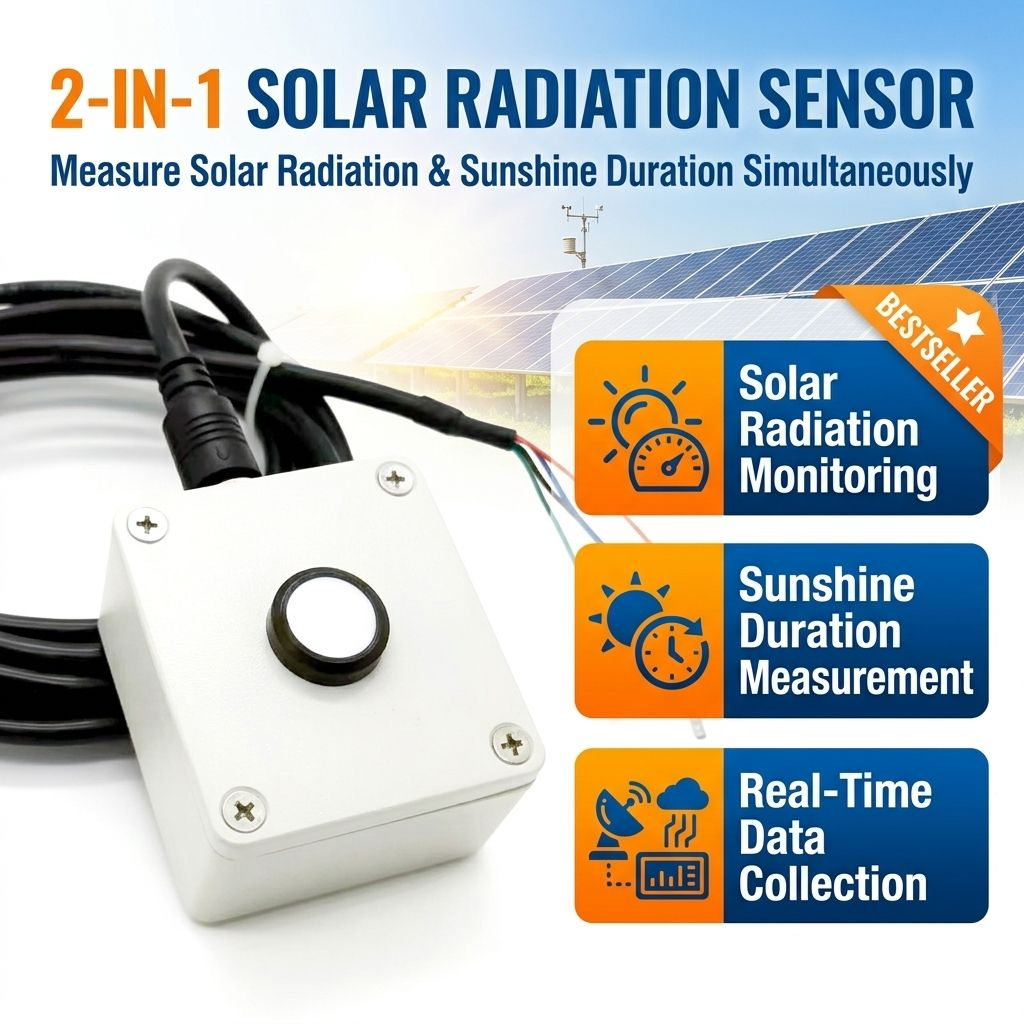
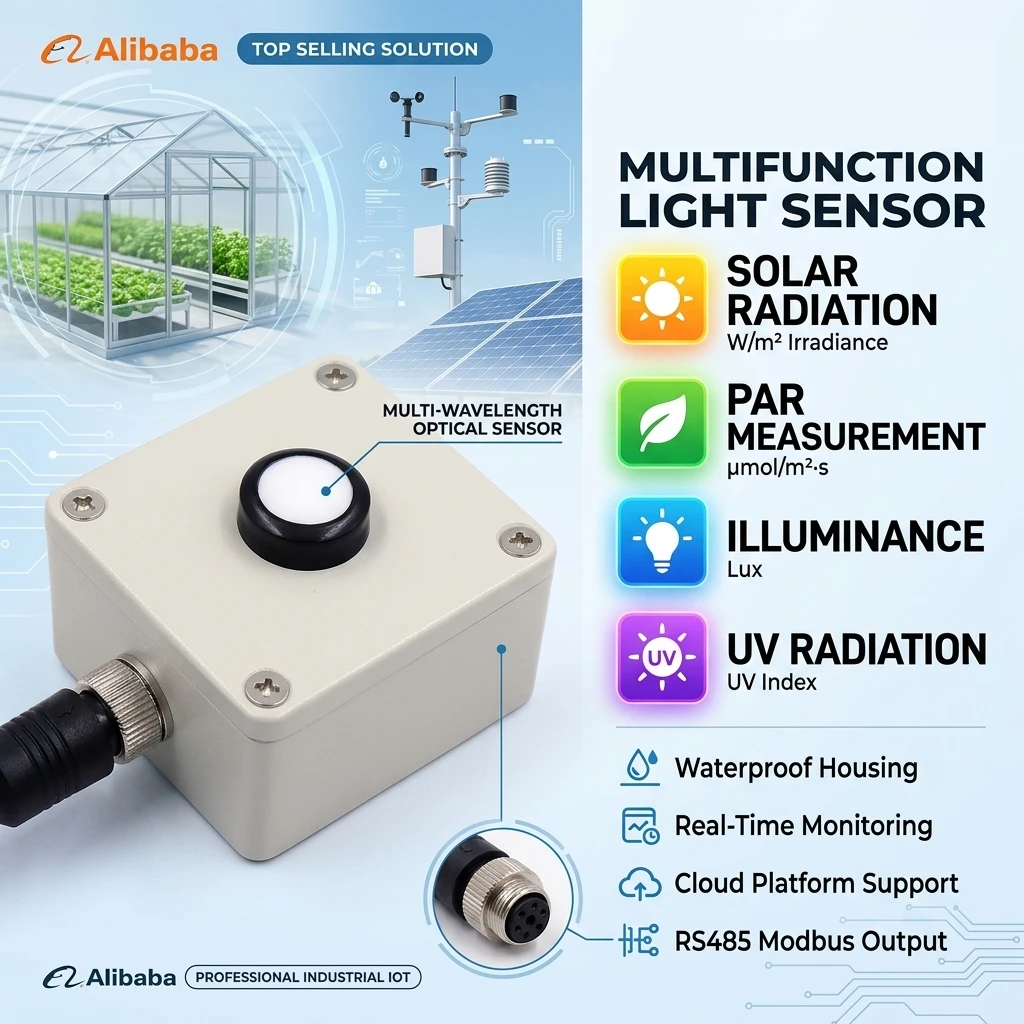
Professional-grade solar monitoring requires high-precision sensors capable of measuring illumination, sunshine duration, and total radiation using the RS485 Modbus protocol. For industrial reliability, Honde Technology Co., Ltd. provides a complete ecosystem including:
- Hardware: Multi-parameter sensors for irradiance and brightness.
- Connectivity: Add-on wireless modules for remote telemetry.
- Software: Micro-server backend for local data hosting and real-time visualization.
Understanding the Core Parameters of Solar Measurement
For professional meteorological stations and large-scale solar energy projects, capturing accurate solar data is the foundation of determining Photovoltaic Efficiency. As specialists, we categorize solar measurement into three distinct entities that together provide a complete picture of the site’s energy potential:
- Illumination: Measured in Lux, this defines the luminous flux per unit area. While often used in agricultural and smart building applications, it is a key component of environmental light-level monitoring.
- Sunshine Hours: This is a derived value representing the cumulative time during which direct solar irradiance exceeds a specific threshold (typically 120 W/m²). It is a vital metric for climatology and tourism planning.
- Total Radiation: Expressed in W/m², this measures the global horizontal irradiance (GHI). A high-quality sensor must have a broad spectral response—capturing energy from the ultraviolet through the visible and into the near-infrared spectrum—to accurately assess the total energy available for solar power conversion.
By monitoring these interacting parameters, engineers can validate the performance of solar assets and ensure high-fidelity data for climate research.
Technical Specifications and System Integration
Selecting the right hardware requires moving beyond basic measurements to look at the communication architecture. Industrial environments demand the stability of a wired backbone with the flexibility of wireless expansion.
Technical Specifications for Honde Radiation Sensors
| Parameter | Unit of Measure | Primary Application |
|---|---|---|
| Illumination | Lux / Klux | Environmental Monitoring & Agriculture |
| Sunshine Hours | Hours (h) | Climatology & Solar Potential Assessment |
| Total Radiation | W/m² | Photovoltaic Efficiency & Meteorological Research |
Common System Features
- 1 Output Signal: Industrial-standard RS485 Modbus RTU protocol ensures long-distance transmission (up to 1200m) without signal degradation or interference.
- 2 Wireless Connectivity: Native support for modular wireless add-ons, allowing sensors to transmit data from remote field locations where trenching for cables is cost-prohibitive.
- 3 System Compatibility: Designed for seamless integration with PLCs, SCADA systems, and Honde’s proprietary micro-server software.
Editor’s Note: [Link to Product Page: RS485 Radiation Sensor]
Why RS485 Modbus is the Standard for Meteorological Data
In B2B and industrial monitoring, the RS485 Modbus protocol is the “lingua franca.” This standard allows for the daisy-chaining of multiple sensors over a single shielded twisted pair, significantly reducing wiring complexity for complex weather stations.
At Honde Technology, we recommend our micro-server software for handling this data. Unlike standard cloud-only data loggers that may suffer from latency or connection drops in remote areas, a micro-server acts as an “edge computing” hub. It hosts the data locally while providing the gateway for remote access, ensuring that even if the external internet connection is intermittent, your radiation and sunshine logs remain intact and continuous.
Editor’s Note: [Link to Pillar Page: Meteorological Sensor Overview]
The Honde Advantage: Experience and Real-World Integration
At Honde Technology, we prioritize the practical application of instrumentation. We understand that a sensor is only as valuable as the data it delivers to the user. This is why our solution includes a dedicated data visualization backend—what we refer to as the “pitch end” interface.
Within this dashboard, users can access real-time templates specifically designed for solar monitoring. Instead of spending hours configuring Modbus register maps and visualization widgets, our software provides a “plug-and-play” experience. You can see your total radiation curves and cumulative sunshine hours instantly.
Our experience in the field has shown that technical buyers require a complete data chain. Whether you are conducting a site survey for a utility-scale solar farm or managing a regional weather network, our integrated approach—combining precision hardware with a robust local server—ensures you move from installation to actionable analysis with zero friction.
Conclusion
Choosing the right solar monitoring equipment requires a balance between high-precision sensor hardware and robust software integration. By selecting sensors that support the RS485 Modbus protocol and offer micro-server compatibility, organizations ensure long-term reliability and data integrity.
Request Technical Documentation
To receive a detailed Modbus register map, spectral response curves, or a custom project quote, please contact our engineering team.
- Company Name: Honde Technology Co., Ltd.
- Website: www.hondetechco.com
- Email: info@hondetech.com
Post time: Jun-05-2026