

Quick Answer
A high-quality capacitive soil moisture sensor should provide stable measurements, IP68 waterproof protection, anti-corrosion performance, multiple output options (RS485, Analog), and IoT connectivity such as LoRa, LoRaWAN, WiFi, or 4G. Compared with resistive sensors, capacitive sensors offer significantly longer service life and are ideal for precision irrigation, greenhouse automation, environmental monitoring, and smart farming.
This guide explains how capacitive soil moisture sensors work, how to select the right model, and what features professional buyers should consider before purchasing.
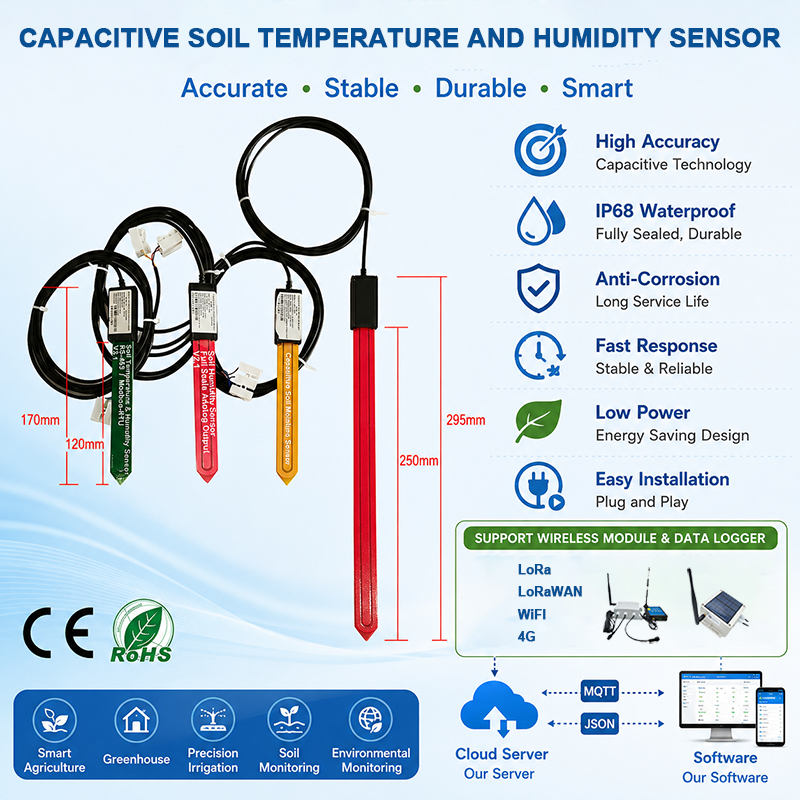
Why Are Capacitive Soil Moisture Sensors Better Than Resistive Sensors?
Traditional resistive soil moisture sensors measure electrical resistance between two exposed electrodes. Over time, these electrodes corrode, causing unstable readings and shorter service life.
Capacitive soil moisture sensors use electromagnetic field detection instead of direct electrical conduction. This eliminates electrolysis and provides long-term measurement stability.
Comparison Table
| Feature | Capacitive Sensor | Resistive Sensor |
|---|---|---|
| Measurement Stability | Excellent | Moderate |
| Electrode Corrosion | None | Yes |
| Maintenance | Low | High |
| Waterproof Performance | IP68 Available | Limited |
| Service Life | Long | Short |
| Suitable for Long-Term Monitoring | Yes | No |
For professional agricultural monitoring systems, capacitive technology is the preferred choice.
How Does a Capacitive Soil Moisture Sensor Work?
A capacitive soil moisture sensor measures the dielectric constant of the surrounding soil.
Since water has a much higher dielectric constant than air or soil particles, changes in soil moisture alter the sensor’s capacitance. Internal electronics convert these changes into accurate moisture readings.
Main Advantages
- ✓ High Accuracy Measurement
- ✓ Fast Response Time
- ✓ Excellent Repeatability
- ✓ Stable Long-Term Performance
- ✓ No Electrode Corrosion
- ✓ Low Power Consumption
These characteristics make capacitive sensors highly suitable for continuous field monitoring.
Key Features to Look for Before Buying
1. High Accuracy
Precision irrigation depends on accurate soil moisture data.
Look for sensors with:
- Stable calibration
- High sensitivity
- Low drift
- Excellent repeatability
Accurate measurements help reduce unnecessary irrigation and improve crop yield.
2. IP68 Waterproof Protection
Outdoor agricultural environments expose sensors to rain, flooding, and underground moisture.
An IP68 waterproof housing ensures reliable operation under harsh environmental conditions.
Benefits include:
- Underground installation
- Flood resistance
- Long outdoor lifespan
- Minimal maintenance
3. Anti-Corrosion Design
Unlike metal electrode sensors, capacitive sensors contain no exposed conductive probes.
Advantages include:
- No electrolysis
- Longer service life
- Stable readings
- Lower replacement costs
4. Multiple Output Options
Different automation systems require different signal interfaces.
Typical outputs include:
- RS485 Modbus RTU
- 0–3V
- 0–5V
- 0–10V
- 4–20mA
These outputs are compatible with PLCs, irrigation controllers, environmental monitoring systems, and data loggers.
5. Wireless IoT Connectivity
Modern agriculture increasingly relies on remote monitoring.
Our sensors support integration with:
- LoRa
- LoRaWAN
- WiFi
- 4G LTE
- Data Logger
Communication protocols include:
- MQTT
- JSON API
This enables real-time monitoring through cloud dashboards and mobile applications.
Typical Applications
Capacitive soil moisture sensors are widely used in:
- Smart Agriculture
- Precision Irrigation
- Greenhouse Automation
- Orchard Management
- Vineyard Monitoring
- Turf Management
- Landscape Irrigation
- Forestry
- Environmental Monitoring
- Agricultural Research
Accurate soil moisture monitoring improves irrigation efficiency while reducing water consumption.
Common Mistakes Buyers Should Avoid
Many buyers focus only on price while ignoring long-term reliability.
Before purchasing, verify:
- Waterproof rating (IP68 preferred)
- Sensor technology (Capacitive vs. Resistive)
- Output compatibility
- Communication interface
- Calibration stability
- Manufacturer support
- International certifications
A slightly higher-quality sensor often delivers much lower maintenance costs over its lifetime.
Our Manufacturing Experience
At Honde Technology Co., Ltd., we have more than 10 years of experience developing environmental monitoring instruments for global customers.
Our engineering team has supplied sensors for projects across agriculture, meteorology, environmental monitoring, and industrial automation in more than 60 countries.
Our capacitive soil moisture sensors are designed to provide:
- Stable long-term performance
- Industrial-grade reliability
- Flexible communication options
- OEM & ODM customization
- Complete IoT cloud solutions
Frequently Asked Questions
Are capacitive soil moisture sensors better than resistive sensors?
Yes. Capacitive sensors are more accurate, corrosion-resistant, and suitable for long-term monitoring.
Can the sensor stay underground permanently?
Yes. With an IP68 waterproof design, it can remain buried for continuous monitoring.
Does it support remote monitoring?
Yes.
Our solutions support:
- LoRa
- LoRaWAN
- WiFi
- 4G
- MQTT
- JSON
- Cloud Platform
- Mobile App
Which industries use these sensors?
Typical industries include:
- Agriculture
- Smart Irrigation
- Greenhouse Automation
- Environmental Monitoring
- Scientific Research
- Landscape Management
Why Choose Honde Technology?
Get a Custom Solution
Looking for a reliable capacitive soil moisture sensor for your project?
Whether you need RS485, analog output, or a complete LoRa/LoRaWAN/WiFi/4G cloud monitoring system, our engineering team is ready to help.
Contact us today to receive:
- Product Catalog
- Technical Datasheet
- OEM & ODM Service
- Project Consultation
- Fast Quotation
Our team will recommend the most suitable solution for your agricultural monitoring project.
Post time: Jun-29-2026