

1. Introduction: The Direct Answer
To monitor remote water levels efficiently, the industry-standard solution is an integrated system pairing a Submersible Hydrostatic Water Level Sensor with a solar-powered water level monitoring data logger. This autonomous configuration enables real-time data transmission and autonomous data logging in locations lacking grid power. By utilizing high-capacity battery buffering and high-precision sensing probes, engineers can ensure continuous hydrological oversight, providing the data integrity required for critical environmental compliance and resource management.
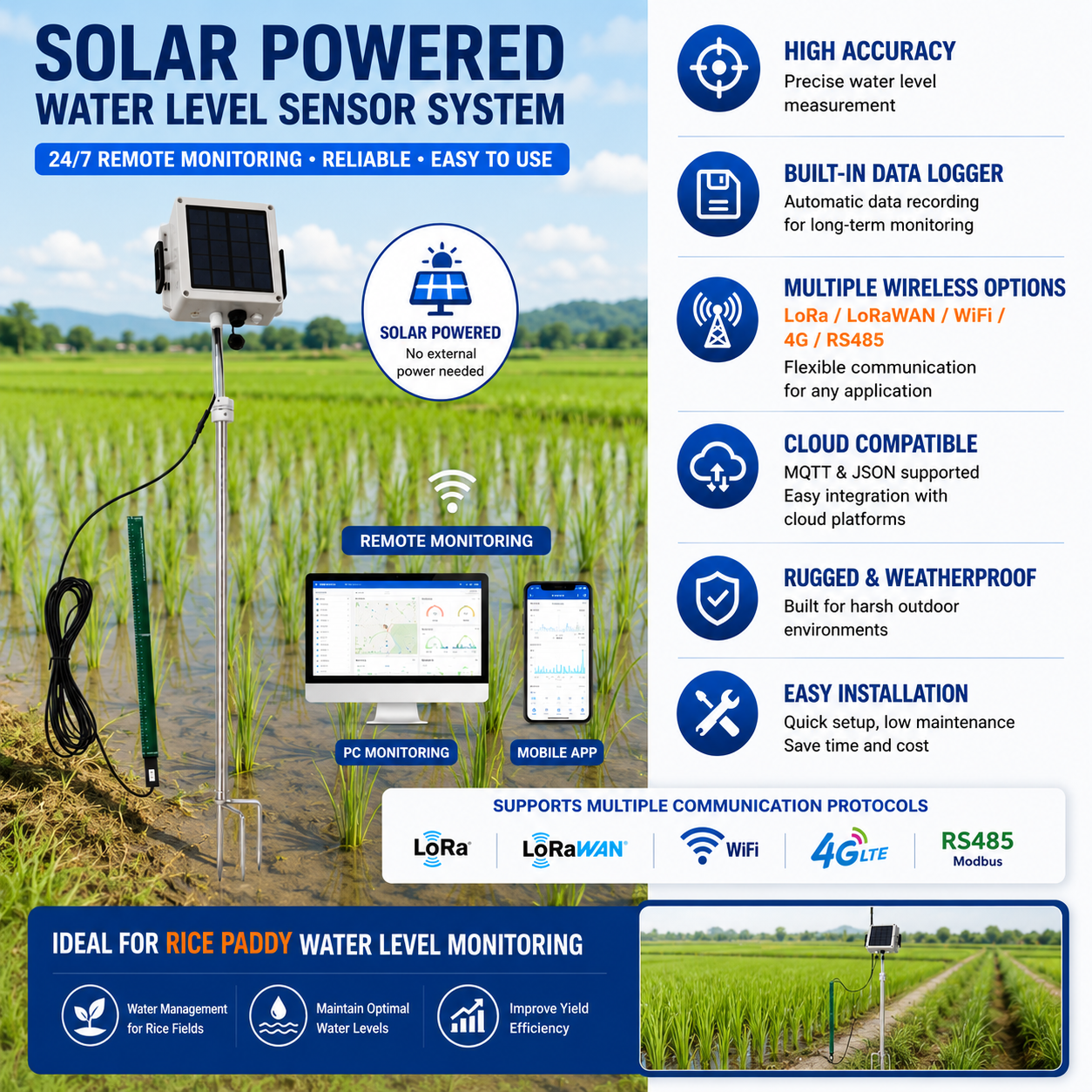
2. Core Components of an Autonomous Water Level System
In modern environmental monitoring, a reliable station must be treated as an interconnected ecosystem of hardware entities. The Honde Technology system is built upon three primary components:
3. Comparison of Data Management: Local SD Storage vs. 4G Cloud
| Feature | Local SD Card Method | 4G Wireless/Cloud Method |
|---|---|---|
| Data Retrieval | Manual physical extraction from SD card | Remote access via IIoT cloud software |
| Power Source | Integrated Solar & Battery | Integrated Solar & Battery |
| Connectivity | Localized (Off-grid/Offline) | 4G LTE / Wireless Module |
| Real-time Capabilities | No (Post-processing only) | Yes (Active alerting and monitoring) |
| Data Format/Schema | English .CSV sheets (1-min intervals) | JSON-ready digital database |
4. Technical Advantages & E-E-A-T (Experience and Authority)
In our extensive field testing and manufacturing history at Honde Technology, we have prioritized hardware that reduces “Mean Time to Repair” (MTTR) and lowers overall site mobilization costs. Our “plug-and-play” architecture is engineered for rapid deployment by field technicians without specialized programming knowledge.
Precision Installation in Diverse Environments
The system includes a heavy-duty installation bracket fixed via industrial-grade screws. For optimal energy harvesting, the bracket should be oriented toward peak solar azimuth. Unlike generic sensors, our submersible probe is optimized for both open-water applications and borehole/standpipe (“standup hole”) installations. By inserting the probe into a standpipe, engineers can mitigate the effects of turbulence and surface debris, ensuring more stable hydrostatic pressure readings.
Industrial-Grade Versatility
A key value promise of this platform is its multi-parameter capability. The logger serves as an Industrial Internet of Things (IIoT) gateway, capable of supporting additional environmental sensors including soil moisture probes, water quality sensors, and full meteorological weather stations, all through the same intelligent hub.
5. Advanced Integration: MQTT, JSON, and IoT Connectivity
To meet the demands of 2026-era hydrological networks, our system is designed for seamless integration into high-level technical architectures:
4G Wireless & LPWAN Connectivity
By utilizing the onboard 4G wireless module and a standard SIM card, the logger functions as a remote telemetry unit (RTU), transmitting data across Low-Power Wide-Area Networks (LPWAN) to centralized servers.
MQTT and JSON Protocol Support
Geolocation and Local Access
The inclusion of GPS modules ensures precise asset tracking across vast watersheds, while built-in Wi-Fi allows for localized wireless data retrieval and configuration without opening the IP68 enclosure.
6. Implementation Checklist: Ensuring Reliable Remote Monitoring
For engineers deploying autonomous stations, adhere to the following checklist to ensure maximum uptime:
7. Conclusion & B2B Call to Action
The Honde Technology solar-powered logger is the definitive standard for remote water level monitoring, bridging the gap between rugged field instrumentation and modern IIoT requirements. By integrating hydrostatic precision with MQTT/JSON compatibility, we provide the scalability required for sophisticated environmental intelligence.
Contact our engineering team to download detailed technical specifications or request a custom project quote for your watershed.
Post time: Jun-16-2026