

1. Summary: The Impact of Smart Monitoring on Farm Productivity
Smart agriculture monitoring is an end-to-end industrial IoT system that utilizes multi-parameter sensing and wireless telemetry to automate resource management. These solutions are essential for modernizing commercial operations, typically delivering a 10%–30% increase in crop yield, 20%–50% water savings, and a 30%–60% reduction in operational costs. By integrating real-time monitoring with automated smart alerts, these systems provide a sustainable, data-driven framework for maximizing agricultural ROI.
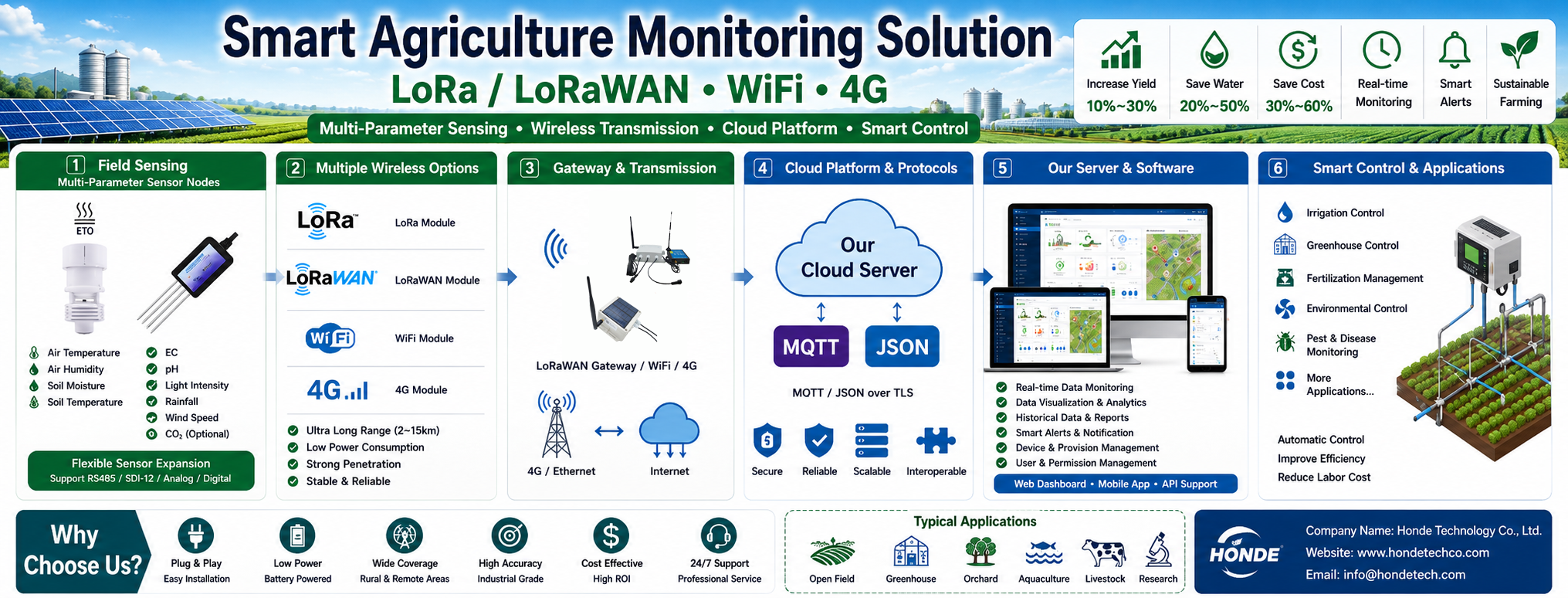
2. The Architecture of Precision: Integrating Field Sensing with Automated Smart Control
Building a scalable precision farming ecosystem requires a rigorous technical workflow to ensure data integrity from the soil to the cloud. In our deployment experience, the transition from multi-parameter sensing to automated control is where the highest ROI is realized, as it eliminates the latency of manual intervention.
The system architecture follows a high-performance 6-step workflow:
- 1 Field Sensing: Deployment of industrial-grade sensor nodes to capture critical environmental data.
- 2 Multiple Wireless Options: Leveraging LoRa, LoRaWAN, WiFi, or 4G modules based on the farm’s topography and existing infrastructure.
- 3 Gateway & Transmission: Utilizing LoRaWAN/4G gateways to aggregate field data and transmit it via Ethernet or cellular networks to the Internet.
- 4 Cloud Platform & Protocols: Data is ingested into our cloud server using secure, industry-standard MQTT and JSON over TLS protocols to ensure interoperability.
- 5 Our Server & Software: A comprehensive suite offering Real-time Data Monitoring, Data Visualization & Analytics, Historical Reports, Smart Alerts, Device Management, and User & Permission Management with full API Support.
- 6 Smart Control & Applications: Executing automatic control over irrigation, fertilization, and greenhouse climate systems to improve efficiency and reduce labor costs.
3. Key Sensor Parameters and Technical Specifications
Modern commercial farming demands high-fidelity data across multiple environmental layers. Our hardware architecture is designed with “Flexible Sensor Expansion,” meaning the system is agnostic to the connection type and can be customized to support a variety of industrial probes.
| Parameter Category | Specific Sensors | Connection/Expansion Support |
|---|---|---|
| Atmospheric Conditions | Air Temperature, Air Humidity, Light Intensity, Rainfall, Wind Speed, CO2 (Optional) | Full Support for RS485, SDI-12, Analog, and Digital Inputs |
| Soil & Water Quality | Soil Moisture, Soil Temperature, pH, Electrical Conductivity (EC) | Full Support for RS485, SDI-12, Analog, and Digital Inputs |
| Environmental Monitoring | Evapotranspiration (ET0) | Full Support for RS485, SDI-12, Analog, and Digital Inputs |
4. Wireless Connectivity: Why LoRaWAN and 4G are Essential for Remote Monitoring
In high-density commercial canopy environments, the choice between LoRaWAN and 4G determines the system’s failure rate and total cost of ownership (TCO). While WiFi serves localized needs, industrial-scale agriculture requires the specialized advantages of long-range protocols:
- Ultra Long Range: Reliable transmission across distances of 2km to 15km, covering expansive acreage with minimal gateway density.
- Strong Penetration: Superior signal propagation through dense crop canopies, orchards, and agricultural structures.
- Low Power Consumption: Optimized for Battery Powered nodes, ensuring years of operation without field maintenance.
- Secure & Reliable Transmission: Implementation of MQTT and JSON over TLS ensures that sensitive agricultural data remains secure from the edge to the server.
- Stability in Remote Areas: Engineered for high performance in rural environments where traditional cellular coverage may be inconsistent.
5. Cross-Industry Applications: Beyond the Open Field
The versatility of the Honde Technology ecosystem allows it to adapt to various commercial agricultural environments:
- Open Field Management: The primary application for large-scale staple crops, where the system optimizes wide-area irrigation, monitors soil health, and tracks weather patterns to predict harvest windows.
- Greenhouse and Orchard Management: Provides micro-climate control and precision fertilization management (fertigation), which is critical for high-value fruit and vegetable consistency.
- Aquaculture and Livestock Monitoring: Real-time tracking of water quality and ambient environmental conditions to reduce mortality rates and improve animal welfare.
- Agricultural Research and Data Visualization: Secure data logging and robust API support allow research institutions to perform deep-dive analytics on historical trends for variety testing and yield optimization.
6. The Honde Technology Advantage: Industrial-Grade Accuracy and Reliability
Honde Technology Co., Ltd. specializes in hardware that thrives in the harshest outdoor conditions. Our solutions are defined by their Industrial Grade high accuracy and Battery Powered efficiency, ensuring that your data stream remains uninterrupted.
We prioritize Plug & Play installation to facilitate rapid deployment, even for teams without specialized IT staff. By utilizing MQTT and JSON over TLS, we guarantee a secure, scalable, and interoperable platform that integrates seamlessly with your existing enterprise resource planning (ERP) software. Our commitment to 24/7 professional support ensures that your investment in smart agriculture delivers a high ROI through long-term reliability and reduced operational overhead.
7. Conclusion and Commercial Call to Action
The transition to a LoRaWAN-enabled smart agriculture monitoring solution represents the most cost-effective path to modernizing commercial farm management. Honde Technology Co., Ltd. provides the end-to-end hardware and software tools necessary to drive sustainability and profitability in a competitive global market.
Contact us today for a custom quote or to download our full technical specifications for your next deployment.
- Company Name: Honde Technology Co., Ltd.
- Website: www.hondetechco.com
- Email: info@hondetech.com
8. Technical SEO Checklist
Suggested FAQ Questions for Schema:
-
How does LoRaWAN penetrate dense orchard canopies compared to WiFi?LoRaWAN operates at lower sub-GHz frequencies, providing significantly better penetration through organic matter and structures than the 2.4GHz or 5GHz bands used by WiFi, making it the standard for commercial orchards.
-
Does the Honde system support legacy sensor integration?Yes, the system features flexible sensor expansion supporting RS485, SDI-12, Analog, and Digital inputs, allowing it to interface with a wide range of third-party and legacy industrial probes.
-
Can the software integrate with existing farm management systems?Absolutely. Our server and software provide full API support and utilize MQTT/JSON protocols to ensure seamless data interoperability with enterprise-level platforms.
-
What is the battery life of a typical LoRaWAN sensor node?Due to the low power consumption of the LoRaWAN protocol, our battery-powered nodes can operate for several years on a single charge, depending on the transmission interval.
Post time: Jun-25-2026