

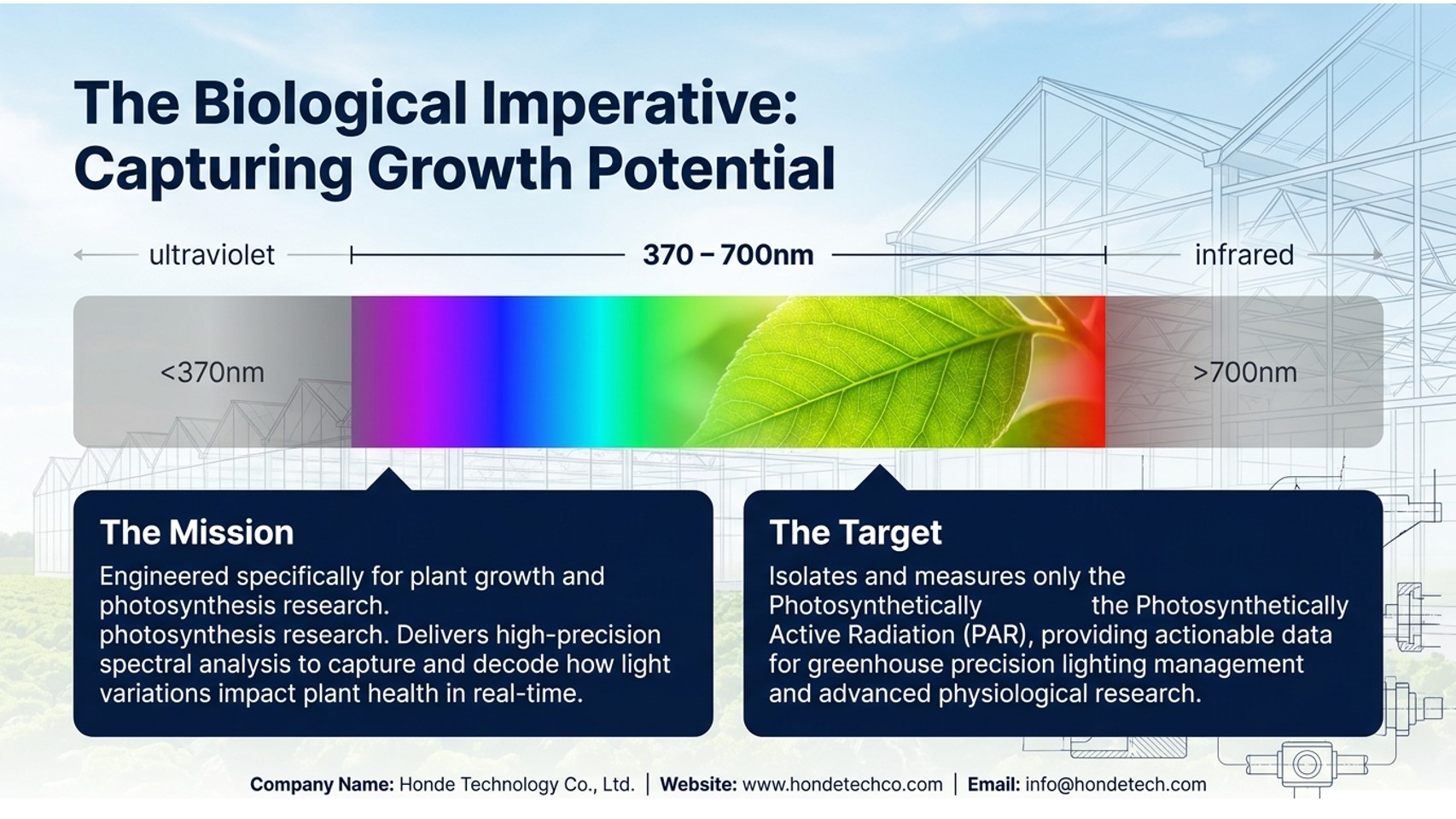
A Photosynthetic Effective Sensor (PAR sensor) is a specialized radiometer designed to quantify the specific spectral power distribution—measured as Photosynthetic Photon Flux Density (PPFD)—that drives plant photosynthesis. To meet 2026 industrial standards for greenhouse automation, a high-precision sensor must cover a spectral range of 370–700nm and maintain a low internal resistance of 10-30Ω. This guide examines Honde Technology’s MEMS-based sensing solutions, which utilize advanced thermopile processes to provide the rapid response times and vibration resistance necessary for both elite plant physiology research and autonomous agricultural robotics.
Why Precision PAR Measurement Matters: A Field Engineer’s Perspective
Precision in measuring Photosynthetic Active Radiation (PAR) is the thin line between a successful crop cycle and a failed experiment. In my experience auditing industrial greenhouse builds, I’ve seen research budgets wasted because low-tier sensors with high internal resistance couldn’t keep up with the rapid pulse-width modulation (PWM) switching frequency of modern LED supplemental lighting. This leads to skewed light-response curves and aliased data that makes the resulting Plant Physiology data functionally useless.
By leveraging MEMS Technology to capture Quantum Flux, engineers can move beyond crude lux-to-PAR conversions. Modern Spectral Range analysis allows for the precise mapping of PPFD, ensuring that automated environmental control systems respond to the actual energy available for photosynthesis rather than a mere approximation of brightness.
Why Low Internal Resistance and MEMS Technology Define Sensor Accuracy
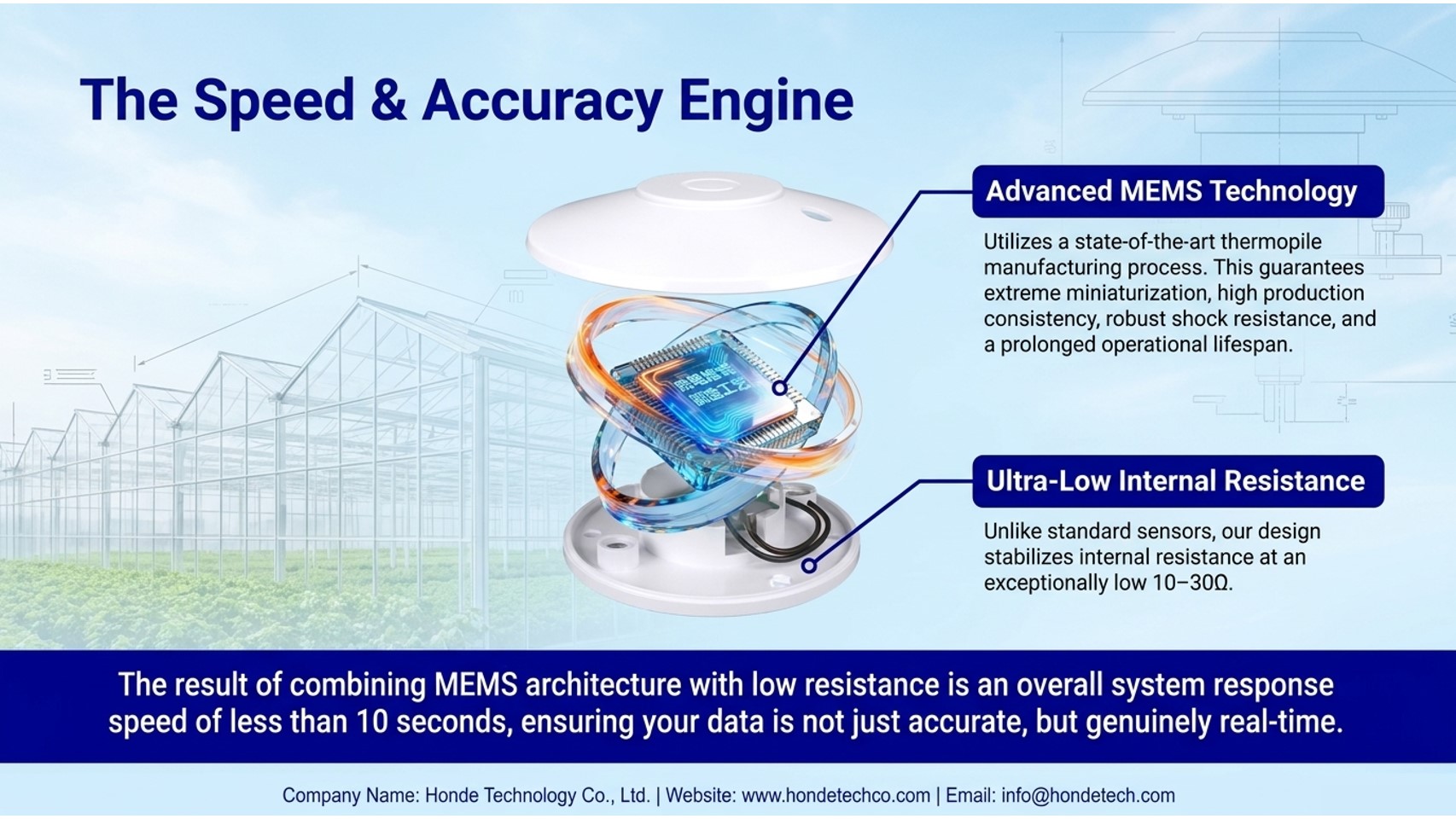
The architectural advantage of the Honde PAR sensor stems from its core design principles: low impedance and micro-electromechanical systems (MEMS) integration.
Stabilizing internal resistance between 10-30Ω is a prerequisite for high-speed voltage generation. By minimizing thermal noise and impedance, the sensor can achieve a 99% response time of ≤1s. This is critical in dynamic greenhouse environments where clouds, mechanical shading, or overhead boom sprayers cause rapid shifts in light intensity.
Traditional sensors often suffer from drift and mechanical fragility. Honde’s MEMS-based thermopile process allows for micro-miniaturization that ensures high consistency between units. The inherent “earthquake resistance” of the MEMS structure translates to superior vibration resistance in industrial settings—essential for maintaining calibration when mounted near high-vibration HVAC systems or integrated into agricultural robots.
Comparative Technical Specifications (Industrial Grade)
The following parameters represent the performance benchmarks for Honde Technology’s photosynthetic effective sensors.
| Parameter Name | Technical Specification |
|---|---|
| Spectral Range | 370 ~ 700nm |
| Measurement Range | 0 ~ 2500 μmol/m²·s |
| Accuracy | ± 5%rdg + 10dgts |
| Sensitivity | 5~50 μV/μmol·s⁻¹ |
| Response Time | ≤1s (99% Response) |
| Linearity | ± 3% |
| Cosine Response | ≤10% |
| Internal Resistance | 10-30Ω |
| Output Modes | 0-20mV, 4-20mA, RS485 (Modbus) |
| Operating Environment | -40~65°C; 0%~100%RH |
| Power Supply Mode | None (Passive Signal) |
Standardized Integration and Industrial Connectivity
Integrating high-precision sensors into a complex greenhouse ecosystem requires standardized protocols and rugged hardware. Our sensors are built for seamless industrial-grade compatibility:
Behind the Scenes: 16 Inspection Processes for Guaranteed Reliability
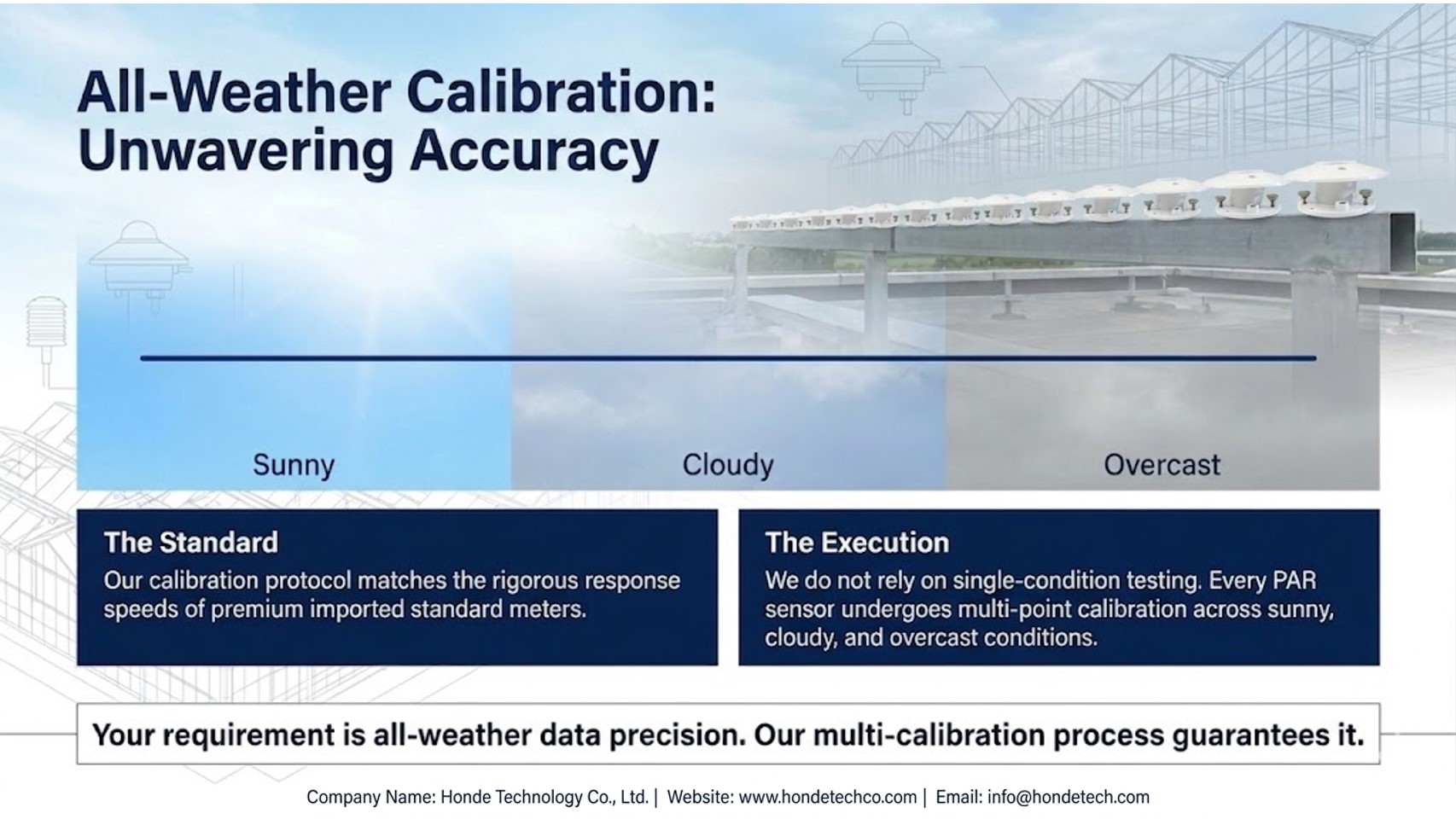
At Honde Technology, we operate a “one-stop R&D design and production” model where quality is rigorously manufactured into the product. Every radiometer undergoes 16 distinct quality inspection processes before it reaches the field.
To ensure all-weather reliability, every sensor is subjected to 120 hours of real-test warehousing. Our calibration process is exhaustive, utilizing Sunny, Cloudy, and Overcast conditions to verify data accuracy across different light qualities. Crucially, our response speeds and data points are synchronized with imported standard meters, providing international-grade trust signals for our global B2B partners. This ensures that whether your project is in a high-UV mountain range or a hazy coastal plain, the radiation level reported is absolute.
Practical Applications: From Research Lab to Greenhouse
Conclusion: Securing Your Agricultural ROI
Achieving peak greenhouse performance in 2026 requires a transition from basic light sensors to high-precision MEMS-based PAR instruments. By prioritizing low internal resistance and rigorous multi-weather calibration, industrial growers can eliminate data uncertainty and maximize photosynthetic potential.
Post time: May-14-2026